
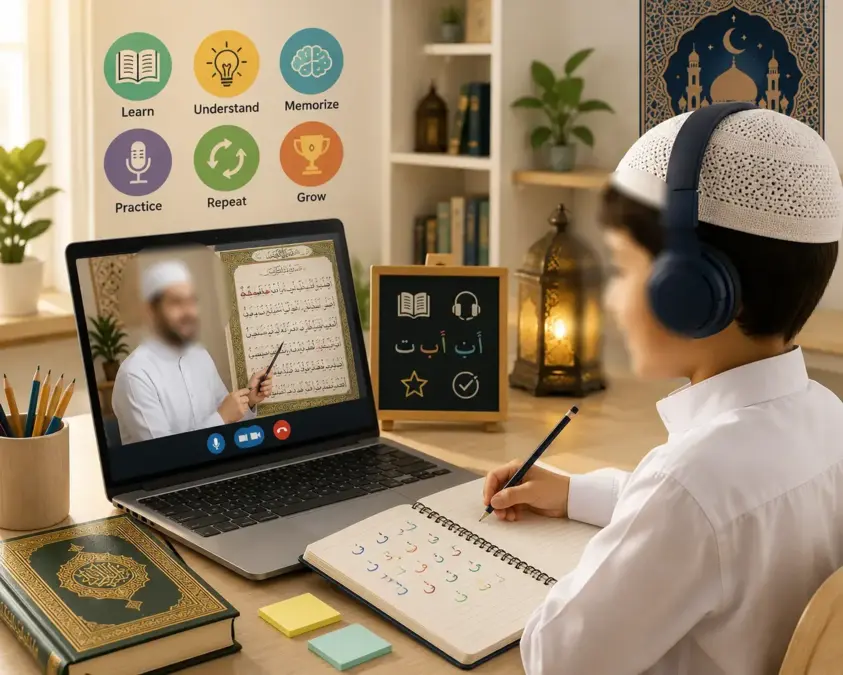
Choosing online Quran courses for kids is an important decision for many parents. A child needs more than a simple video lesson or a list of verses to memorize. They need a clear method, a patient teacher, regular practice and lessons adapted to their age and level.
Every child learns differently. Some children recognize Arabic letters quickly, while others need more repetition. Some enjoy memorization, while others first need confidence in reading and pronunciation. A good Quran course for children should respect this pace while keeping a structured learning path.
Online Quran learning can be very effective when it combines Quran reading, Tajweed, memorization and encouragement. The goal is not only to help the child recite, but also to build a positive and respectful relationship with the Book of Allah.
Why Choose Online Quran Courses for Kids?
Online Quran courses give children the opportunity to learn from home with a teacher, without travelling and without depending only on local availability. This can be especially useful for families who have busy schedules or limited access to qualified Quran teachers nearby.
For children, regularity is essential. A short lesson several times a week, or a weekly class with consistent revision, can help the child progress without feeling overwhelmed.
Online learning also allows the teacher to adapt the lesson to the child’s level. A beginner may start with Arabic letters and pronunciation, while another child may work on Tajweed, Quran recitation or memorization.
Where Should a Child Start?
A child’s starting point depends on their current level. Before memorizing long passages, it is usually important to check whether the child can recognize Arabic letters, pronounce them correctly and read simple words.
A progressive Quran program for kids should move step by step. It should not rush the child into advanced recitation before the foundations are ready.
The Arabic Alphabet and Quran Reading
For many children, the first step is learning the Arabic alphabet. This includes recognizing the letters, understanding their different forms and pronouncing them correctly.
Good pronunciation matters because Quran recitation depends on the correct articulation of letters. The child should learn slowly, with repetition, examples and correction from the teacher.
Once the letters are familiar, the child can begin reading short words, then short verses, while gradually improving fluency.
Child-Friendly Tajweed
Tajweed means reciting the Quran with correct pronunciation and rules. For children, Tajweed should be introduced gradually and simply. The teacher should not overload the child with too many technical terms at the beginning.
Simple rules such as elongation, clear pronunciation and basic articulation points can be taught through examples, repetition and listening. As the child progresses, more rules can be added step by step.
The purpose of Tajweed for kids is to help them recite correctly while keeping the learning experience positive and accessible.
Progressive Quran Memorization
Quran memorization should begin with short surahs or short passages that are suitable for the child’s level. Repetition, listening and regular revision are key elements of successful memorization.
It is better for a child to memorize a small amount well than to move too quickly and forget what was learned. A good teacher will balance new memorization with revision of previous lessons.
Parents also play an important role. A few minutes of daily revision at home can make a big difference in the child’s progress.
How to Recognize a Good Quran Course for Children
A good online Quran course for kids should be clear, structured and adapted to children. It should not treat children like adults. The pace, examples, correction and lesson duration should match the child’s age and attention span.
Before choosing a course, parents can look for several important signs:
- a qualified and patient Quran teacher;
- a clear program based on the child’s level;
- attention to pronunciation and Tajweed;
- regular revision of previous lessons;
- short and realistic learning goals;
- a positive teaching style;
- communication with parents about progress;
- flexibility in scheduling when possible.
The best course is not always the fastest one. For children, progress should be steady, encouraging and built on strong foundations.
The Role of the Teacher in Quran Learning
The teacher has a central role in a child’s Quran learning. A child may listen to recordings or use apps, but a teacher can correct mistakes, encourage effort and adapt the lesson when the child struggles.
A good Quran teacher for kids combines knowledge with patience. They know when to repeat, when to correct, when to encourage and when to slow down.
The teacher also helps the child develop good habits: sitting properly, listening carefully, respecting the Quran, revising regularly and reciting with attention.
How to Keep a Child Motivated
Motivation is very important in Quran learning. Children may lose interest if lessons are too long, too difficult or too repetitive without encouragement.
Parents can help by creating a positive environment around Quran learning. This may include choosing a regular time, praising effort, listening to the child recite and avoiding excessive pressure.
Useful ways to support motivation include:
- setting small goals;
- celebrating progress;
- reviewing for a few minutes daily;
- using age-appropriate explanations;
- connecting memorized surahs to their meaning;
- keeping lessons consistent but not too heavy;
- working with a teacher who understands children.
The aim is to help the child love learning the Quran, not to make the process feel like a punishment or a competition.
Learning Quran, Tajweed and Islam Step by Step
Learning the Quran is connected to other areas of Islamic education. A child who learns Quran recitation can also benefit from simple Islamic manners, basic supplications, prayer and age-appropriate Islamic knowledge.
To explore more educational resources, you can read our Islamic articles, which cover different topics related to worship, Islamic practice and children’s education.
For a structured child-friendly program, discover our Quran for children courses, designed to help young learners progress in Quran reading, Tajweed and memorization.
You can also visit our broader page for online courses for children, including Arabic, Quran and Islamic studies.
If your child needs to improve recitation, our online Quran and Tajweed classes can support step-by-step progress. For memorization goals, our Quran memorization course may also be useful.
Book your free trial of 30 minutes
Registration form
FAQ About Online Quran Courses for Kids
At what age can a child start learning the Quran online?
Many children can begin with Arabic letters and short Quran lessons from around the age of five or six, depending on attention span and maturity. Some children may start earlier with very short and gentle sessions.
Should my child learn Arabic before Quran recitation?
A child does not need to master Arabic before starting, but learning the Arabic alphabet and correct pronunciation is usually the first foundation for Quran reading.
How often should a child take Quran lessons?
This depends on the child’s age and goals. One to three lessons per week, combined with short daily revision, is often more effective than irregular long sessions.
Can children learn Tajweed online?
Yes. Children can learn Tajweed online when the teacher explains the rules simply, gives clear examples and corrects pronunciation during recitation.
How can parents support Quran memorization at home?
Parents can help by setting a regular revision time, listening to the child recite, encouraging effort and avoiding pressure that makes learning stressful.
Conclusion: Gentle and Progressive Quran Learning
Online Quran courses for kids can be a strong support when they are structured, regular and adapted to the child’s level. Children need patient teaching, repetition, encouragement and realistic goals.
The best Quran learning path usually begins with the Arabic alphabet and correct pronunciation, then moves toward Quran reading, Tajweed and memorization step by step.
With a qualified teacher, parental support and regular practice, a child can build a positive relationship with the Quran and progress with confidence.




No Comments
No comments yet.