
To learn Arabic correctly, it is essential to understand the types of words in Arabic. This topic is one of the foundations of Arabic grammar, because it helps students recognize the function of a word in a sentence and understand how the language is structured.
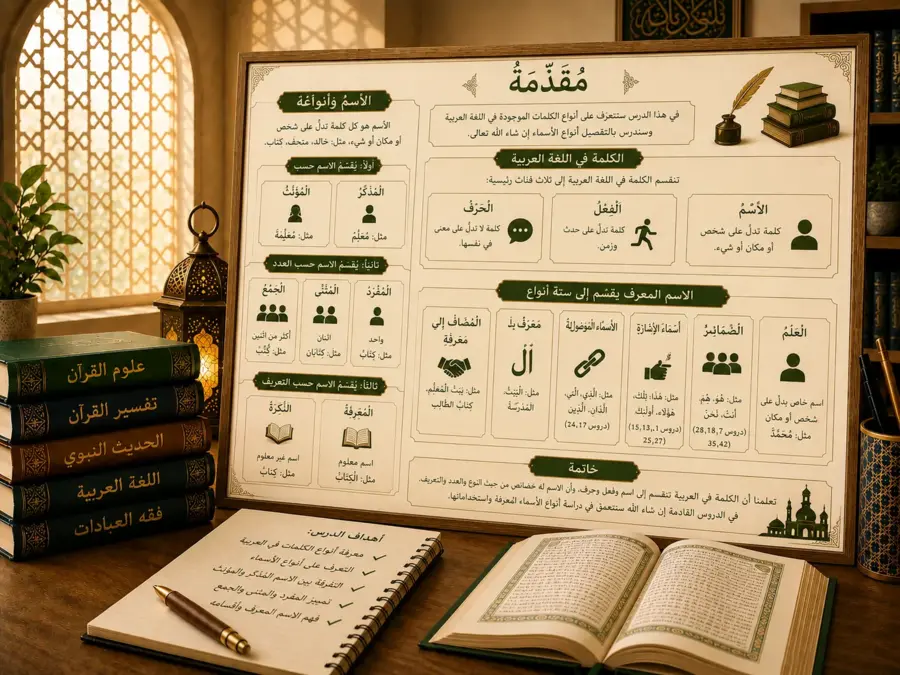
In Arabic, words are divided into three main categories: the noun, the verb and the particle. In Arabic, these are called الاسْمُ, الفِعْلُ and الحَرْفُ. These categories are essential for Arabic reading, Arabic vocabulary, Modern Standard Arabic and Quranic Arabic.
This lesson is suitable for Arabic for beginners, adults, children and anyone who wants to learn Arabic online with a clear and progressive method.
What Are the Types of Words in Arabic?
In Arabic grammar, a word is usually classified into one of three main categories:
- the noun: الاسْمُ;
- the verb: الفِعْلُ;
- the particle: الحَرْفُ.
This classification is fundamental. Before studying Arabic conjugation, declension, nominal sentences, verbal sentences or reading rules, students must first know whether a word is a noun, a verb or a particle.
The Three Main Word Categories in Arabic
Each category has a specific role in the Arabic sentence. Understanding the difference between them helps students analyze sentences more clearly and avoid many common mistakes.
The Noun in Arabic: الاسْمُ
A noun in Arabic refers to a person, place, thing, idea or quality. Depending on the context, it may correspond to a common noun, a proper noun, an adjective or a pronoun.
Examples:
- كِتَابٌ: a book;
- مُحَمَّدٌ: Muhammad;
- بَيْتٌ: a house;
- كَبِيرٌ: big;
- أَنَا: I.
The noun is a very important category because it can be masculine or feminine, singular, dual or plural, definite or indefinite.
The Verb in Arabic: الفِعْلُ
A verb in Arabic expresses an action or a state connected to time. It can refer to a past action, a present or future action, or a command.
Examples:
- كَتَبَ: he wrote;
- يَكْتُبُ: he writes;
- اُكْتُبْ: write.
The verb is essential for understanding verbal sentences, Arabic conjugation and texts in Modern Standard Arabic or literary Arabic.
The Particle in Arabic: الحَرْفُ
A particle in Arabic is a word that does not always have a complete meaning when isolated, but it gains its meaning in the sentence. It often links words, introduces a relation or changes the meaning of a phrase.
Examples:
- مِنْ: from;
- إِلَى: to, toward;
- فِي: in;
- عَلَى: on;
- وَ: and.
Particles are often short, but they play a major role in Arabic grammar. Some particles can change the grammatical case of the noun that follows them.
Why Are These Categories Important in Arabic Grammar?
Recognizing the types of words in Arabic helps students understand the sentence. For example, if a word is a verb, students need to look for its subject. If a word is a noun, they need to observe its gender, number and grammatical case. If a word is a particle, they need to understand its effect on the words that follow.
This skill is especially useful for:
- improving Arabic reading;
- understanding simple sentences;
- analyzing texts in literary Arabic;
- progressing in Modern Standard Arabic;
- studying Quranic Arabic with more precision;
- building strong Arabic vocabulary.
The Main Categories of Arabic Nouns
After identifying a noun, students need to learn its main characteristics. An Arabic noun can be studied according to gender, number and state.
Gender: Masculine and Feminine
In Arabic, a noun can be masculine or feminine. The masculine is called المُذَكَّرُ and the feminine is called المُؤَنَّثُ.
Examples:
- وَلَدٌ: a boy;
- بِنْتٌ: a girl;
- مُعَلِّمٌ: a male teacher;
- مُعَلِّمَةٌ: a female teacher.
Gender is important because it can influence agreement with adjectives, pronouns and sometimes verbs.
Number: Singular, Dual and Plural
In Arabic, a noun can be singular, dual or plural. The dual is an important feature because it is used to refer to two people or two things.
- Singular: المُفْرَدُ;
- Dual: المُثَنَّى;
- Plural: الجَمْعُ.
Examples:
- كِتَابٌ: one book;
- كِتَابَانِ: two books;
- كُتُبٌ: books.
Noun State: Definite and Indefinite
An Arabic noun can be indefinite or definite. An indefinite noun refers to something in a general way. A definite noun refers to something known, specific or already identified.
Examples:
- كِتَابٌ: a book;
- الكِتَابُ: the book;
- كِتَابِي: my book.
Understanding the difference between definite and indefinite nouns helps students read Arabic sentences more accurately and understand declension.
The Six Categories of Definite Nouns in Arabic
In Arabic grammar, a definite noun can belong to several categories. The main ones are:
- the proper noun: العَلَمُ;
- pronouns: الضَّمَائِرُ;
- demonstrative pronouns: أَسْمَاءُ الإِشَارَةِ;
- relative pronouns: الأَسْمَاءُ المَوْصُولَةُ;
- the noun made definite with ال;
- a noun attached to a definite noun in an annexation structure.
These categories are important because they explain why some nouns are considered definite even when they do not begin with ال.
Arabic Word Categories Summary Table
| Category | Arabic | Role | Example |
|---|---|---|---|
| Noun | الاسْمُ | Names a person, thing, place or quality | كِتَابٌ |
| Verb | الفِعْلُ | Expresses an action connected to time | كَتَبَ |
| Particle | الحَرْفُ | Links, introduces or modifies meaning | فِي |
Simple Examples to Recognize Arabic Words
Here are a few examples to recognize the types of words in Arabic:
- الوَلَدُ يَقْرَأُ الكِتَابَ: the child reads the book.
- الوَلَدُ is a noun.
- يَقْرَأُ is a verb.
- الكِتَابَ is a noun.
Another example:
- المُعَلِّمُ فِي المَدْرَسَةِ: the teacher is in the school.
- المُعَلِّمُ is a noun.
- فِي is a particle.
- المَدْرَسَةِ is a noun.
These examples show that an Arabic sentence can be analyzed step by step by first identifying the category of each word.
How to Study Arabic Grammar Step by Step
To progress in Arabic grammar, students should not try to learn everything at once. It is better to move step by step.
Here is a simple progression:
- Learn the Arabic alphabet and Arabic reading.
- Understand the difference between nouns, verbs and particles.
- Study noun gender: masculine and feminine.
- Study number: singular, dual and plural.
- Understand definite and indefinite nouns.
- Learn nominal sentences and verbal sentences.
- Practise with corrected exercises.
This progression is suitable for Arabic for beginners, adults, children and anyone who wants to learn Arabic in a structured way.
Learn Arabic with a Teacher
The types of words in Arabic are an essential foundation. Without this concept, it becomes difficult to understand Arabic grammar, conjugation, reading and sentence construction.
To learn Arabic effectively, online Arabic classes with an Arabic teacher online help students progress with a clear method, correct their mistakes and practise regularly. Personalized learning helps students work on Arabic reading, Arabic pronunciation, Arabic vocabulary and the foundations of grammar.
At Al-Dirassa, you can take private Arabic lessons, start with the Arabic alphabet, progress in Modern Standard Arabic, improve your Quranic Arabic or use free Arabic books for beginners alongside your lessons.
Book your free trial of 30 minutes
Registration form
Conclusion
The types of words in Arabic are three: the noun الاسْمُ, the verb الفِعْلُ and the particle الحَرْفُ. This classification is one of the first foundations students need to master in order to understand Arabic grammar.
The noun can then be studied according to gender, number and state: masculine or feminine, singular, dual or plural, definite or indefinite. These notions help students read, analyze and build Arabic sentences more accurately.
This lesson helps you understand one precise point of Arabic grammar. However, learning Arabic fully requires a progressive method, regular practice, exercises and correction from a teacher. With personalized learning, Arabic grammar becomes clearer and easier to apply.



No Comments
No comments yet.