
In this Arabic grammar lesson, we will study the feminine near demonstrative pronoun هَذِهِ. This topic is essential for students who want to learn Arabic online, build simple Arabic sentences and distinguish between masculine and feminine nouns.
In Arabic, a demonstrative pronoun is called اِسْمُ إِشَارَةٍ. It is used to point to a person, object, animal or idea.
What Does هَذِهِ Mean in Arabic?
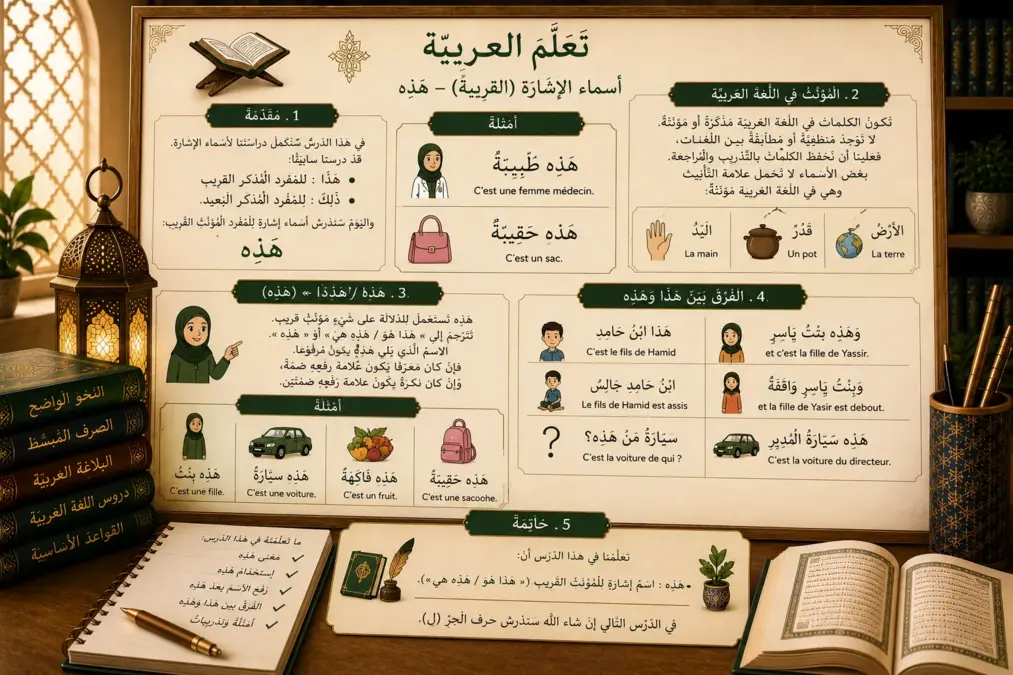
The word هَذِهِ is a feminine singular near demonstrative pronoun. It can be translated as “this”, “this one” or “this is”, depending on the context.
It is used to refer to a feminine singular noun that is near the speaker.
Examples:
- هَذِهِ طَبِيبَةٌ: this is a female doctor;
- هَذِهِ حَقِيبَةٌ: this is a bag;
- هَذِهِ بِنْتٌ: this is a girl.
Feminine Nouns in Arabic
In Arabic, nouns can be masculine or feminine. Some feminine nouns have a visible feminine marker, such as the letter ة. Other nouns are feminine even if they do not have an obvious feminine ending.
It is therefore important to learn the gender of Arabic nouns gradually as you build your vocabulary.
Examples of feminine nouns:
- الأَرْضُ: the earth;
- قِدْرٌ: a pot;
- الْيَدُ: the hand;
- سَيَّارَةٌ: a car;
- حَقِيبَةٌ: a bag.
When to Use هَذِهِ
You use هَذِهِ to refer to a feminine singular noun that is close to the speaker. This rule is very useful for Arabic for beginners, Arabic reading, Arabic grammar and Modern Standard Arabic.
The noun that follows هَذِهِ is usually feminine.
- هَذِهِ حَقِيبَةٌ: this is a bag;
- هَذِهِ فَاكِهَةٌ: this is a fruit;
- هَذِهِ سَيَّارَةٌ: this is a car;
- هَذِهِ بِنْتٌ: this is a girl.
Difference Between هَذَا and هَذِهِ
The difference between هَذَا and هَذِهِ depends on the gender of the noun being pointed to.
- هَذَا is used with a masculine singular noun that is near;
- هَذِهِ is used with a feminine singular noun that is near.
Examples:
- هَـٰذَا ابْنُ حَامِدٍ: this is the son of Hamid;
- وَهَذِهِ بِنْتُ يَاسِرٍ: and this is the daughter of Yasir;
- اِبْنُ حَامِدٍ جَالِسٌ: the son of Hamid is sitting;
- وَبِنْتُ يَاسِرٍ وَاقِفَةٌ: and the daughter of Yasir is standing.
هَذِهِ and the Nominative Case
When a noun comes after the demonstrative pronoun هَذِهِ, it is generally in the nominative case.
If the noun is indefinite, it may carry a double damma. If it is definite, it usually carries a single damma.
Examples:
- هَذِهِ حَقِيبَةٌ: this is a bag;
- هَذِهِ فَاكِهَةٌ: this is a fruit;
- هَذِهِ سَيَّارَةٌ: this is a car;
- هَذِهِ بِنْتٌ: this is a girl.
Question Examples with هَذِهِ
The demonstrative pronoun هَذِهِ can also be used in questions.
- سَيَّارَةُ مَنْ هَذِهِ؟: whose car is this?
- هَذِهِ سَيَّارَةُ الْمُدِيرِ: this is the director’s car.
How to Memorize هَذِهِ
To memorize هَذِهِ, remember three simple points:
- هَذِهِ refers to something near;
- هَذِهِ is used with feminine nouns;
- هَذِهِ is used in the singular.
You can then practise with simple Arabic vocabulary: حَقِيبَةٌ, سَيَّارَةٌ, بِنْتٌ and طَبِيبَةٌ.
Learn Arabic Grammar with a Teacher
Demonstrative pronouns are essential for students who want to learn Arabic online, understand simple sentences and progress in Modern Standard Arabic or Quranic Arabic.
To continue your learning, you can follow our online Arabic classes, study through our Modern Standard Arabic online lessons, review the Arabic alphabet or download our free Arabic books for beginners.
Book your free trial of 30 minutes
Registration form
Conclusion
In this lesson, we studied the feminine near demonstrative pronoun هَذِهِ. We learned that it is used to refer to a feminine singular noun that is near the speaker.
This topic helps you build simple Arabic sentences and better understand Arabic demonstrative pronouns. However, to learn Arabic correctly, you need a clear method, regular practice and correction from a qualified Arabic teacher.




No Comments
No comments yet.