
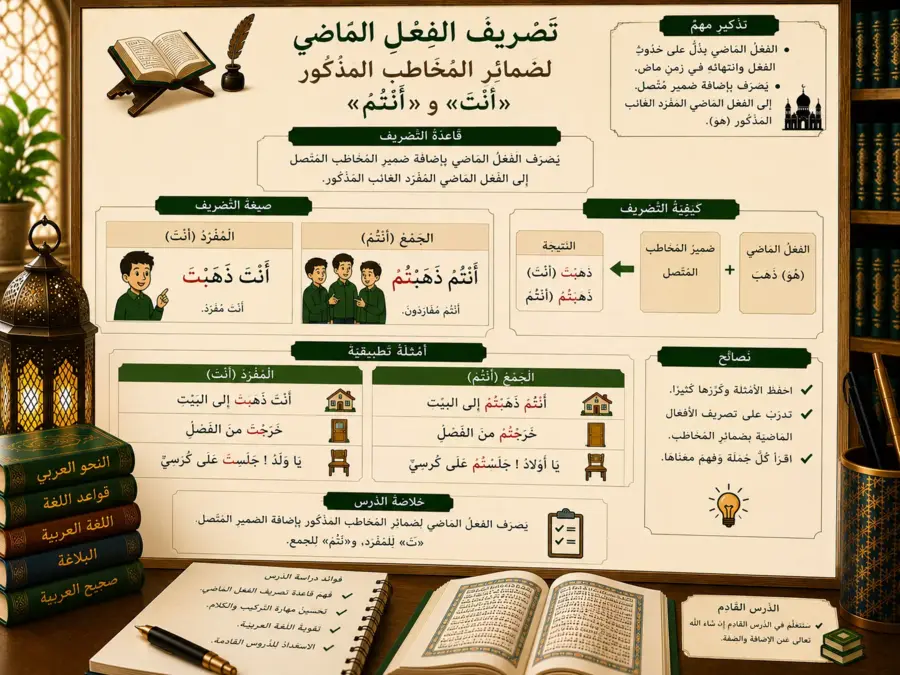
Arabic past tense conjugation is an essential foundation for learning Arabic verbs. The past tense, called الْفِعْلُ الْمَاضِي, generally expresses a completed action in the past.
In this lesson, we will study Arabic past tense conjugation with two masculine second-person pronouns: أَنْتَ, which means “you” in the masculine singular, and أَنْتُمْ, which means “you” in the masculine plural.
This lesson is useful for beginners, but also for students who want to strengthen their Arabic verb conjugation, better understand personal pronouns and progress in literary Arabic, Modern Standard Arabic and Quranic Arabic.
Understanding the Arabic Past Tense
The Arabic past tense indicates a completed action. It often corresponds to the English past tense.
Example:
ذَهَبَ
He went.
From this basic form, endings can be added to show who performed the action.
The Masculine Second-Person Pronouns
In Arabic, the second person refers to the person being addressed. In this lesson, we study two masculine forms:
- أَنْتَ: you, masculine singular;
- أَنْتُمْ: you, masculine plural.
These pronouns are important because Arabic clearly distinguishes between masculine, feminine, singular, dual and plural forms.
Conjugating with أَنْتَ in the Masculine Singular
To conjugate a verb in the past tense with أَنْتَ, Arabic generally adds the ending ـتَ to the verb stem.
Example:
أَنْتَ ذَهَبْتَ
You went.
The ending ـتَ indicates that the speaker is addressing one masculine person.
Conjugating with أَنْتُمْ in the Masculine Plural
To conjugate a verb in the past tense with أَنْتُمْ, Arabic generally adds the ending ـتُمْ to the verb stem.
Example:
أَنْتُمْ ذَهَبْتُمْ
You went.
The ending ـتُمْ indicates that the speaker is addressing several masculine people or a group that includes at least one masculine person.
Arabic Past Tense Conjugation Table
| Arabic Pronoun | Verb Form | Meaning | Ending |
|---|---|---|---|
| أَنْتَ | ذَهَبْتَ | you went, masculine singular | ـتَ |
| أَنْتُمْ | ذَهَبْتُمْ | you went, masculine plural | ـتُمْ |
This table clearly shows the difference between the masculine singular and the masculine plural.
Examples with أَنْتَ
Here are several examples with the pronoun أَنْتَ.
- أَنْتَ ذَهَبْتَ إِلَى الْبَيْتِ: you went to the house.
- خَرَجْتَ مِنَ الْفَصْلِ: you left the classroom.
- يَا وَلَدُ، جَلَسْتَ عَلَى كُرْسِيٍّ: O boy, you sat on a chair.
In these sentences, the speaker is addressing one masculine person.
Examples with أَنْتُمْ
Here are the same types of examples with the pronoun أَنْتُمْ.
- أَنْتُمْ ذَهَبْتُمْ إِلَى الْبَيْتِ: you went to the house.
- خَرَجْتُمْ مِنَ الْفَصْلِ: you left the classroom.
- يَا أَوْلَادُ، جَلَسْتُمْ عَلَى كُرْسِيٍّ: O boys, you sat on a chair.
In these sentences, the speaker is addressing several masculine people or a group that is grammatically masculine.
Difference Between ذَهَبْتَ and ذَهَبْتُمْ
The difference between ذَهَبْتَ and ذَهَبْتُمْ is related to the number of people being addressed.
- ذَهَبْتَ is used when speaking to one man or boy.
- ذَهَبْتُمْ is used when speaking to several men, boys or a group that includes at least one masculine person.
This distinction is important because it allows students to address one person or a group correctly in Arabic.
Common Mistakes to Avoid
Here are some common mistakes made by students who learn Arabic past tense conjugation:
- confusing أَنْتَ and أَنْتِ;
- using ذَهَبْتِ instead of ذَهَبْتَ when speaking to a man;
- using ذَهَبْتَ instead of ذَهَبْتُمْ when speaking to several men;
- forgetting the ending ـتُمْ in the masculine plural;
- not distinguishing between singular and plural in the second person.
These mistakes are normal at the beginning. They gradually decrease with practice, reading and correction.
Learn Arabic Verb Conjugation with a Teacher
Arabic conjugation requires students to understand the verb, the pronoun, gender and number. The forms ذَهَبْتَ and ذَهَبْتُمْ show that Arabic is a precise language, where each ending carries meaning.
To learn Arabic effectively, online Arabic classes with an Arabic teacher online help students move step by step. A teacher can correct your mistakes, explain conjugation and provide exercises adapted to your level.
At Al-Dirassa, you can take private Arabic lessons, start Arabic for beginners, progress in Modern Standard Arabic, strengthen your Quranic Arabic or use free Arabic books for beginners alongside your lessons.
Book your free trial of 30 minutes
Registration form
Conclusion
In this lesson, we studied Arabic past tense conjugation with the masculine second-person pronouns أَنْتَ and أَنْتُمْ.
With أَنْتَ, Arabic uses a form such as ذَهَبْتَ, meaning “you went” for one masculine person. With أَنْتُمْ, Arabic uses a form such as ذَهَبْتُمْ, meaning “you went” for several masculine people.
With a progressive method, regular exercises and correction from a teacher, Arabic conjugation becomes clearer and easier to use in real sentences.



No Comments
No comments yet.