
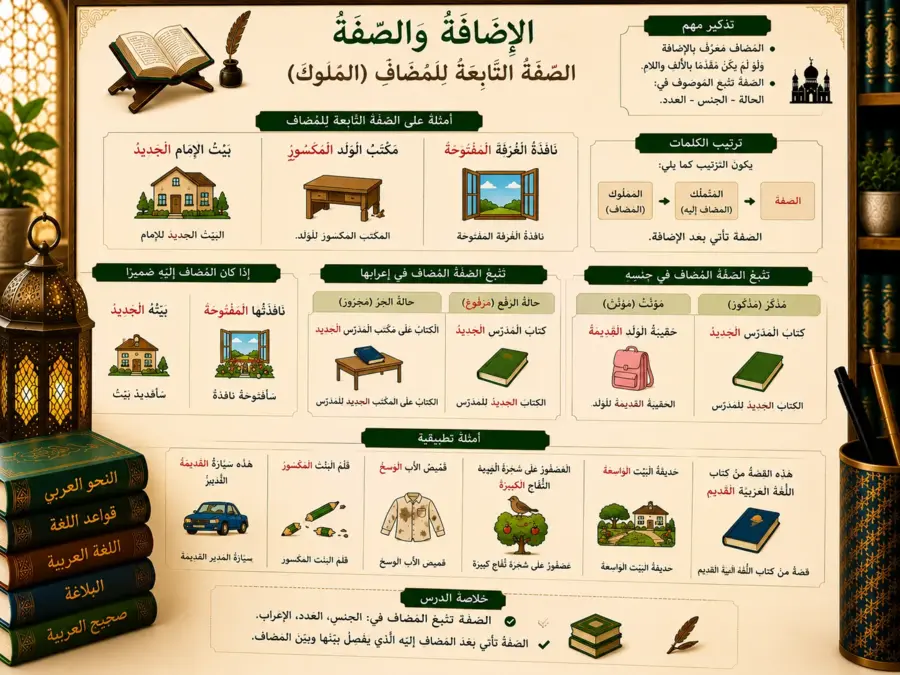
Arabic idafa, called الإِضَافَةُ, is a very important grammatical construction. It is used to express possession, belonging or a relationship between two nouns. When an adjective is added to an idafa construction, students must follow a precise rule of word order and agreement.
In this lesson, we will study how to use adjectives with Arabic idafa. We will learn where the adjective is placed, which noun it describes and how it agrees with that noun.
This lesson is useful for beginners, but also for students who want to improve their Arabic grammar, literary Arabic, Modern Standard Arabic and Quranic Arabic.
Understanding Arabic Idafa
Idafa is a construction made of two nouns. It often expresses possession or belonging.
Example:
بَيْتُ الإِمَامِ
The house of the imam.
In this expression, بَيْتُ means “house” and الإِمَامِ means “of the imam”.
Reminder: What Are مُضَافٌ and مُضَافٌ إِلَيْهِ?
In an idafa construction, the first term is called مُضَافٌ. It is the annexed noun, often translated as the thing possessed.
The second term is called مُضَافٌ إِلَيْهِ. It is the noun to which the first one is attached, often translated as the possessor.
| Element | Arabic Term | Example | Role |
|---|---|---|---|
| First noun | مُضَافٌ | بَيْتُ | the house |
| Second noun | مُضَافٌ إِلَيْهِ | الإِمَامِ | of the imam |
The مُضَافٌ إِلَيْهِ is generally in the genitive case. The مُضَافٌ takes its case according to its grammatical function in the sentence.
Where Should the Adjective Be Placed in an Idafa?
When an adjective describes the first noun of an idafa construction, the adjective is placed after the entire idafa construction.
Example:
بَيْتُ الإِمَامِ الْجَدِيدُ
The new house of the imam.
The order of the construction is therefore:
- the مُضَافٌ: بَيْتُ;
- the مُضَافٌ إِلَيْهِ: الإِمَامِ;
- the adjective: الْجَدِيدُ.
In English, the adjective usually comes before the noun. In Arabic, however, in this structure, the adjective comes after the full idafa construction.
Which Noun Does the Adjective Describe?
In the example بَيْتُ الإِمَامِ الْجَدِيدُ, the adjective الْجَدِيدُ describes بَيْتُ, meaning the house, not the imam.
The correct meaning is:
The new house of the imam.
It does not mean:
The house of the new imam.
To say “the house of the new imam”, the adjective must describe the second noun:
بَيْتُ الإِمَامِ الْجَدِيدِ
The house of the new imam.
This distinction is very important in Arabic grammar because the final vowel of the adjective helps students understand which noun it describes.
Adjective Agreement with the مُضَافٌ
When the adjective describes the مُضَافٌ, it agrees with that noun in gender, number, grammatical case and definiteness.
Agreement in Gender
The adjective follows the gender of the noun it describes.
Examples:
- كِتَابُ الْمُدَرِّسِ الْجَدِيدُ: the teacher’s new book;
- حَقِيبَةُ الْوَلَدِ الْقَدِيمَةُ: the boy’s old bag.
In the first example, كِتَابُ is masculine, so the adjective is masculine: الْجَدِيدُ. In the second example, حَقِيبَةُ is feminine, so the adjective is feminine: الْقَدِيمَةُ.
Agreement in Number
The adjective also follows the number of the noun it describes: singular, dual or plural.
In the simple examples of this lesson, the adjective mainly describes a singular noun. However, the same rule applies to other forms.
Agreement in Grammatical Case
The adjective follows the grammatical case of the noun it describes.
Example in the nominative case:
كِتَابُ الْمُدَرِّسِ الْجَدِيدُ
The teacher’s new book.
Example in the genitive case:
اَلْكِتَابُ عَلَى مَكْتَبِ الْمُدَرِّسِ الْجَدِيدِ
The book is on the teacher’s new desk.
In the second example, مَكْتَبِ is in the genitive case because of the preposition عَلَى. The adjective الْجَدِيدِ follows this case.
Agreement in Definiteness
The مُضَافٌ can be definite through idafa, even if it does not carry the definite article ال. When the adjective describes this definite noun, the adjective usually takes the definite article.
Example:
بَيْتُ الإِمَامِ الْجَدِيدُ
The new house of the imam.
The adjective الْجَدِيدُ is definite because the noun it describes is definite through idafa.
Examples of Idafa with Adjectives
Here are several examples to understand this rule clearly:
- بَيْتُ الإِمَامِ الْجَدِيدُ: the imam’s new house.
- مَكْتَبُ الْوَلَدِ الْمَكْسُورُ: the boy’s broken desk.
- نَافِذَةُ الْغُرْفَةِ الْمَفْتُوحَةُ: the room’s open window.
- هَذِهِ سَيَّارَةُ الْمُدِيرِ الْقَدِيمَةُ: this is the director’s old car.
- قَلَمُ الْبِنْتِ الْمَكْسُورُ: the girl’s broken pencil.
- قَمِيصُ الأَبِ الْوَسِخُ: the father’s dirty shirt.
- حَدِيقَةُ الْبَيْتِ الْوَاسِعَةُ: the house’s spacious garden.
In each example, the adjective comes after the idafa construction and describes the first noun.
Summary Table of the Rule
| Element | Arabic Example | Role | Note |
|---|---|---|---|
| مُضَافٌ | بَيْتُ | noun described | definite through idafa |
| مُضَافٌ إِلَيْهِ | الإِمَامِ | possessor | in the genitive case |
| Adjective | الْجَدِيدُ | describes the مُضَافٌ | agrees with the noun described |
The full structure is therefore: بَيْتُ الإِمَامِ الْجَدِيدُ.
Special Case: مُضَافٌ with an Attached Pronoun
The same rule applies when the possessor is expressed by an attached pronoun.
Examples:
- بَيْتُهُ الْجَدِيدُ: his new house;
- نَافِذَتُهَا الْمَفْتُوحَةُ: her open window.
In these examples, the attached pronoun plays the role of the مُضَافٌ إِلَيْهِ. The adjective comes after it and agrees with the noun being described.
Common Mistakes to Avoid
Here are some common mistakes made by students who learn Arabic idafa and adjectives:
- placing the adjective between the مُضَافٌ and the مُضَافٌ إِلَيْهِ;
- making the adjective agree with the wrong noun;
- forgetting that the مُضَافٌ is definite through idafa;
- forgetting the definite article on the adjective when the noun described is definite;
- confusing “the imam’s new house” with “the house of the new imam”.
These mistakes are normal at the beginning. They gradually decrease with reading, exercises and correction.
Learn Arabic Grammar with a Teacher
Idafa and adjectives are two fundamental concepts in Arabic. When they appear together in the same sentence, word order and agreement become essential for understanding the exact meaning.
To learn Arabic effectively, online Arabic classes with an Arabic teacher online help students move step by step. A teacher can correct your mistakes, explain grammar rules and provide exercises adapted to your level.
At Al-Dirassa, you can take private Arabic lessons, start Arabic for beginners, progress in Modern Standard Arabic, strengthen your Quranic Arabic or use free Arabic books for beginners alongside your lessons.
Book your free trial of 30 minutes
Registration form
Conclusion
Arabic idafa, called الإِضَافَةُ, connects two nouns. When an adjective describes the مُضَافٌ, it is placed after the full idafa construction and agrees with the noun being described.
The adjective therefore follows the مُضَافٌ in gender, number, grammatical case and definiteness. This rule helps students distinguish important meanings, such as “the imam’s new house” and “the house of the new imam”.
With a progressive method, regular examples and correction from a teacher, using adjectives with Arabic idafa becomes clearer and easier to apply in correct Arabic sentences.




No Comments
No comments yet.