
In this lesson, we will continue studying Arabic personal pronouns, known in Arabic as الضَّمَائِرُ. Pronouns are essential for building simple Arabic sentences, improving Arabic reading and understanding the structure of Arabic grammar.
This lesson focuses on the third-person pronouns, which are used to speak about someone who is not directly addressed. In Arabic grammar, this is called الْغَائِبُ, meaning “the absent person” or “the person being spoken about”.
We will study the Arabic equivalents of “he”, “she”, “they” for masculine groups and “they” for feminine groups. This lesson is especially useful for students learning Arabic for beginners, but also for anyone who wants to improve their understanding of Modern Standard Arabic, Quranic Arabic and basic Arabic grammar.
Understanding Arabic Personal Pronouns
In Arabic, personal pronouns allow us to refer to a person without repeating their name. For example, instead of repeating “Muhammad”, we can say “he”. Instead of repeating “Fatimah”, we can say “she”.
Arabic personal pronouns can appear in different forms. Two important categories are:
- detached personal pronouns: الضَّمَائِرُ الْمُنْفَصِلَةُ;
- attached personal pronouns: الضَّمَائِرُ الْمُتَّصِلَةُ.
Detached pronouns are independent words. They can appear on their own in a sentence. Attached pronouns are joined to the end of a noun, verb or preposition.
In this lesson, we will study both forms through simple examples.
Detached Third-Person Pronouns in Arabic
Third-person detached pronouns are used when speaking about another person or group of people. In English, they correspond to “he”, “she” and “they”.
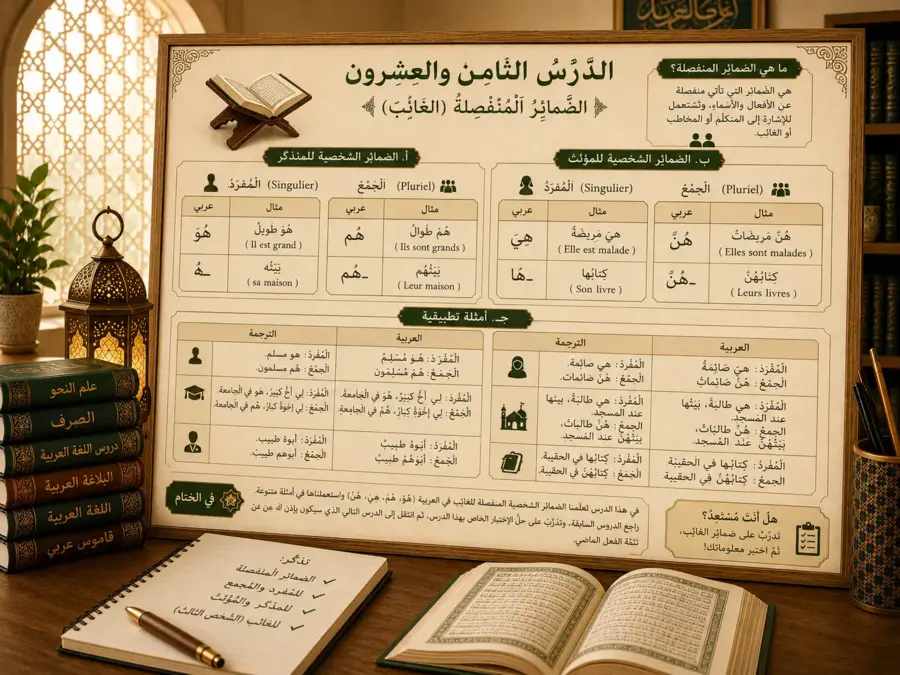
Masculine Pronouns: هُوَ and هُمْ
To speak about one man, one boy or a masculine singular noun, Arabic uses the pronoun هُوَ, which means “he”.
Example:
هُوَ طَوِيلٌ
He is tall.
To speak about several men, boys or a masculine plural group, Arabic uses هُمْ, which means “they”.
Example:
هُمْ طِوَالٌ
They are tall.
Feminine Pronouns: هِيَ and هُنَّ
To speak about one woman, one girl or a feminine singular noun, Arabic uses the pronoun هِيَ, which means “she”.
Example:
هِيَ مَرِيضَةٌ
She is ill.
To speak about several women or girls, Arabic uses هُنَّ, which means “they” for a feminine group.
Example:
هُنَّ مَرِيضَاتٌ
They are ill.
Attached Arabic Pronouns: His, Her and Their
In Arabic, some pronouns can also be attached to the end of a word. When they are attached to a noun, they often express possession, such as “his”, “her” or “their”.
Here are some simple examples:
| Pronoun | Meaning | Arabic example | Translation |
|---|---|---|---|
| ـهُ | his / its, for a masculine singular possessor | بَيْتُهُ | his house |
| ـهَا | her / its, for a feminine singular possessor | كِتَابُهَا | her book |
| ـهُمْ | their, for a masculine plural group | بَيْتُهُمْ | their house |
| ـهُنَّ | their, for a feminine plural group | كِتَابُهُنَّ | their book |
This distinction is important for improving Arabic reading, Arabic vocabulary and sentence comprehension. It also helps students understand how possession is expressed in Arabic.
Summary Table of Third-Person Arabic Pronouns
| Category | Detached pronoun | Meaning | Attached pronoun | Example |
|---|---|---|---|---|
| Masculine singular | هُوَ | He | ـهُ | بَيْتُهُ: his house |
| Masculine plural | هُمْ | They | ـهُمْ | بَيْتُهُمْ: their house |
| Feminine singular | هِيَ | She | ـهَا | كِتَابُهَا: her book |
| Feminine plural | هُنَّ | They | ـهُنَّ | كِتَابُهُنَّ: their book |
Simple Examples with Arabic Personal Pronouns
Let us now look at some examples showing how detached and attached Arabic pronouns are used in simple sentences.
| English | Arabic |
|---|---|
| He is a teacher. | هُوَ مُدَرِّسٌ |
| They are teachers. | هُمْ مُدَرِّسُونَ |
| She is a teacher. | هِيَ مُدَرِّسَةٌ |
| They are teachers. | هُنَّ مُدَرِّسَاتٌ |
| His father is a doctor. | أَبُوهُ طَبِيبٌ |
| Their father is a doctor. | أَبُوهُمْ طَبِيبٌ |
| Her book is in the bag. | كِتَابُهَا فِي الْحَقِيبَةِ |
| Their book is in the bag. | كِتَابُهُنَّ فِي الْحَقِيبَةِ |
Practice Exercise for Arabic Pronouns
Complete the following sentences mentally with the correct Arabic personal pronoun: هُوَ, هِيَ, هُمْ or هُنَّ.
- Ahmed is a student. ___ is from America.
- Fatimah is hardworking. ___ is a student.
- The boys are at the university. ___ are at the university.
- The girls are fasting. ___ are fasting.
Answers:
- هُوَ
- هِيَ
- هُمْ
- هُنَّ
Learning Arabic Grammar with a Clear Method
Personal pronouns are an essential foundation for anyone who wants to learn Arabic online. They help students build simple sentences, understand short texts and progress toward more advanced Arabic grammar.
For students learning Arabic for beginners, it is important to study step by step:
- the Arabic alphabet;
- Arabic reading and Arabic pronunciation;
- Arabic personal pronouns;
- nominal and verbal sentences;
- basic Arabic vocabulary;
- the first rules of Arabic conjugation.
If your goal is to understand classical texts, the Quran or Islamic supplications, it is also useful to follow a structured path in Quranic Arabic. If you want to read, write and communicate in a broader context, you can study Modern Standard Arabic.
Learn Arabic with a Teacher
This lesson helps you understand one specific grammar point, but complete Arabic learning requires practice, repetition and regular correction. With a private Arabic tutor, you can work on Arabic reading, Arabic pronunciation, Arabic grammar and expression at your own pace.
Al-Dirassa offers online Arabic classes for adults and Arabic classes for kids, with personalized learning and a free trial lesson.
Book your free trial of 30 minutes
Registration form
Conclusion
In this lesson, we studied the third-person Arabic personal pronouns: هُوَ, هِيَ, هُمْ and هُنَّ. We also saw their attached forms: ـهُ, ـهَا, ـهُمْ and ـهُنَّ.
This grammar point is an important step for understanding simple Arabic sentences. However, to learn Arabic properly, students need a clear method, regular practice, revision and correction from a teacher. This is how they can make steady progress in Arabic for beginners, Modern Standard Arabic or Quranic Arabic.



No Comments
No comments yet.