
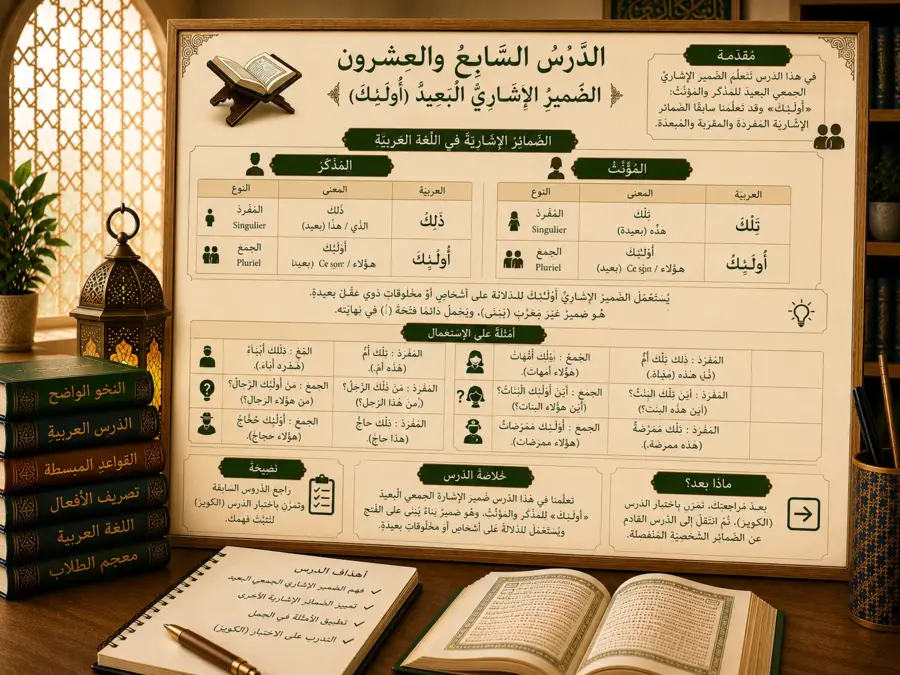
In this Arabic lesson, we will study an important point in Arabic grammar: the distant plural demonstrative pronoun in Arabic أُولَـٰئِكَ. This word is used to say “those”, “those ones” or “those are” when referring to several distant people.
This lesson continues the study of Arabic demonstrative pronouns. We have already seen near and distant singular forms, such as هَذَا, هَذِهِ, ذَلِكَ and تِلْكَ. We have also studied the near plural form هَؤُلاءِ. In this lesson, we will learn how to use أُولَـٰئِكَ for the distant plural.
This topic is very useful for students learning Arabic for beginners, but also for those who want to improve their understanding of Modern Standard Arabic, Quranic Arabic and basic Arabic sentence structure.
Understanding Arabic Demonstrative Pronouns
A demonstrative pronoun is used to point to or identify a person, an object or a group. In English, we use words such as “this”, “these”, “that”, “those”, “this one” and “those ones”.
In Arabic, demonstrative pronouns change according to three elements:
- gender: masculine or feminine;
- number: singular, dual or plural;
- distance: near or distant.
In this lesson, we focus on the distant plural form: أُولَـٰئِكَ.
What Does أُولَـٰئِكَ Mean in Arabic?
The demonstrative pronoun أُولَـٰئِكَ means “those”, “those ones” or “those are”. It is used to refer to a distant plural group.
Example with a masculine plural:
أُولَـٰئِكَ آبَاءٌ
Those are fathers.
Example with a feminine plural:
أُولَـٰئِكَ أُمَّهَاتٌ
Those are mothers.
The same form أُولَـٰئِكَ is used for a masculine or feminine group when speaking about distant people.
When Should You Use أُولَـٰئِكَ?
Use أُولَـٰئِكَ to refer to several distant people. This form is mainly used for human beings or rational beings.
For example, it can be used with:
- fathers;
- mothers;
- men;
- girls;
- pilgrims;
- female nurses;
- students.
Example:
مَنْ أُولَـٰئِكَ الرِّجَالُ؟
Who are those men?
The Difference Between هَؤُلاءِ and أُولَـٰئِكَ
The difference between هَؤُلاءِ and أُولَـٰئِكَ is mainly based on distance.
| Pronoun | Distance | Number | Meaning | Example |
|---|---|---|---|---|
| هَؤُلاءِ | Near | Plural | these, these ones | هَؤُلاءِ مُدَرِّسُونَ: these are teachers |
| أُولَـٰئِكَ | Distant | Plural | those, those ones | أُولَـٰئِكَ آبَاءٌ: those are fathers |
Use هَؤُلاءِ for a nearby group and أُولَـٰئِكَ for a distant group.
The Difference Between ذَلِكَ, تِلْكَ and أُولَـٰئِكَ
The pronouns ذَلِكَ, تِلْكَ and أُولَـٰئِكَ are all used to refer to something distant, but they are not used with the same gender and number.
| Demonstrative pronoun | Number | Gender | Meaning | Example |
|---|---|---|---|---|
| ذَلِكَ | Singular | Masculine | that, that one, that is | ذَلِكَ أَبٌ: that is a father |
| تِلْكَ | Singular | Feminine | that, that one, that is | تِلْكَ أُمٌّ: that is a mother |
| أُولَـٰئِكَ | Plural | Masculine or feminine | those, those ones, those are | أُولَـٰئِكَ أُمَّهَاتٌ: those are mothers |
Summary Table of Distant Demonstrative Pronouns
| Category | Arabic | Translation | Arabic example | Example translation |
|---|---|---|---|---|
| Masculine singular distant | ذَلِكَ | that, that one, that is | ذَلِكَ حَاجٌّ | That is a pilgrim. |
| Feminine singular distant | تِلْكَ | that, that one, that is | تِلْكَ مُمَرِّضَةٌ | That is a nurse. |
| Masculine plural distant | أُولَـٰئِكَ | those, those are | أُولَـٰئِكَ حُجَّاجٌ | Those are pilgrims. |
| Feminine plural distant | أُولَـٰئِكَ | those, those are | أُولَـٰئِكَ مُمَرِّضَاتٌ | Those are female nurses. |
Examples with أُولَـٰئِكَ for Masculine and Feminine Plurals
Here are several examples to help you understand how to use أُولَـٰئِكَ in simple Arabic sentences.
| English | Arabic |
|---|---|
| That is a father. | ذَلِكَ أَبٌ |
| Those are fathers. | أُولَـٰئِكَ آبَاءٌ |
| That is a mother. | تِلْكَ أُمٌّ |
| Those are mothers. | أُولَـٰئِكَ أُمَّهَاتٌ |
| Who is that man? | مَنْ ذَلِكَ الرَّجُلُ؟ |
| Who are those men? | مَنْ أُولَـٰئِكَ الرِّجَالُ؟ |
| Where is that girl? | أَيْنَ تِلْكَ الْبِنْتُ؟ |
| Where are those girls? | أَيْنَ أُولَـٰئِكَ الْبَنَاتُ؟ |
| That is a pilgrim. | ذَلِكَ حَاجٌّ |
| Those are pilgrims. | أُولَـٰئِكَ حُجَّاجٌ |
| That is a female nurse. | تِلْكَ مُمَرِّضَةٌ |
| Those are female nurses. | أُولَـٰئِكَ مُمَرِّضَاتٌ |
Arabic Grammar Points to Remember
The demonstrative pronoun أُولَـٰئِكَ has several important characteristics.
- It is used for the distant plural.
- It can refer to a masculine or feminine group.
- It is mainly used for human beings or rational beings.
- It is indeclinable: its form does not change according to its function in the sentence.
- It ends with a fatha in its full form: أُولَـٰئِكَ.
This stability is important for Arabic reading and beginner Arabic grammar. Students should learn to recognize أُولَـٰئِكَ as a distant plural demonstrative pronoun.
Practice Exercise with أُولَـٰئِكَ
Transform the following singular sentences into distant plural sentences using أُولَـٰئِكَ.
- ذَلِكَ أَبٌ: that is a father.
- تِلْكَ أُمٌّ: that is a mother.
- ذَلِكَ حَاجٌّ: that is a pilgrim.
- تِلْكَ مُمَرِّضَةٌ: that is a female nurse.
Answers:
- أُولَـٰئِكَ آبَاءٌ: those are fathers.
- أُولَـٰئِكَ أُمَّهَاتٌ: those are mothers.
- أُولَـٰئِكَ حُجَّاجٌ: those are pilgrims.
- أُولَـٰئِكَ مُمَرِّضَاتٌ: those are female nurses.
Learning Arabic Grammar with a Clear Method
Demonstrative pronouns are essential for anyone who wants to learn Arabic online. They help students point to people, build simple sentences and understand texts in Modern Standard Arabic or Arabic reading lessons.
For students learning Arabic for beginners, it is helpful to study step by step:
- the Arabic alphabet;
- Arabic reading and Arabic pronunciation;
- Arabic personal pronouns;
- Arabic demonstrative pronouns;
- singular and plural forms;
- nominal sentences;
- the foundations of Arabic grammar.
If your goal is to understand religious texts or the Quran, a structured path in Quranic Arabic can help you recognize these forms in context. To read, write and understand Arabic in a broader setting, studying Modern Standard Arabic is also very useful.
Learn Arabic with a Teacher
This lesson helps you understand the distant plural demonstrative pronoun أُولَـٰئِكَ. However, mastering Arabic grammar requires regular practice, varied reading exercises and correction from an Arabic teacher.
Al-Dirassa offers online Arabic classes for adults and Arabic classes for kids, with personalized learning, structured progression and a free trial lesson.
Book your free trial of 30 minutes
Registration form
Conclusion
In this lesson, we studied the distant plural demonstrative pronoun in Arabic: أُولَـٰئِكَ. It means “those”, “those ones” or “those are”, and it is used to refer to several distant people.
We saw that أُولَـٰئِكَ can be used with a masculine or feminine plural group. We also compared it with هَؤُلاءِ, ذَلِكَ and تِلْكَ.
This grammar point is an important step in learning Arabic. However, to learn Arabic properly, students need a clear method, regular practice, varied examples and correction from a teacher. This is how they can make steady progress in Arabic for beginners, Modern Standard Arabic or Quranic Arabic.



No Comments
No comments yet.