
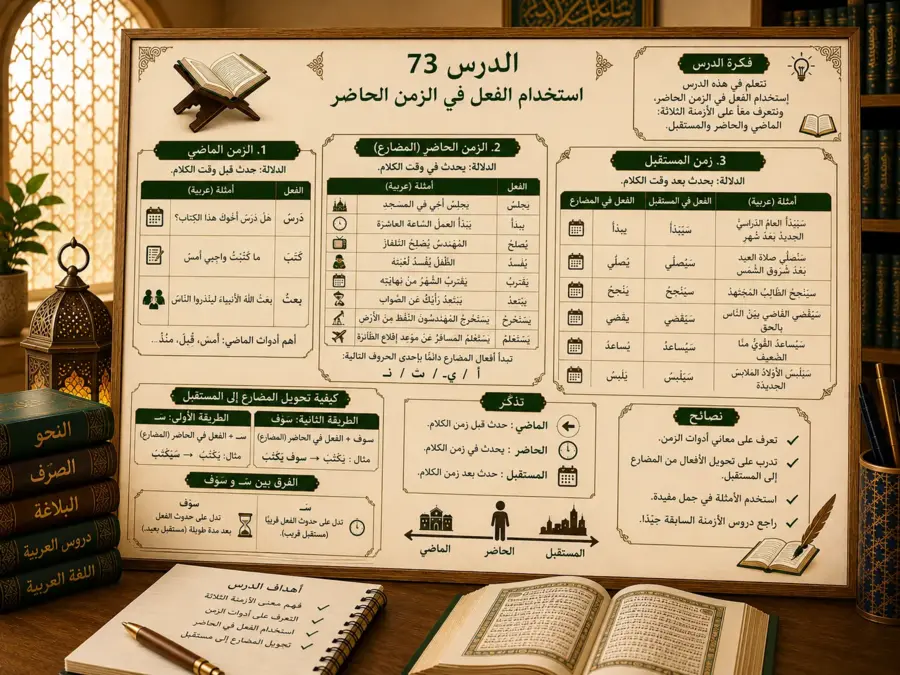
Arabic present and future tense verbs are essential for understanding Arabic conjugation and building correct sentences. In Arabic, verbs can express a past, present or future action depending on their form and the elements that accompany them.
In this lesson, we will study the Arabic present tense verb, then see how to form the future tense from the present tense with the prefix سـ. This rule is important for Arabic for beginners, but also for students who want to improve their Arabic grammar, Modern Standard Arabic, Quranic Arabic and Arabic reading.
Understanding Arabic Verb Tenses
In Arabic, verbs are generally studied through three main time references:
- the past: the action happened before the moment of speaking;
- the present: the action is happening now or expresses a habit;
- the future: the action will happen after the moment of speaking.
Understanding these three tenses helps students read, translate and build more precise Arabic sentences.
The Arabic Past Tense: Quick Reminder
The past tense verb indicates that an action has already happened. It is often used to describe a completed event.
هَلْ دَرَسَ أَخُوكَ هَذَا الكِتَابَ؟
Did your brother study this book?
In this sentence, the verb دَرَسَ means “he studied”. The action is completed.
مَا كَتَبْتُ وَاجِبِي أَمْسِ
I did not write my homework yesterday.
Here, the verb كَتَبْتُ refers to a past action, reinforced by the time adverb أَمْسِ, which means “yesterday”.
The Arabic Present Tense
The Arabic present tense verb expresses an action that is happening now, a habitual action or sometimes a near action depending on the context.
مُحَمَّدٌ يَأْكُلُ
Mohammed is eating.
In this example, the verb يَأْكُلُ shows that the action is happening at the moment of speaking or is presented as a current action.
Here are more examples of Arabic present tense verbs:
يَجْلِسُ أَخِي فِي المَسْجِدِ
My brother is sitting in the mosque.
يَبْدَأُ العَمَلُ السَّاعَةَ العَاشِرَةَ
Work starts at ten o’clock.
المُهَنْدِسُ يُصْلِحُ التِّلْفَازَ
The engineer is repairing the television.
يَسْتَخْرِجُ المُهَنْدِسُونَ النِّفْطَ مِنَ الأَرْضِ
The engineers extract oil from the earth.
The Letters of the Arabic Present Tense Verb
The Arabic present tense verb generally begins with one of the following letters:
- أ: for the first-person singular;
- نـ: for the first-person plural;
- يـ: often for the third-person masculine;
- تـ: often for the second person or the third-person feminine.
These letters are sometimes summarized by the formula أَنَيْتُ, which is used in traditional Arabic conjugation learning.
Examples:
- أَكْتُبُ: I write;
- نَكْتُبُ: we write;
- يَكْتُبُ: he writes;
- تَكْتُبُ: she writes / you write.
How to Form the Future Tense in Arabic with سـ
The future tense in Arabic can be formed simply by adding the prefix سـ before the present tense verb. This prefix indicates that the action will happen later.
Example:
يَذْهَبُ مُحَمَّدٌ إِلَى العَمَلِ
Mohammed goes to work.
سَيَذْهَبُ مُحَمَّدٌ إِلَى العَمَلِ
Mohammed will go to work.
The verb يَذْهَبُ is in the present tense. When سـ is added, it becomes سَيَذْهَبُ, which expresses the future.
Examples of Arabic Present and Future Tense Verbs
Here are several examples to compare the present and future tense in Arabic.
يَبْدَأُ العَامُ الدِّرَاسِيُّ الجَدِيدُ
The new school year begins.
سَيَبْدَأُ العَامُ الدِّرَاسِيُّ الجَدِيدُ بَعْدَ شَهْرٍ
The new school year will begin in one month.
نُصَلِّي صَلَاةَ العِيدِ
We perform the Eid prayer.
سَنُصَلِّي صَلَاةَ العِيدِ بَعْدَ شُرُوقِ الشَّمْسِ
We will perform the Eid prayer after sunrise.
يَنْجَحُ الطَّالِبُ المُجْتَهِدُ
The hardworking student succeeds.
سَيَنْجَحُ الطَّالِبُ المُجْتَهِدُ
The hardworking student will succeed.
يُسَاعِدُ القَوِيُّ مِنَّا الضَّعِيفَ
The strong among us helps the weak.
سَيُسَاعِدُ القَوِيُّ مِنَّا الضَّعِيفَ
The strong among us will help the weak.
Summary Table
| Concept | Arabic form | Example | Translation |
|---|---|---|---|
| Past | Past tense verb | دَرَسَ | He studied |
| Present | Verb often beginning with أ، ن، ي، ت | يَدْرُسُ | He studies |
| Future | سـ + present tense verb | سَيَدْرُسُ | He will study |
| Near future | سـ + present tense verb + time adverb | سَيَذْهَبُ غَدًا | He will go tomorrow |
How to Improve Your Arabic Conjugation
Understanding Arabic present and future tense verbs is an important step, but students then need to practise this rule in real sentences. The learner must learn how to recognize the verb root, the present tense letters, conjugation markers and the words that indicate the time of the action.
If you want to learn Arabic online with a structured method, online Arabic classes allow you to progress with an Arabic teacher online who corrects your mistakes and guides you step by step.
To strengthen Arabic grammar, Arabic reading, Arabic pronunciation and Arabic vocabulary, you can also follow a course in Modern Standard Arabic. Students who want to better understand Quranic texts can study Quranic Arabic.
For families, Al-Dirassa also offers Arabic classes for kids adapted to each student’s age and level.
Book your free trial of 30 minutes
Registration form
Conclusion
The Arabic present tense verb expresses a current, habitual or context-related action. The future tense can be formed by adding سـ before the present tense verb, as in يَذْهَبُ “he goes” and سَيَذْهَبُ “he will go”.
This lesson helps you understand an essential point of Arabic conjugation. However, to learn Arabic fully, students need a clear method, regular practice and personalized correction from a teacher. This combination allows learners to make lasting progress in Arabic reading, understanding and expression.



No Comments
No comments yet.