
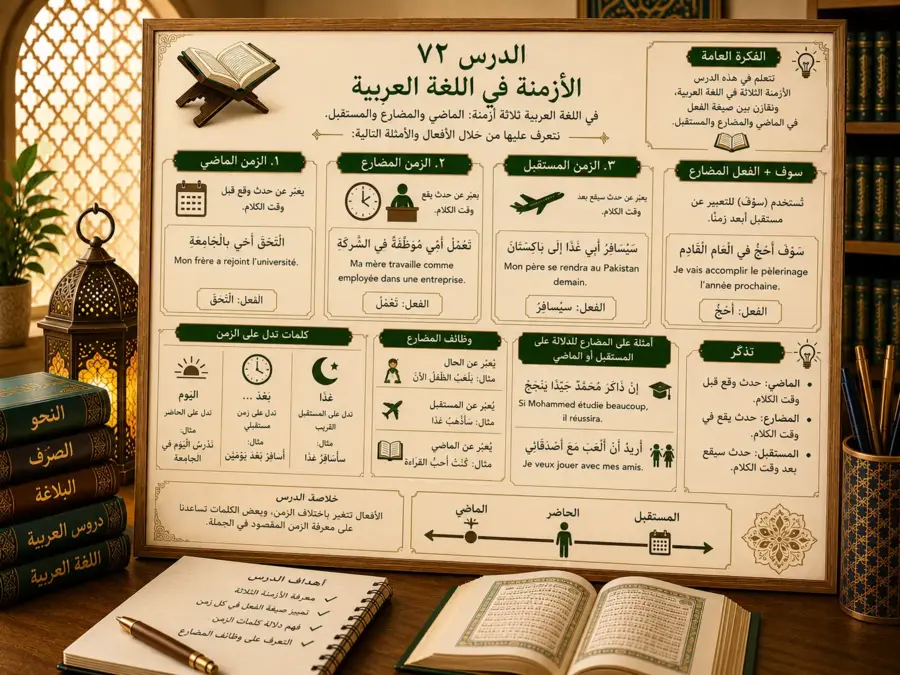
Arabic verb tenses are an essential foundation for understanding Arabic conjugation and building correct sentences. In Arabic, the verb can express a past, present or future action depending on its form, the context and the words that accompany it.
In this lesson, we will introduce the three main Arabic verb tenses: the past, the present and the future. This introduction is useful for Arabic for beginners, but also for anyone who wants to improve Arabic grammar, Arabic reading, Modern Standard Arabic, Quranic Arabic and Arabic conjugation.
Understanding Arabic Verb Tenses
In Arabic, verb tenses help place an action in time. An action may have happened before the moment of speaking, may be happening now or may happen later.
The three main concepts are:
- the past tense: الماضي;
- the present tense: المُضارِع;
- the future tense: المُسْتَقْبَل.
These three tenses are essential for learning Arabic, reading simple sentences and understanding Arabic verb structure.
The Past Tense in Arabic: الماضي
The past tense in Arabic, called الماضي, is used to express a completed action. It often corresponds to the English past simple or present perfect, depending on the context.
اِلْتَحَقَ أَخِي بِالْجَامِعَةِ
My brother joined the university.
In this sentence, the verb اِلْتَحَقَ indicates an action that has already happened. The time of the action is therefore the past.
The past tense is very common in stories, biographies, historical texts and religious texts. It is therefore important for students who want to progress in Modern Standard Arabic and Quranic Arabic.
The Present Tense in Arabic: المضارع
The present tense in Arabic, called المُضارِع, expresses an action that is happening now, a habit or a general action.
تَعْمَلُ أُمِّي مُوَظَّفَةً فِي الشَّرِكَةِ
My mother works as an employee in the company.
In this example, the verb تَعْمَلُ expresses an action in the present. It may mean that the person is working now or that she works there as a regular job.
The present tense is an important step in Arabic conjugation because it also serves as the basis for certain future constructions.
The Future Tense in Arabic: المستقبل
The future tense in Arabic, called المُسْتَقْبَل, is used to express an action that will happen later. It can be indicated by the context, by a time adverb or by markers such as سـ and سَوْفَ.
سَيُسَافِرُ أَبِي غَدًا إِلَى بَاكِسْتَانَ
My father will travel tomorrow to Pakistan.
In this sentence, the prefix سـ and the word غَدًا, meaning “tomorrow”, show that the action will take place in the future.
سَوْفَ أَحُجُّ فِي العَامِ القَادِمِ
I will perform Hajj next year.
Here, سَوْفَ also indicates a future action.
To go further, you can read the lesson on Arabic present and future tense verbs.
Words That Indicate the Time of the Action
In Arabic, certain words help specify when an action takes place. These words are very useful for identifying the time expressed by the verb.
- أَمْسِ: yesterday;
- اليَوْمَ: today;
- غَدًا: tomorrow;
- بَعْدَ: after.
These expressions help students understand whether the sentence refers to the past, present or future.
غَدًا
Tomorrow.
اليَوْمَ
Today.
بَعْدَ سَاعَةٍ
After one hour / in one hour.
To deepen this vocabulary, you can read the lesson on Arabic time adverbs.
When the Present Tense Can Express Another Time
In Arabic, the present tense can sometimes express a future meaning or be used in specific constructions. In these cases, context plays an important role.
إِنْ ذَاكَرَ مُحَمَّدٌ جَيِّدًا يَنْجَحْ
If Mohammed studies seriously, he will succeed.
In this example, the verb يَنْجَحْ can be understood with a future meaning because it depends on a condition.
أُرِيدُ أَنْ أَلْعَبَ مَعَ أَصْدِقَائِي
I want to play with my friends.
Here, the verb أَلْعَبَ depends on أَنْ. This type of construction is common in Arabic grammar and should be studied progressively.
Summary Table of Arabic Verb Tenses
| Tense | Arabic term | Example | Translation |
|---|---|---|---|
| Past | الماضي | اِلْتَحَقَ أَخِي | My brother joined |
| Present | المُضارِع | تَعْمَلُ أُمِّي | My mother works |
| Future | المُسْتَقْبَل | سَيُسَافِرُ أَبِي | My father will travel |
| Future with سَوْفَ | المُسْتَقْبَل | سَوْفَ أَحُجُّ | I will perform Hajj |
How to Improve Your Arabic Conjugation
Understanding Arabic verb tenses is a first step. To make real progress, students then need to practise Arabic conjugation in complete sentences, read regularly and receive correction.
If you want to learn Arabic online with a structured method, online Arabic classes allow you to study with an Arabic teacher online who corrects your mistakes and guides you step by step.
To strengthen Arabic grammar, Arabic reading, Arabic pronunciation and Arabic vocabulary, you can also follow a course in Modern Standard Arabic. Students who want to better understand Quranic texts can study Quranic Arabic.
For families, Al-Dirassa also offers Arabic classes for kids adapted to each student’s age and level.
Book your free trial of 30 minutes
Registration form
Conclusion
Arabic verb tenses allow you to express a past, present or future action. The past tense is called الماضي, the present tense is called المُضارِع and the future tense is called المُسْتَقْبَل.
This lesson helps you understand an essential foundation of Arabic conjugation. However, to learn Arabic fully, students need a clear method, regular practice and personalized correction from a teacher. This combination allows learners to make lasting progress in Arabic reading, understanding and expression.



No Comments
No comments yet.