
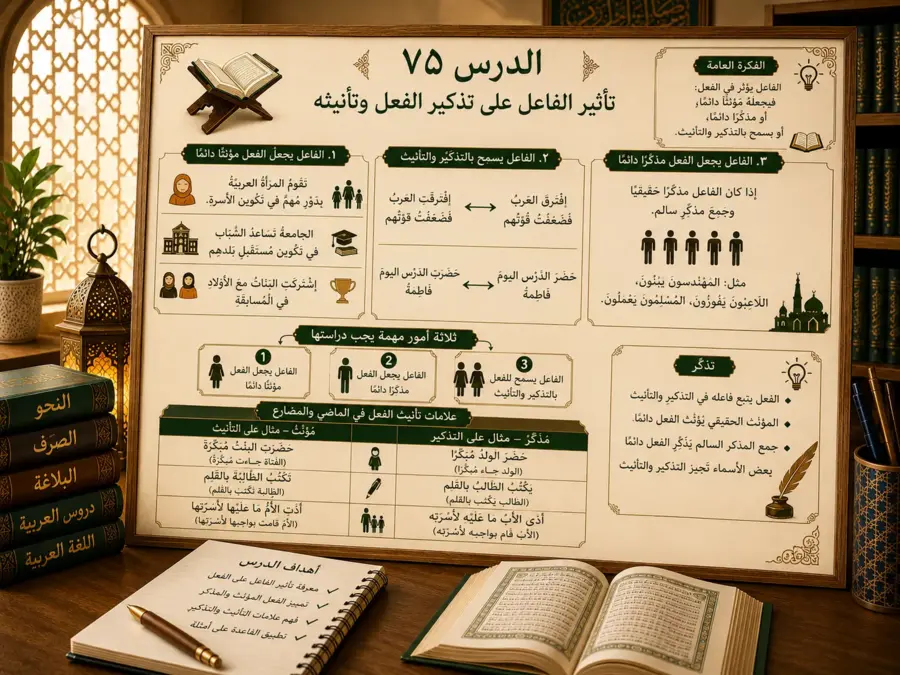
Arabic verb agreement is an essential rule for understanding Arabic grammar and building correct sentences. In Arabic, the verb can be masculine or feminine depending on the subject, its position in the sentence and the type of noun used.
This lesson helps you understand the basic rules of Arabic verb agreement: when the verb must be feminine, when it must remain masculine and when both forms may be possible.
This grammar point is important for Arabic for beginners, but also for students who want to improve their Modern Standard Arabic, Quranic Arabic, Arabic reading and Arabic conjugation.
Understanding Arabic Verb Agreement
In English, the verb does not usually show the gender of the subject. In Arabic, however, the verb can carry a masculine or feminine marker.
Example with a feminine verb:
تَقُومُ المَرْأَةُ العَرَبِيَّةُ بِدَوْرٍ مُهِمٍّ في تَكْوينِ الأُسْرَةِ
The Arab woman plays an important role in building the family.
In this sentence, the verb تَقُومُ is feminine because the subject المَرْأَةُ is feminine.
When the Arabic Verb Becomes Feminine
The Arabic verb becomes feminine when the subject is feminine and the sentence structure requires this agreement.
الْجَامِعَةُ تُسَاعِدُ الشَّبَابَ فِي تَكْوِينِ مُسْتَقْبَلِ بَلَدِهِمْ
The university helps young people build the future of their country.
Here, the word الْجَامِعَةُ is feminine in Arabic. The verb تُسَاعِدُ therefore takes a feminine form.
اِشْتَرَكَتْ الْبَنَاتُ مَعَ الأَوْلَادِ فِي الْمُسَابَقَةِ
The girls participated with the boys in the competition.
In this example, the subject الْبَنَاتُ is a feminine plural. The verb اِشْتَرَكَتْ is therefore feminine.
To study this rule in more detail, you can read the lesson on feminine Arabic verb agreement.
When the Arabic Verb Remains Masculine
The Arabic verb remains masculine when the subject is masculine and no special rule requires the feminine form.
حَضَرَ الوَلَدُ مُبَكِّرًا
The boy came early.
يَكْتُبُ الطَّالِبُ بِالقَلَمِ
The male student writes with the pen.
أَدَّى الأَبُ مَا عَلَيْهِ لِأُسْرَتِهِ
The father fulfilled his duty towards his family.
In these three examples, the subjects are masculine: الوَلَدُ, الطَّالِبُ and الأَبُ. The verbs therefore remain masculine.
When the Verb Can Be Masculine or Feminine
In some cases, the subject allows the verb to be either masculine or feminine. This can happen with certain plurals, collective nouns or when the feminine subject is separated from the verb.
اِفْتَرَقَ العَرَبُ فَضَعُفَتْ قُوَّتُهُمْ
The Arabs divided, and their strength weakened.
اِفْتَرَقَتِ العَرَبُ فَضَعُفَتْ قُوَّتُهُمْ
The Arabs divided, and their strength weakened.
In these two sentences, both forms may be found depending on how the subject is analysed grammatically.
Another example:
حَضَرَ الدَّرْسَ اليَوْمَ فَاطِمَةُ
Fatima attended the lesson today.
حَضَرَتِ الدَّرْسَ اليَوْمَ فَاطِمَةُ
Fatima attended the lesson today.
Here, the feminine subject فَاطِمَةُ is separated from the verb by other elements of the sentence. This is why both forms may be possible.
To study this point in detail, read the lesson on cases where the Arabic verb can be masculine or feminine.
Feminine Markers in the Past and Present Tense
In Arabic, the feminine form of the verb can appear differently depending on the tense.
In the past tense, the feminine is often marked by the ending تْ.
حَضَرَتِ البِنْتُ مُبَكِّرَةً
The girl came early.
أَدَّتِ الأُمُّ مَا عَلَيْهَا لِأُسْرَتِهَا
The mother fulfilled her duty towards her family.
In the present tense, the feminine is often marked by the letter ت at the beginning of the verb.
تَكْتُبُ الطَّالِبَةُ بِالقَلَمِ
The female student writes with the pen.
By contrast, the masculine present-tense verb often begins with ي in the third person.
يَكْتُبُ الطَّالِبُ بِالقَلَمِ
The male student writes with the pen.
Summary Table
| Situation | General rule | Example |
|---|---|---|
| Direct feminine subject | The verb is feminine | تَقُومُ المَرْأَةُ |
| Masculine subject | The verb is masculine | يَكْتُبُ الطَّالِبُ |
| Feminine subject separated from the verb | Masculine or feminine may be possible | حَضَرَ / حَضَرَتْ فَاطِمَةُ |
| Feminine in the past tense | Often marked by تْ | حَضَرَتْ |
| Feminine in the present tense | Often marked by ت | تَكْتُبُ |
How to Improve Your Arabic Grammar
Understanding Arabic verb agreement is essential for reading, analysing and building correct sentences. But this rule must be practised regularly through exercises, examples and personalized correction.
If you want to learn Arabic online with a clear method, online Arabic classes allow you to progress with an Arabic teacher online. You can work on Arabic reading, Arabic pronunciation, Arabic vocabulary and Arabic grammar through a progressive learning path.
Students who want to strengthen their level can follow a course in Modern Standard Arabic. Those who want to better understand the language of the Quran can study Quranic Arabic.
For families, Al-Dirassa also offers Arabic classes for kids adapted to each student’s age and level.
Book your free trial of 30 minutes
Registration form
Conclusion
Arabic verb agreement depends on the gender of the subject, its position in the sentence and the type of noun used. In some cases, the verb must be feminine; in others, it must remain masculine; and in certain situations, both forms may be possible.
This lesson helps you understand the foundations of Arabic verb agreement. However, to learn Arabic fully, students need a structured method, regular practice and correction from a teacher. This is how learners make real progress in Arabic grammar, reading and expression.




No Comments
No comments yet.