
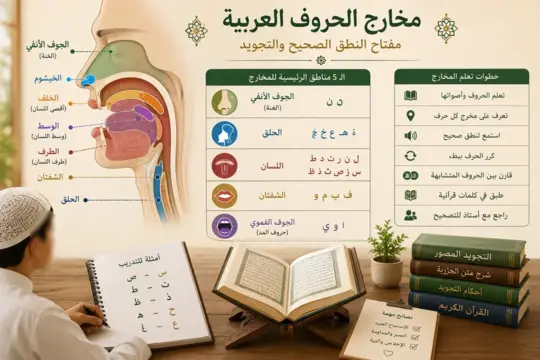
The articulation points of Arabic letters, known as Makharij al-Huruf, play an essential role in Arabic pronunciation and Tajweed. They refer to the precise places from which letters are produced when they are pronounced.
To recite the Quran correctly, it is not enough to recognize the letters. The learner also needs to know how to produce them using the mouth, tongue, throat, lips or nasal cavity. This precision helps avoid confusion between similar letters and improves the clarity of recitation.
In this article, we will explain what Makharij are, why they matter in Tajweed, what the main articulation areas are and how to learn them step by step.
What Does Makharij al-Huruf Mean?
The word makharij is the plural of makhraj. It refers to the exit point of a letter. The expression Makharij al-Huruf therefore means the articulation points of letters.
Each Arabic letter has an articulation point or a specific area of production. Some letters come from the throat, others from the tongue, the lips or the oral cavity.
Knowing these points helps the learner pronounce letters with more precision. It is an important foundation for studying Tajweed and reciting the Quran correctly.
Why Articulation Points Matter in Tajweed
Tajweed teaches the correct way to recite the Quran. Makharij help the learner respect Arabic letters and avoid pronunciation mistakes.
Some letters may seem similar to English speakers, such as س and ص, ت and ط, or ذ and ظ. However, they are not pronounced in the same way and do not always come from the same place.
Working on articulation points therefore helps distinguish letters, improve recitation and read the Quran with more attention.
To deepen this area, Tajweed lessons online can help learners work on pronunciation with correction.
The 5 Main Articulation Areas of Arabic Letters
Scholars of Tajweed generally group articulation points into several main areas. These areas help learners understand how Arabic letters are produced.
The Oral Cavity
The oral cavity is related to long vowel letters, also known as the letters of prolongation or madd. They are linked to elongated sounds produced with ا, و and ي in specific conditions.
These letters require good control of duration and airflow in order to respect the recitation.
The Throat
The throat is an important area for several Arabic letters. It includes letters such as ء, ه, ع, ح, غ and خ.
These letters can be difficult for beginners because some of their sounds do not exist in English. They therefore require listening, repetition and correction.
The Tongue
The tongue is the most used articulation area. Many Arabic letters are produced with different parts of the tongue: its tip, sides, middle or back.
Among the letters related to the tongue are ل, ن, ر, ت, د, ط, س, ز, ص, ث, ذ and ظ.
The Lips
The lips produce several letters, including ف, ب, م and و in certain cases. The position of the lips directly affects the clarity of these sounds.
Incorrect closure or poor lip placement can change pronunciation.
The Nasal Cavity
The nasal cavity is linked to ghunnah, a nasal sound found especially with م and ن in certain Tajweed rules.
Ghunnah is not learned only through theory. It needs to be heard, repeated and corrected in order to be applied correctly.
Common Pronunciation Mistakes
Beginners often face difficulties when learning the articulation points of Arabic letters.
- Confusing emphatic and non-emphatic letters.
- Pronouncing ع like a simple vowel.
- Confusing ح and ه.
- Not distinguishing س and ص.
- Pronouncing ط like ت.
- Neglecting ghunnah.
- Reading too quickly without respecting the sounds.
These mistakes can be corrected gradually through listening, repetition and suitable correction.
How to Learn Makharij Correctly
To learn Makharij, it is important to progress step by step. It is better to begin with the most frequent letters, then work on difficult letters with simple examples.
A useful method is to:
- learn Arabic letters and their sounds;
- identify the articulation area of each letter;
- listen to correct pronunciation;
- repeat each letter slowly;
- compare similar letters;
- apply the sounds in Quranic words;
- recite to a teacher for correction.
Beginners who do not yet master the letters can start with an Arabic alphabet course.
Why Learning With a Teacher Can Help
Makharij are a practical science. Reading an explanation can help, but it is not always enough to correct pronunciation.
A teacher can listen to the student, identify mistakes, demonstrate correct articulation and suggest suitable exercises. This support is especially useful for difficult letters and Tajweed rules applied to recitation.
Al-Dirassa offers online Quran classes and Tajweed courses to help students improve recitation with method.
Students who want to better understand Quranic vocabulary and language can also study Quranic Arabic.
Book your free trial of 30 minutes
Registration form
Conclusion: Better Pronunciation for Better Recitation
The articulation points of Arabic letters are an essential foundation for improving pronunciation, Tajweed and Quran recitation. They help distinguish letters, avoid confusion and recite with more precision.
Learning Makharij requires patience. The learner needs to listen, repeat, correct and apply the sounds in real words and verses.
With a progressive method and support from a teacher whenever possible, every learner can improve Arabic pronunciation and move toward clearer, more attentive recitation.




No Comments
No comments yet.