
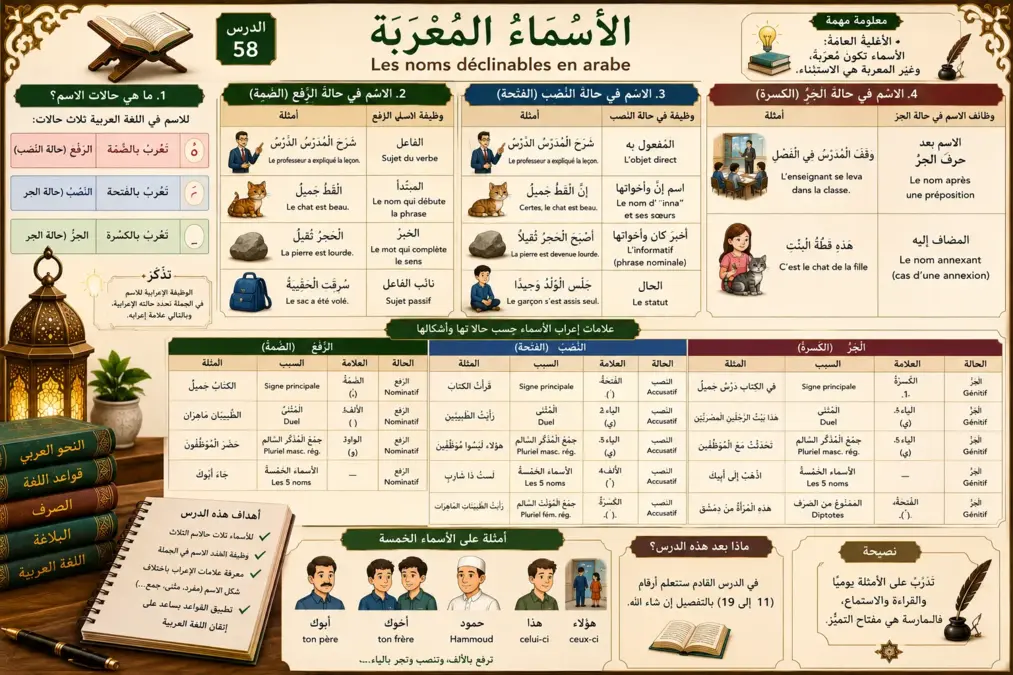
To progress in Arabic grammar, it is essential to understand declinable nouns. In Arabic, a declinable noun is called اسْمٌ مُعْرَبٌ. It is a noun whose ending can change according to its function in the sentence.
Most Arabic nouns are declinable. This means that their final vowel may change according to the grammatical case: nominative, accusative or genitive. This rule is fundamental for learning Arabic, reading sentences correctly and understanding the structure of the Arabic language.
This lesson is useful for Arabic for beginners, but also for students who want to strengthen their Arabic grammar, Arabic reading, Modern Standard Arabic or Quranic Arabic.
What Is a Declinable Noun in Arabic?
A declinable noun in Arabic is a noun whose final vowel changes according to its grammatical function. In Arabic, this variation is called declension, or الإِعْرَابُ.
For example, a noun can be a subject, a direct object, a noun after a preposition or part of an annexation structure. According to its function, it will take a different final mark.
The three basic marks are:
- ḍammah: ـُ;
- fatḥah: ـَ;
- kasrah: ـِ.
The Three Grammatical Cases in Arabic
In Arabic, declinable nouns can be in three main grammatical cases:
- nominative: الرَّفْعُ;
- accusative: النَّصْبُ;
- genitive: الجَرُّ.
Each case corresponds to certain functions in the sentence. To learn Arabic correctly, you must therefore understand the noun’s function before determining its ending.
The Nominative Case in Arabic
A noun is in the nominative case when it fulfills certain important functions in the sentence. The main sign of the nominative case is ḍammah.
The nominative case is used especially for:
- the subject of the verb: الْفَاعِلُ;
- the beginning of a nominal sentence: الْمُبْتَدَأُ;
- the information that completes the nominal sentence: الْخَبَرُ;
- the passive subject: نَائِبُ الْفَاعِلِ.
| Arabic Example | Translation | Function |
|---|---|---|
| شَرَحَ الْمُدَرِّسُ الدَّرْسَ | The teacher explained the lesson. | Subject of the verb |
| الْقِطُّ جَمِيلٌ | The cat is beautiful. | Beginning of a nominal sentence |
| الْحَجَرُ ثَقِيلٌ | The stone is heavy. | Predicate of the nominal sentence |
| سُرِقَتِ الْحَقِيبَةُ | The bag was stolen. | Passive subject |
The Accusative Case in Arabic
A noun is in the accusative case when it functions as a direct object or when it is affected by certain grammatical words. The main sign of the accusative case is fatḥah.
The accusative case is used especially for:
- the direct object: الْمَفْعُولُ بِهِ;
- the noun of إِنَّ and its sisters;
- the predicate of كَانَ and its sisters;
- the circumstantial state: الْحَالُ.
| Arabic Example | Translation | Function |
|---|---|---|
| شَرَحَ الْمُدَرِّسُ الدَّرْسَ | The teacher explained the lesson. | Direct object |
| إِنَّ الْقِطَّ جَمِيلٌ | Indeed, the cat is beautiful. | Noun of إِنَّ |
| أَصْبَحَ الْحَجَرُ ثَقِيلًا | The stone became heavy. | Predicate of أَصْبَحَ |
| جَلَسَ الْوَلَدُ وَحِيدًا | The boy sat alone. | Circumstantial state |
The Genitive Case in Arabic
A noun is in the genitive case when it comes after a preposition or when it is the second element of an annexation structure. The main sign of the genitive case is kasrah.
The genitive case is used especially for:
- the noun after a preposition: الاسْمُ بَعْدَ حَرْفِ الجَرِّ;
- the complement of annexation: الْمُضَافُ إِلَيْهِ.
| Arabic Example | Translation | Function |
|---|---|---|
| وَقَفَ الْمُدَرِّسُ فِي الْفَصْلِ | The teacher stood in the classroom. | Noun after a preposition |
| هَذِهِ قِطَّةُ الْبِنْتِ | This is the girl’s cat. | Complement of annexation |
Declension Marks of Arabic Nouns
In their basic form, nouns in the nominative case take ḍammah, nouns in the accusative case take fatḥah and nouns in the genitive case take kasrah.
However, some nouns take other signs according to their form. This includes the dual, the sound masculine plural, the sound feminine plural, the five nouns and certain diptotes.
| Case | Main Mark | Other Possible Marks | Example |
|---|---|---|---|
| Nominative | ḍammah | alif for the dual, wāw for the sound masculine plural and the five nouns | الْكِتَابُ جَمِيلٌ |
| Accusative | fatḥah | yā for the dual and sound masculine plural, alif for the five nouns, kasrah for the sound feminine plural | قَرَأْتُ الْكِتَابَ |
| Genitive | kasrah | yā for the dual, sound masculine plural and the five nouns, fatḥah for certain diptotes | فِي الْكِتَابِ دَرْسٌ |
Examples of Special Declension Marks
Here are some examples to help you understand special declension marks in Arabic.
| Form | Arabic Example | Translation | Mark |
|---|---|---|---|
| Dual in the nominative case | الطَّبِيبَانِ مَاهِرَانِ | The two doctors are skilled. | alif |
| Dual in the accusative case | رَأَيْتُ الطَّبِيبَيْنِ | I saw the two doctors. | yā |
| Sound masculine plural in the nominative case | حَضَرَ الْمُوَظَّفُونَ | The employees came. | wāw |
| Sound masculine plural in the genitive case | تَحَدَّثْتُ مَعَ الْمُوَظَّفِينَ | I spoke with the employees. | yā |
| Sound feminine plural in the accusative case | رَأَيْتُ الطَّبِيبَاتِ الْمَاهِرَاتِ | I saw the skilled female doctors. | kasrah |
| Diptote in the genitive case | هَذِهِ الْمَرْأَةُ مِنْ دِمَشْقَ | This woman is from Damascus. | fatḥah |
Why Learn Arabic Declension?
Arabic declension is an essential foundation for understanding the function of words in a sentence. It helps you know whether a noun is a subject, an object, a noun after a preposition or part of an annexation structure.
This topic is useful for students who want to:
- improve Arabic reading;
- progress in Arabic grammar;
- understand Modern Standard Arabic;
- analyze some structures found in Quranic Arabic;
- build correct Arabic sentences;
- gain confidence in Arabic for beginners.
To strengthen your foundations, you can start with our guide to learn Arabic online, review the Arabic alphabet or use our free Arabic books for beginners.
Learn Arabic Grammar with a Teacher
Declinable nouns and grammatical cases may seem difficult at first. However, with a progressive method, simple examples and regular correction, they become much clearer.
A private Arabic tutor can help you recognize noun functions, understand declension marks and read sentences accurately.
At Al-Dirassa, you can follow online Arabic classes with personalized learning. These classes are suitable for adults, children, beginners and students who want to progress in Modern Standard Arabic or Quranic Arabic.
To go further in understanding religious texts, you can also discover our Quranic Arabic course.
Book your free trial of 30 minutes
Registration form
Conclusion
Declinable nouns in Arabic change according to their function in the sentence. They can be in the nominative, accusative or genitive case. Each case has a main sign: ḍammah, fatḥah or kasrah.
This lesson helps you understand an important foundation of Arabic grammar. However, to learn Arabic completely, you need a clear method, regular practice and correction from a teacher.
With private Arabic lessons and progressive learning, you will be able to read, analyze and understand Arabic sentences with greater confidence.




No Comments
No comments yet.