
Arabic numbers from 11 to 19 are essential for understanding compound numbers and building simple sentences. They are used to talk about age, quantities, dates, prices, schedules and many everyday situations.
This lesson is useful for Arabic for beginners, but also for anyone who wants to strengthen their Arabic vocabulary, Arabic reading and Arabic grammar. Arabic numbers from 11 to 19 require special attention because their form often depends on the gender of the counted noun.
In this lesson, you will learn Arabic numbers from 11 to 19, the special rules for 11 and 12, masculine and feminine forms, and several simple examples.
Arabic Numbers from 11 to 19
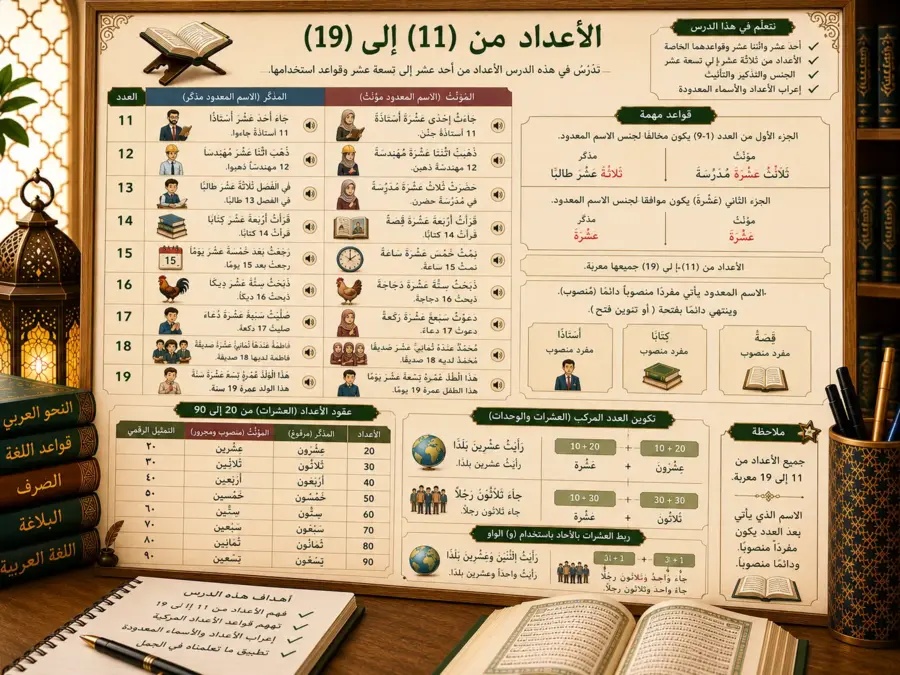
In Arabic, the numbers from 11 to 19 are compound numbers. They are generally built with a first part related to the unit and a second part related to the word “ten”.
The numbers 11 and 12 have specific rules. The numbers from 13 to 19 follow a different rule based on the relationship between the gender of the number and the gender of the counted noun.
Arabic Numbers from 11 to 19 Table
| Number | With a Masculine Noun | With a Feminine Noun |
|---|---|---|
| 11 | أَحَدَ عَشَرَ | إِحْدَى عَشْرَةَ |
| 12 | اِثْنَا عَشَرَ | اِثْنَتَا عَشْرَةَ |
| 13 | ثَلَاثَةَ عَشَرَ | ثَلَاثَ عَشْرَةَ |
| 14 | أَرْبَعَةَ عَشَرَ | أَرْبَعَ عَشْرَةَ |
| 15 | خَمْسَةَ عَشَرَ | خَمْسَ عَشْرَةَ |
| 16 | سِتَّةَ عَشَرَ | سِتَّ عَشْرَةَ |
| 17 | سَبْعَةَ عَشَرَ | سَبْعَ عَشْرَةَ |
| 18 | ثَمَانِيَةَ عَشَرَ | ثَمَانِيَ عَشْرَةَ |
| 19 | تِسْعَةَ عَشَرَ | تِسْعَ عَشْرَةَ |
Special Rules for 11 and 12
The numbers 11 and 12 follow a specific rule: both parts of the number generally agree with the gender of the counted noun.
Number 11 in Arabic
With a masculine noun, we use:
أَحَدَ عَشَرَ أُسْتَاذًا
eleven male teachers
With a feminine noun, we use:
إِحْدَى عَشْرَةَ أُسْتَاذَةً
eleven female teachers
Number 12 in Arabic
The number 12 also changes according to the gender of the counted noun:
اِثْنَا عَشَرَ مُهَنْدِسًا
twelve male engineers
اِثْنَتَا عَشْرَةَ مُهَنْدِسَةً
twelve female engineers
The number 12 also has specific forms according to grammatical case. This rule can be studied progressively with an Arabic teacher or in a more advanced Arabic grammar lesson.
Arabic Numbers from 13 to 19
Arabic numbers from 13 to 19 follow a different rule. The first part of the number usually has the opposite gender of the counted noun, while the second part has the same gender as the counted noun.
Example with a masculine noun:
ثَلَاثَةَ عَشَرَ طَالِبًا
thirteen students
Example with a feminine noun:
ثَلَاثَ عَشْرَةَ مُدَرِّسَةً
thirteen female teachers
For a more detailed explanation, you can read our lesson dedicated to Arabic numbers from 13 to 19.
The Counted Noun After Arabic Numbers from 11 to 19
The noun that follows Arabic numbers from 11 to 19 is generally singular and accusative. In Arabic grammar, it is described as مَنْصُوب.
Examples:
- أَحَدَ عَشَرَ أُسْتَاذًا: eleven teachers;
- إِحْدَى عَشْرَةَ أُسْتَاذَةً: eleven female teachers;
- اِثْنَا عَشَرَ مُهَنْدِسًا: twelve male engineers;
- ثَلَاثَةَ عَشَرَ طَالِبًا: thirteen students;
- تِسْعَ عَشْرَةَ سَنَةً: nineteen years.
Example Sentences with Arabic Numbers from 11 to 19
| Arabic Sentence | Translation | Note |
|---|---|---|
| جَاءَ أَحَدَ عَشَرَ أُسْتَاذًا | Eleven male teachers came. | Masculine noun |
| جَاءَتْ إِحْدَى عَشْرَةَ أُسْتَاذَةً | Eleven female teachers came. | Feminine noun |
| ذَهَبَ اِثْنَا عَشَرَ مُهَنْدِسًا | Twelve male engineers left. | Masculine noun |
| ذَهَبَتْ اِثْنَتَا عَشْرَةَ مُهَنْدِسَةً | Twelve female engineers left. | Feminine noun |
| قَرَأْتُ أَرْبَعَةَ عَشَرَ كِتَابًا | I read fourteen books. | Masculine noun |
| نِمْتُ خَمْسَ عَشْرَةَ سَاعَةً | I slept fifteen hours. | Feminine noun |
| مُحَمَّدٌ عِنْدَهُ ثَمَانِيَةَ عَشَرَ صَدِيقًا | Muhammad has eighteen friends. | Masculine noun |
| هَذَا الوَلَدُ عُمْرُهُ تِسْعَ عَشْرَةَ سَنَةً | This boy is nineteen years old. | Feminine noun |
Introduction to Arabic Tens
After Arabic numbers from 11 to 19, the next step is to learn Arabic tens: 20, 30, 40, 50, 60, 70, 80 and 90.
Arabic tens follow another grammar rule: they end with ـونَ in the nominative case and with ـينَ in the accusative and genitive cases.
Examples:
- عِشْرُونَ طَالِبًا: twenty students;
- ثَلَاثُونَ رَجُلًا: thirty men;
- عِشْرِينَ بَلَدًا: twenty countries.
Why Learn Arabic Numbers?
Numbers are essential when learning Arabic. They allow students to talk about age, time, prices, dates, quantities, schedules and many daily situations.
Mastering Arabic numbers from 11 to 19 helps students:
- strengthen Arabic vocabulary;
- improve Arabic reading;
- understand masculine and feminine grammar rules;
- progress in Arabic grammar;
- use Arabic numbers in complete sentences;
- prepare for the study of tens, hundreds and thousands.
To strengthen your foundations, you can start with our guide to learn Arabic online, review the Arabic alphabet or use our free Arabic books for beginners.
Learn Arabic Numbers with a Teacher
Arabic numbers require practice because their form changes according to the gender of the counted noun and according to certain Arabic grammar rules. A private Arabic tutor can help you understand these rules, correct your Arabic pronunciation and teach you how to use numbers in real sentences.
At Al-Dirassa, you can follow online Arabic classes with personalized learning. These classes are suitable for adults, children, beginners and students who want to progress in Modern Standard Arabic or Quranic Arabic.
For younger learners, you can also discover our Arabic classes for kids, adapted to their age, level and learning rhythm.
Book your free trial of 30 minutes
Registration form
Conclusion
Arabic numbers from 11 to 19 are essential for understanding compound numbers. The numbers 11 and 12 have special rules, while numbers from 13 to 19 follow a rule related to the gender of the counted noun.
This lesson helps you understand a precise topic in Arabic numbers, but complete Arabic learning requires method, regular practice and correction from a teacher.
With private Arabic lessons and progressive learning, you will be able to read, understand and use Arabic numbers more confidently in your sentences and conversations.



No Comments
No comments yet.