
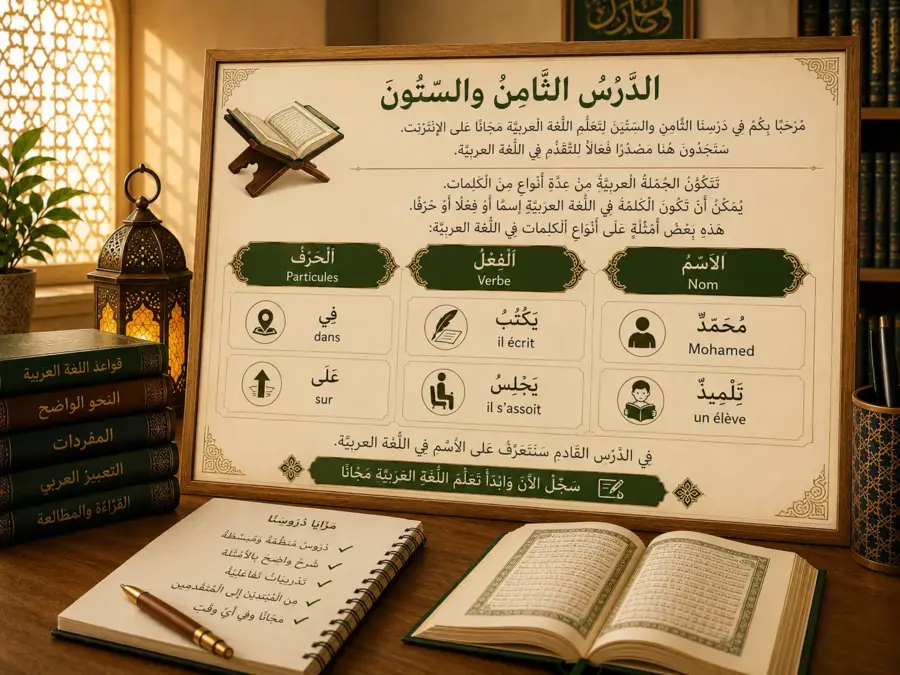
To learn Arabic correctly, it is essential to understand how words are classified in a sentence. In Arabic grammar, every word generally belongs to one of three main categories: a noun, a verb or a particle.
This distinction is a fundamental step for Arabic for beginners, but also for students who want to improve their Arabic reading, Arabic grammar, Modern Standard Arabic or Quranic Arabic.
In this lesson, you will learn the difference between الاسم, الفعل and الحرف with simple examples.
Understanding the Three Types of Words in Arabic
In Arabic, a word can be:
- a noun: الاسم
- a verb: الفعل
- a particle: الحرف
This classification helps students understand how Arabic sentences are built. It also helps learners analyze texts, read words correctly and form simple Arabic sentences.
For example, in an Arabic sentence, you need to identify who performs the action, what action is taking place and which words connect the elements together.
Arabic Nouns: الاسم
An Arabic noun, called الاسم, refers to a person, object, place, idea, quality or living being. A noun is not directly connected to time.
Here are some examples:
- مُحَمَّدٌ: Muhammad
- تِلْمِيذٌ: a student
- كِتَابٌ: a book
- بَيْتٌ: a house
A noun can be used as a subject, an object or a descriptive element in a sentence.
مُحَمَّدٌ تِلْمِيذٌ
Muhammad is a student.
In this sentence, مُحَمَّدٌ and تِلْمِيذٌ are both nouns.
Arabic Verbs: الفعل
An Arabic verb, called الفعل, expresses an action connected to time. It may refer to the past, the present, the future or an imperative command.
Here are some examples:
- كَتَبَ: he wrote
- يَكْتُبُ: he writes
- جَلَسَ: he sat down
- يَجْلِسُ: he sits down
The verb is very important in Arabic lessons online because it changes according to tense, person, gender and number. This is why Arabic verb conjugation is a key part of Arabic grammar.
يَكْتُبُ مُحَمَّدٌ
Muhammad writes.
In this sentence, يَكْتُبُ is the verb because it expresses the action of writing.
Arabic Particles: الحرف
An Arabic particle, called الحرف, is a word that usually does not have a complete meaning when used alone. It often connects words, clarifies a relationship or changes the meaning of a sentence.
Here are some common Arabic particles:
- فِي: in
- عَلَى: on
- مِنْ: from
- إِلَى: to, towards
Example:
الْكِتَابُ عَلَى الطَّاوِلَةِ
The book is on the table.
In this sentence, عَلَى is a particle. It shows the relationship between the book and the table.
Comparison Table: Nouns, Verbs and Particles in Arabic
| Word Type | Arabic Name | Function | Example | Meaning |
|---|---|---|---|---|
| Noun | الاسم | Refers to a person, thing, place or idea | كِتَابٌ | a book |
| Verb | الفعل | Expresses an action connected to time | يَكْتُبُ | he writes |
| Particle | الحرف | Connects words or clarifies meaning | فِي | in |
How to Identify Each Type of Word in Arabic
How to Recognize an Arabic Noun
An Arabic noun can often be preceded by the definite article ال. It may also refer to a person, an object, a place or an abstract idea.
Examples:
- الْبَيْتُ: the house
- الطَّالِبُ: the student
- الْقَلَمُ: the pen
How to Recognize an Arabic Verb
A verb expresses an action. It can change according to tense: past, present or imperative. To learn Arabic online effectively, students should practise verb forms regularly with clear examples.
Examples:
- قَرَأَ: he read
- يَقْرَأُ: he reads
- اِقْرَأْ: read
How to Recognize an Arabic Particle
A particle usually establishes a relationship between words. It can indicate place, direction, origin, negation or logical connection.
Examples:
- فِي الْبَيْتِ: in the house
- مِنَ الْمَدْرَسَةِ: from the school
- إِلَى الْمَسْجِدِ: to the mosque
Why This Distinction Matters When Learning Arabic
Understanding the difference between nouns, verbs and particles helps learners read, translate and build Arabic sentences more accurately. It is an essential foundation for improving Arabic vocabulary, Arabic pronunciation and Arabic grammar.
This lesson is especially useful for:
- adults starting Arabic classes for adults;
- children beginning Arabic classes for kids;
- students learning Modern Standard Arabic;
- learners who want to understand Quranic Arabic;
- beginners who want to improve their Arabic reading.
If you are just starting, you can continue with our guide to learn Arabic online, our lesson on the Arabic alphabet and our free Arabic books for beginners.
Learn Arabic Grammar with a Teacher
Arabic grammar becomes easier when it is explained step by step. A private Arabic tutor can help you identify words, correct your Arabic reading, improve your Arabic pronunciation and guide you in building correct sentences.
At Al-Dirassa, you can follow online Arabic classes with personalized learning. These courses are suitable for adults, beginners and students who want to progress in Modern Standard Arabic or Quranic Arabic.
For younger learners, Al-Dirassa also offers Arabic classes for kids, adapted to their age, level and learning rhythm.
Book your free trial of 30 minutes
Registration form
Conclusion
In Arabic, words are mainly divided into three categories: nouns, verbs and particles. A noun refers to a person, thing or idea. A verb expresses an action connected to time. A particle connects words or clarifies the meaning of a sentence.
This lesson helps you understand an essential concept in Arabic grammar. However, to learn Arabic completely, you need a clear method, regular practice, suitable exercises and correction from an Arabic teacher online.
With progressive learning and private Arabic lessons, you will be able to read, understand and use Arabic more confidently in your studies, religious learning or daily life.



No Comments
No comments yet.