
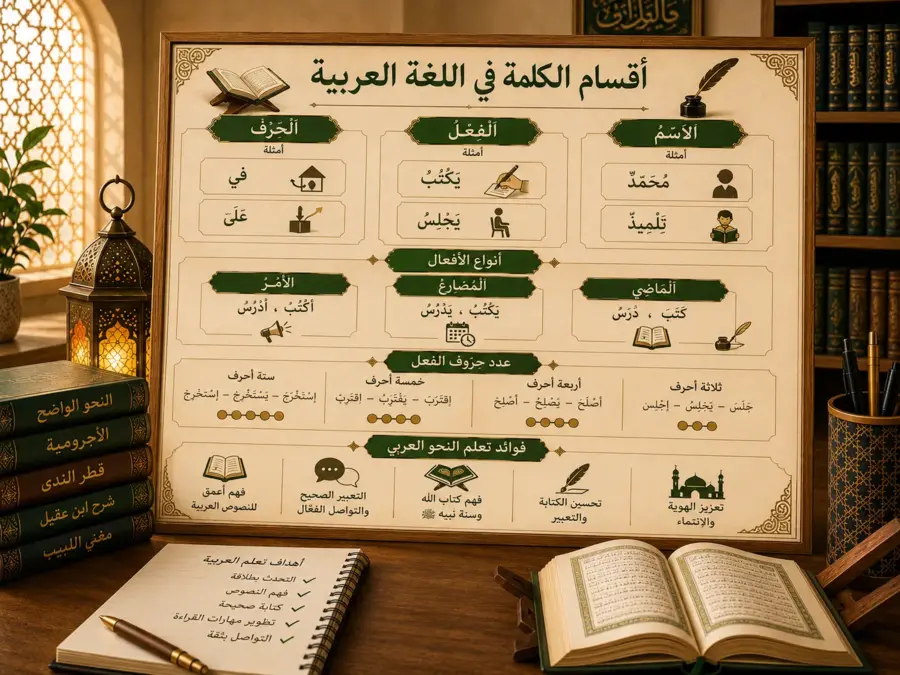
To learn Arabic correctly, it is essential to understand the different types of verbs. In Arabic, a verb is called الفِعْلُ. It expresses an action connected to time or a command.
This lesson introduces the three main forms of Arabic verbs: the past tense, the present tense and the imperative. It is useful for Arabic for beginners, but also for students who want to improve their Arabic grammar, Arabic reading, Modern Standard Arabic or Quranic Arabic.
Understanding these three forms will help you recognize verbs in Arabic sentences, expand your Arabic vocabulary and build a strong foundation in Arabic verb conjugation.
Understanding the Types of Arabic Verbs
In Arabic, verbs mainly appear in three forms:
- the past tense: الفِعْلُ المَاضِي
- the present tense: الفِعْلُ المُضَارِعُ
- the imperative: فِعْلُ الأَمْرِ
These three forms allow learners to express an action that has already happened, an action that is happening or repeated, or a command addressed to someone.
The Past Tense in Arabic: الفِعْلُ المَاضِي
The past tense in Arabic indicates that an action has already taken place. In English, it usually corresponds to verbs such as “he wrote”, “he studied” or “he sat down”.
Examples:
- كَتَبَ: he wrote
- دَرَسَ: he studied
- جَلَسَ: he sat down
- نَامَ: he slept
In Arabic verb conjugation, the past tense is a very important base form. Many Arabic dictionaries present verbs using their past tense form.
The Present Tense in Arabic: الفِعْلُ المُضَارِعُ
The present tense in Arabic indicates an action that is happening, repeated or expected in the future, depending on the context. It can correspond to the English present tense, but sometimes also to the future.
Examples:
- يَكْتُبُ: he writes
- يَدْرُسُ: he studies
- يَجْلِسُ: he sits down
- يَنَامُ: he sleeps
The present tense is often recognized by a letter added at the beginning of the verb, such as ي, ت, أ or ن. These letters help indicate who performs the action.
The Imperative in Arabic: فِعْلُ الأَمْرِ
The imperative in Arabic is used to give an order, instruction or direct request. It is generally addressed to the second person.
Examples:
- اُكْتُبْ: write
- اُدْرُسْ: study
- اِجْلِسْ: sit down
- نَمْ: sleep
The imperative is useful in everyday communication, Arabic grammar exercises and the understanding of many expressions found in Arabic texts.
Comparison Table: Past, Present and Imperative Arabic Verbs
| Verb | Past | Present | Imperative | Meaning |
|---|---|---|---|---|
| To write | كَتَبَ | يَكْتُبُ | اُكْتُبْ | to write |
| To study | دَرَسَ | يَدْرُسُ | اُدْرُسْ | to study |
| To sit down | جَلَسَ | يَجْلِسُ | اِجْلِسْ | to sit down |
| To sleep | نَامَ | يَنَامُ | نَمْ | to sleep |
Arabic Verb Roots
In Arabic, many verbs are built from a root. This root may consist of three, four, five or six letters. The number of letters can influence the form of the verb in the present tense or imperative.
Here are some examples:
| Number of Letters | Past | Present | Imperative | Meaning |
|---|---|---|---|---|
| Three letters | جَلَسَ | يَجْلِسُ | اِجْلِسْ | to sit down |
| Four letters | أَصْلَحَ | يُصْلِحُ | أَصْلِحْ | to reform |
| Five letters | اِقْتَرَبَ | يَقْتَرِبُ | اِقْتَرِبْ | to approach |
| Six letters | اِسْتَخْرَجَ | يَسْتَخْرِجُ | اِسْتَخْرِجْ | to extract |
For a beginner, it is not necessary to master all Arabic verb patterns immediately. The first goal is to recognize the three main forms: past, present and imperative.
Why Learn Arabic Verbs Step by Step?
Arabic verb conjugation may seem difficult at first because the verb changes according to person, gender, number and tense. However, with a clear method, learning becomes much easier.
Progressive learning helps students:
- recognize verbs in Arabic sentences more easily;
- improve Arabic reading and text comprehension;
- expand Arabic vocabulary;
- build correct Arabic sentences;
- progress in Modern Standard Arabic;
- better understand some structures used in Quranic Arabic.
If you are starting your learning journey, you can also continue with our guide to learn Arabic online, our page on the Arabic alphabet and our free Arabic books for beginners.
Learn Arabic Verb Conjugation with a Teacher
Arabic verb conjugation requires practice, repetition and regular correction. A private Arabic tutor can help you understand verb forms, improve your Arabic pronunciation and use verbs in complete sentences.
At Al-Dirassa, you can follow online Arabic classes with personalized learning. These classes are suitable for adults, children, beginners and students who want to progress in Modern Standard Arabic or Quranic Arabic.
Younger learners can also join Arabic classes for kids, adapted to their age, level and learning rhythm.
Book your free trial of 30 minutes
Registration form
Conclusion
The three main types of Arabic verbs are the past tense, the present tense and the imperative. The past tense expresses an action that has already happened, the present tense indicates an action that is happening or repeated, and the imperative is used to give an order or instruction.
This lesson helps you understand an essential point of Arabic grammar. However, to learn Arabic completely, you need a structured method, regular practice and correction from an Arabic teacher online.
With private Arabic lessons and progressive learning, you will be able to recognize verbs more easily, build correct sentences and move forward with confidence in your study of the Arabic language.



No Comments
No comments yet.