
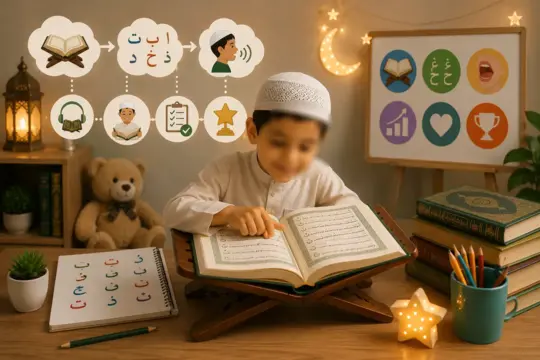
Teaching the Quran to children is an important concern for many Muslim parents. They want their children to build a living connection with the Book of Allah while developing strong foundations in Arabic reading, recitation, Tajweed and memorization.
However, Quran learning for children should not be approached in the same way as adult learning. A child needs a progressive method, an adapted pace, encouragement, repetition and a teacher who can make lessons simple and motivating.
In this article, we will explain how children can learn the Quran step by step, which foundations should come first, how to approach recitation and Tajweed, and how to organize online Quran classes adapted to their age and level.
Why Should Children Learn the Quran?
Learning the Quran helps children build a positive relationship with their religion. They gradually discover Arabic reading, recitation, memorization of short surahs and essential teachings related to conduct and faith.
For a child, the goal is not only to repeat words. It is also to learn with respect, attention and love for the Quran. A good method can help the child progress without excessive pressure.
Quran classes for kids can support this progression with a program adapted to each student’s age, level and pace.
At What Age Can a Child Start?
There is no single age that applies to all children. Some can begin very early with listening, repetition of short surahs and recognition of Arabic letters. Others may need to wait until they are more comfortable with concentration and reading.
For younger children, sessions should remain short, simple and encouraging. It is better to build a positive habit than to impose a heavy program.
A child can start with:
- listening to short surahs;
- repeating with a parent or teacher;
- recognizing some Arabic letters;
- learning simple vowels;
- memorizing short passages gradually;
- associating learning with regular and pleasant moments.
What Foundations Should Come First?
Before reading long Quran passages, a child needs to build strong foundations. These foundations include the Arabic alphabet, sounds, vowels and reading signs.
Recognizing Arabic Letters
The first step is to recognize Arabic letters. The child learns to distinguish letters, their shapes and their sounds. Some letters look similar, so they need to be practiced with patience and repetition.
An Arabic alphabet free course can help children begin with the letters before moving to Quran reading.
Reading Vowels and Reading Signs
After letters, the child discovers short vowels such as Fatha, Kasra and Damma. Then, they gradually learn Sukoon, Shaddah, Tanween and other signs used for correct reading.
These elements are necessary for reading Quranic words without depending only on phonetic transliteration.
Working on Pronunciation Gradually
Pronunciation is an important step. Some Arabic sounds may be difficult for non-Arabic speaking children. They should be corrected gently and through repetition.
A child should not feel discouraged by mistakes. Corrections should be simple, regular and adapted to their age.
How to Teach Quran Recitation to Children
Quran recitation requires listening, repetition and oral correction. A child can listen to a short passage, repeat it phrase by phrase, then read it with the teacher’s help.
It is better to begin with short and familiar passages. The teacher can then help the child improve fluency, pauses, sounds and reading accuracy.
To learn Quran, progression should be slow and regular. Clear reading is better than fast but incorrect reading.
Tajweed for Kids: How to Introduce It Simply
Tajweed helps students recite the Quran with precision. For children, it should not begin with explanations that are too technical. Rules should be introduced gradually through practice.
For example, a child can first learn how to pronounce certain letters correctly, lengthen some sounds or pay attention to pauses. Technical terms can come later, when the child is ready.
Tajweed lessons online can introduce these rules step by step, with exercises adapted to the child’s level.
Quran Memorization: Progressing without Pressure
Quran memorization can be beneficial for children, but it should remain adapted to their ability. It is better to memorize a small amount correctly, with good recitation and regular revision.
A simple method can include:
- listening to the passage several times;
- repeating verse by verse;
- correcting pronunciation;
- revising the passage the next day;
- returning often to surahs already learned;
- avoiding too many new verses without revision.
A Quran memorization program should always include a strong revision component, especially for children.
How to Motivate a Child to Learn Quran
A child’s motivation depends greatly on the learning atmosphere. If lessons become a source of stress, the child may become resistant. If learning is progressive, positive and regular, the child can develop a more natural connection with the Quran.
Here are some useful tips:
- set short and achievable goals;
- praise efforts, not only results;
- avoid comparisons with other children;
- choose a lesson duration adapted to the child;
- revise regularly without overload;
- connect learning to a calm moment;
- keep positive communication with the teacher.
Every child progresses at their own pace. Consistency is often more important than quantity.
Why Choose a Qualified Teacher?
A qualified teacher can adapt the method to the child’s age, reading level and concentration. They know how to correct without discouraging, explain simply and build a realistic progression.
For non-Arabic speaking children, guidance is especially important. The teacher helps distinguish Arabic sounds, read signs correctly and avoid bad habits from the beginning.
With online Quran classes, children can learn from home in a more flexible setting while receiving personalized support.
Book your free trial of 30 minutes
Registration form
How to Organize Online Quran Classes for Kids
Online classes should be organized simply. For a child, it is better to schedule regular sessions adapted to their age. A lesson that is too long may reduce concentration.
A good organization can include:
- a fixed weekly schedule;
- a duration adapted to the child’s age;
- a small goal for each class;
- revision time between sessions;
- tracking frequent mistakes;
- communication between parents and teacher.
Online courses for children should take into account the child’s rhythm, needs and family environment.
Common Mistakes to Avoid
When parents want their child to learn the Quran, some mistakes can slow progress or create resistance to learning.
- starting with sessions that are too long;
- wanting the child to memorize too quickly;
- neglecting pronunciation;
- correcting too harshly;
- comparing the child with other students;
- changing methods constantly;
- forgetting revision;
- not adapting the lesson to the child’s age.
Successful learning is based on patience, regularity, encouragement and gradual correction.
Conclusion: Building a Positive Connection with the Quran
Teaching the Quran to children requires an adapted method. The child should progress gradually in Arabic reading, recitation, Tajweed and memorization, without excessive pressure and with caring guidance.
With simple goals, regular sessions, a qualified teacher and good communication with parents, children can build a positive relationship with the Quran and progress according to their level.




No Comments
No comments yet.