
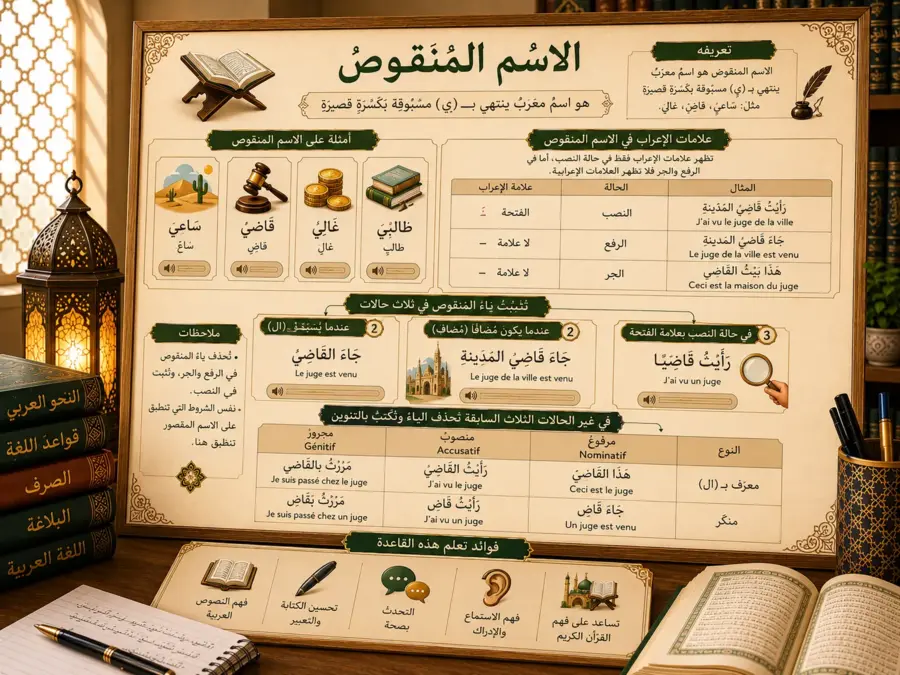
To improve your Arabic grammar, it is important to understand the different forms of Arabic nouns. One of these forms is the manqus noun, called الاسْمُ المَنْقُوصُ in Arabic.
This lesson is useful for Arabic for beginners, but also for students who want to strengthen their Arabic reading, Arabic grammar, Modern Standard Arabic or Quranic Arabic.
The manqus noun has a specific ending and precise declension rules. Understanding this concept will help you read Arabic words more accurately, recognize their function in a sentence and progress in learning Arabic.
What Is a Manqus Noun in Arabic?
A manqus noun, اسْمٌ مَنْقُوصٌ, is a declinable noun that ends with the letter ي, called ya, preceded by a kasrah.
In other words, the manqus noun usually ends with a long -ī sound.
Examples:
- قَاضِي: judge
- سَاعِي: one who seeks or strives
- غَالِي: expensive, precious
- نَادِي: club
This rule applies to Arabic nouns ending with ya preceded by kasrah. It is close to some rules studied with the maqsour noun, but the behavior of the final letter is different.
Why Is the Manqus Noun Particular?
The manqus noun is particular because the declension marks are not always visible at the end of the word. In Arabic, a noun can be in the nominative, accusative or genitive case.
With the manqus noun, the fatḥah appears in the accusative case. However, the ḍammah in the nominative case and the kasrah in the genitive case are often implied, meaning that they are not clearly pronounced at the end of the word.
Declension of the Manqus Noun
The manqus noun is declined according to its grammatical function in the sentence. Here are the three main cases:
- nominative: when it is a subject or predicate;
- accusative: when it is a direct object or used in certain constructions;
- genitive: after a preposition or in an annexation structure.
| Case | Arabic Example | Translation | Note |
|---|---|---|---|
| Nominative | جَاءَ قَاضِي الْمَدِينَةِ | The judge of the city came. | The ḍammah is implied. |
| Accusative | رَأَيْتُ قَاضِيَ الْمَدِينَةِ | I saw the judge of the city. | The fatḥah appears. |
| Genitive | هَذَا بَيْتُ الْقَاضِي | This is the house of the judge. | The kasrah is implied. |
When Is the Ya Kept in the Manqus Noun?
The letter ي in the manqus noun is kept in several important situations.
When the noun is defined by ال
When the manqus noun is preceded by the definite article ال, the ya is kept.
جَاءَ الْقَاضِي
The judge came.
When the noun is in annexation
The ya is also kept when the manqus noun is in annexation, meaning when it is مُضَافٌ.
جَاءَ قَاضِي الْمَدِينَةِ
The judge of the city came.
When the noun is in the accusative case
In the accusative case, the fatḥah appears and the ya is generally kept.
رَأَيْتُ قَاضِيًا
I saw a judge.
When Is the Ya Removed?
In some cases, the final letter ي of the manqus noun is removed. This happens when the noun is indefinite, not in annexation and not in the accusative case.
Examples:
| Case | Arabic Form | Translation | Explanation |
|---|---|---|---|
| Nominative | هَذَا قَاضٍ | This is a judge. | The ya is removed. |
| Genitive | مَرَرْتُ بِنَادٍ كَبِيرٍ | I passed by a large club. | The ya is removed. |
| Accusative | رَأَى أَخِي نَادِيًا كَبِيرًا | My brother saw a large club. | The ya is kept. |
Summary Table of the Manqus Noun
| Situation | Nominative | Accusative | Genitive |
|---|---|---|---|
| Defined by ال | الْقَاضِي | الْقَاضِيَ | الْقَاضِي |
| In annexation | قَاضِي الْمَدِينَةِ | قَاضِيَ الْمَدِينَةِ | قَاضِي الْمَدِينَةِ |
| Indefinite, not in annexation | قَاضٍ | قَاضِيًا | قَاضٍ |
Why This Rule Matters When Learning Arabic
The manqus noun is a precise grammar topic, but it helps learners understand the logic of Arabic. It teaches how to recognize endings, read words correctly and understand their role in a sentence.
This rule is useful for students who want to:
- improve Arabic reading;
- strengthen Arabic grammar;
- understand Arabic declension;
- progress in Modern Standard Arabic;
- analyze some structures found in Quranic Arabic;
- build confidence in Arabic for beginners.
If you are just starting, you can begin with our guide to learn Arabic online, review the Arabic alphabet and download our free Arabic books for beginners.
Learn Arabic Grammar with a Teacher
The rules of the manqus noun become easier when they are explained progressively. A private Arabic tutor can help you understand declension, recognize noun forms and correct your Arabic reading.
At Al-Dirassa, you can follow online Arabic classes with personalized learning. These classes are suitable for adults, children, beginners and students who want to progress in Modern Standard Arabic or Quranic Arabic.
To go further in understanding religious texts, you can also discover our Quranic Arabic course.
Book your free trial of 30 minutes
Registration form
Conclusion
The manqus noun in Arabic is a declinable noun that ends with ya preceded by a kasrah. Its particular feature is that the ya can be kept or removed depending on whether the noun is defined, in annexation, indefinite or in the accusative case.
This lesson helps you understand an important rule of Arabic grammar. However, to learn Arabic completely, you need a clear method, regular practice and correction from an Arabic teacher online.
With private Arabic lessons and progressive learning, you will be able to read, analyze and understand Arabic texts with greater confidence.



No Comments
No comments yet.