
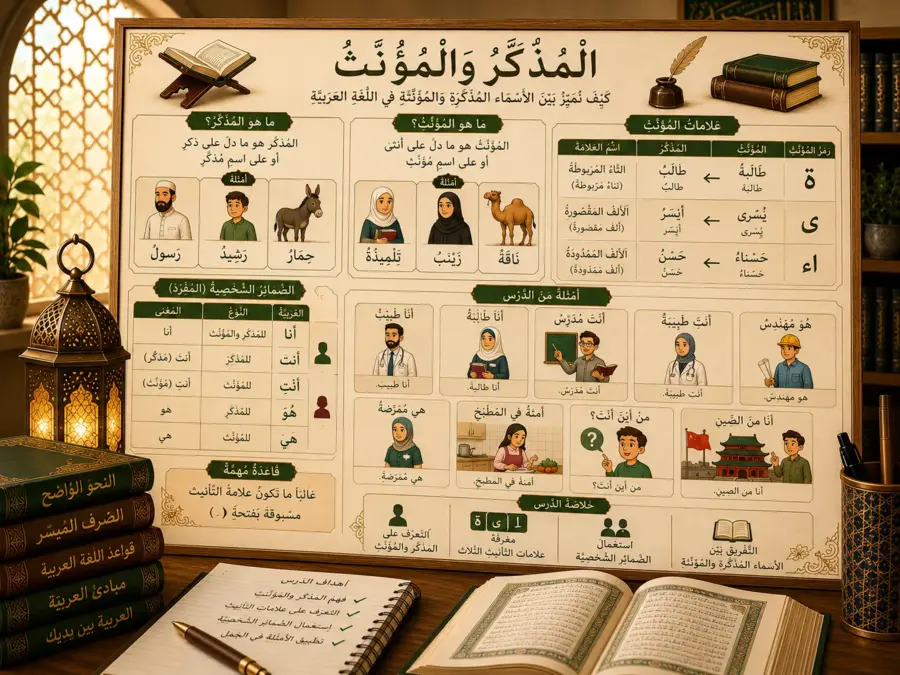
In this Arabic grammar lesson, we will study masculine and feminine nouns in Arabic, known as الْمُذَكَّرُ وَالْمُؤَنَّثُ. This topic is essential for students who want to learn Arabic online, understand nouns, use pronouns correctly and build simple Arabic sentences.
In Arabic, nouns can be masculine or feminine. The gender of a noun often affects pronouns, adjectives and sentence structure. This is why this rule is important for Arabic beginners, Modern Standard Arabic and Arabic grammar.
What Are Masculine and Feminine Nouns in Arabic?
The masculine in Arabic is called الْمُذَكَّرُ. It usually refers to a male person or animal, but it can also refer to objects, places or ideas that are grammatically masculine in Arabic.
The feminine in Arabic is called الْمُؤَنَّثُ. It usually refers to a female person or animal, but it can also refer to objects, places or ideas that are grammatically feminine.
It is important to understand that grammatical gender in Arabic does not always correspond to gender in English. Some words must therefore be learned gradually with vocabulary.
Masculine Nouns in Arabic
A masculine noun can refer to a man, a male animal, an object or an idea considered masculine in Arabic.
Examples:
- طَالِبٌ: a male student;
- رَسُولٌ: a messenger;
- رَشِيدٌ: Rashid;
- حِمَارٌ: a donkey.
Feminine Nouns in Arabic
A feminine noun can refer to a woman, a female animal, an object or an idea considered feminine in Arabic.
Examples:
- طَالِبَةٌ: a female student;
- زَيْنَبُ: Zaynab;
- نَاقَةٌ: a she-camel;
- طَبِيبَةٌ: a female doctor.
Feminine Markers in Arabic
In Arabic, the feminine can be marked by certain endings placed at the end of the word. The three main feminine markers are:
- ة: the ta marbuta;
- ى: the alif maqsura;
- اء: the alif mamduda.
The Ta Marbuta ة
The تَاءٌ مَرْبُوطَةٌ is one of the most common feminine markers in Arabic.
| Masculine | Feminine | Translation |
|---|---|---|
| طَالِبٌ | طَالِبَةٌ | Male student / female student |
| طَبِيبٌ | طَبِيبَةٌ | Male doctor / female doctor |
| مُدَرِّسٌ | مُدَرِّسَةٌ | Male teacher / female teacher |
The Alif Maqsura ى
The alif maqsura ى can also mark certain feminine forms.
| Masculine | Feminine | Translation |
|---|---|---|
| أَيْسَرُ | يُسْرَى | Left, masculine and feminine forms |
The Alif Mamduda اء
The alif mamduda اء can also be a feminine marker.
| Masculine | Feminine | Translation |
|---|---|---|
| حَسَنٌ | حَسْنَاءُ | Good / beautiful, masculine and feminine forms |
Masculine and Feminine Personal Pronouns
Gender is also visible in Arabic personal pronouns. Some pronouns change depending on whether you are speaking to a man or a woman, or speaking about a man or a woman.
| English | Gender | Arabic |
|---|---|---|
| I | Masculine and feminine | أَنَا |
| You | Masculine | أَنْتَ |
| You | Feminine | أَنْتِ |
| He | Masculine | هُوَ |
| She | Feminine | هِيَ |
Sentence Examples with Masculine and Feminine Forms
Here are some simple sentences to observe the difference between masculine and feminine forms in Arabic:
- أَنَا طَبِيبٌ: I am a male doctor;
- أَنَا طَالِبَةٌ: I am a female student;
- أَنْتَ مُدَرِّسٌ: you are a male teacher;
- أَنْتِ طَبِيبَةٌ: you are a female doctor;
- هُوَ مُهَنْدِسٌ: he is an engineer;
- هِيَ مُمَرِّضَةٌ: she is a nurse.
We can see that the feminine is often marked by the ta marbuta ة, but this is not always the case. This is why it is important to learn Arabic words with their gender.
Additional Examples
Here are more useful examples for Arabic reading and sentence construction:
- آمِنَةُ فِي الْمَطْبَخِ: Amina is in the kitchen;
- مِنْ أَيْنَ أَنْتَ؟: where are you from?
- أَنَا مِنَ الصِّينِ: I am from China.
How to Memorize Arabic Gender
To memorize masculine and feminine nouns in Arabic, it is useful to learn nouns with complete examples rather than in isolation.
For example:
- طَالِبٌ جَدِيدٌ: a new male student;
- طَالِبَةٌ جَدِيدَةٌ: a new female student;
- مُدَرِّسٌ مَاهِرٌ: a skilled male teacher;
- مُدَرِّسَةٌ مَاهِرَةٌ: a skilled female teacher.
This method helps you improve Arabic vocabulary, Arabic grammar, Arabic pronunciation and Modern Standard Arabic.
Learn Arabic Grammar with a Teacher
Understanding masculine and feminine forms is essential for students who want to learn Arabic online, use pronouns correctly and make words agree properly in a sentence.
To continue your learning, you can follow our online Arabic classes, study through our Modern Standard Arabic online lessons, review the Arabic alphabet or download our free Arabic books for beginners.
Book your free trial of 30 minutes
Registration form
Conclusion
In this lesson, we studied masculine and feminine nouns in Arabic. We learned that some words are masculine, others are feminine, and that feminine forms can be marked by ة, ى or اء.
This rule helps you better understand Arabic nouns, pronouns and agreement. However, to learn Arabic correctly, you need a progressive method, regular practice and correction from a qualified Arabic teacher.



No Comments
No comments yet.