
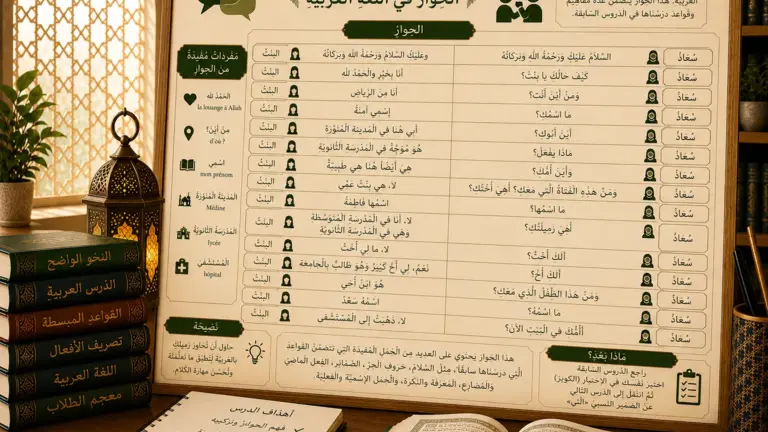
In this Arabic lesson, we will study an Arabic dialogue for beginners. A dialogue is called الحِوَارُ in Arabic, and it is an excellent way to review Arabic vocabulary, simple questions, personal pronouns, prepositions and basic Arabic grammar.
This lesson brings together several important topics: Arabic greetings, personal introduction, origin, family, school, professions and the Arabic past tense. It is especially useful for students learning Arabic for beginners who want to improve Arabic reading, Arabic pronunciation and sentence comprehension.
The dialogue is presented in Arabic with English translation to help you understand each sentence step by step.
Learning with an Arabic Dialogue
Studying a dialogue is very useful when you want to learn Arabic, because it allows you to see words and grammar rules in a real context. Instead of learning only isolated vocabulary lists, students discover how Arabic words are used in a conversation.
In this dialogue, you will find several common structures:
- Arabic greetings;
- questions with مَا, أَيْنَ, مَنْ and كَيْفَ;
- personal pronouns such as أَنَا, هُوَ and هِيَ;
- prepositions such as مِنْ, فِي and مَعَ;
- family vocabulary in Arabic;
- simple sentences in the present and past tense.
Useful Vocabulary Before the Dialogue
Before reading the dialogue, here are some important words to know.
| Arabic | Simple transcription | Translation |
|---|---|---|
| الحِوَارُ | al-hiwar | the dialogue |
| البِنْتُ | al-bint | the girl |
| أَبٌ | ab | a father |
| أُمٌّ | umm | a mother |
| أُخْتٌ | ukht | a sister |
| أَخٌ | akh | a brother |
| طَالِبٌ | talib | a student |
| طَبِيبَةٌ | tabibah | a female doctor |
Arabic Dialogue with English Translation
Here is the full dialogue in Arabic with its English translation. First, read the Arabic sentences, then check the meaning with the English translation.
| Arabic | English |
|---|---|
| سُعَادُ: السَّلَامُ عَلَيْكِ وَرَحْمَةُ اللهِ وَبَرَكَاتُهُ | Souad: Peace be upon you, and the mercy of Allah and His blessings. |
| البِنْتُ: وَعَلَيْكِ السَّلَامُ وَرَحْمَةُ اللهِ وَبَرَكَاتُهُ | The girl: And peace be upon you too, and the mercy of Allah and His blessings. |
| سُعَادُ: كَيْفَ حَالُكِ يَا بِنْتُ؟ | Souad: How are you, young girl? |
| البِنْتُ: أَنَا بِخَيْرٍ وَالْحَمْدُ للهِ | The girl: I am well, and praise belongs to Allah. |
| سُعَادُ: وَمِنْ أَيْنَ أَنْتِ؟ | Souad: And where are you from? |
| البِنْتُ: أَنَا مِنَ الرِّيَاضِ | The girl: I am from Riyadh. |
| سُعَادُ: مَا اسْمُكِ؟ | Souad: What is your name? |
| البِنْتُ: اسْمِي آمِنَةُ | The girl: My name is Aminah. |
| سُعَادُ: أَيْنَ أَبُوكِ؟ | Souad: Where is your father? |
| البِنْتُ: أَبِي هُنَا فِي الْمَدِينَةِ الْمُنَوَّرَةِ | The girl: My father is here in Madinah. |
| سُعَادُ: مَاذَا يَفْعَلُ؟ | Souad: What does he do? |
| البِنْتُ: هُوَ مُوَجِّهٌ فِي الْمَدْرَسَةِ الثَّانَوِيَّةِ | The girl: He is a supervisor at the secondary school. |
| سُعَادُ: وَأَيْنَ أُمُّكِ؟ | Souad: And where is your mother? |
| البِنْتُ: هِيَ أَيْضًا هُنَا، هِيَ طَبِيبَةٌ | The girl: She is here too. She is a doctor. |
| سُعَادُ: وَمَنْ هَذِهِ الْفَتَاةُ الَّتِي مَعَكِ؟ أَهِيَ أُخْتُكِ؟ | Souad: And who is this young girl who is with you? Is she your sister? |
| البِنْتُ: لَا، هِيَ بِنْتُ عَمِّي | The girl: No, she is the daughter of my paternal uncle. |
| سُعَادُ: مَا اسْمُهَا؟ | Souad: What is her name? |
| البِنْتُ: اسْمُهَا فَاطِمَةُ | The girl: Her name is Fatimah. |
| سُعَادُ: أَهِيَ زَمِيلَتُكِ؟ | Souad: Is she your classmate? |
| البِنْتُ: لَا، أَنَا فِي الْمَدْرَسَةِ الْمُتَوَسِّطَةِ وَهِيَ فِي الْمَدْرَسَةِ الثَّانَوِيَّةِ | The girl: No, I am in middle school and she is in secondary school. |
| سُعَادُ: أَلَكِ أُخْتٌ؟ | Souad: Do you have a sister? |
| البِنْتُ: لَا، مَا لِي أُخْتٌ | The girl: No, I do not have a sister. |
| سُعَادُ: أَلَكِ أَخٌ؟ | Souad: Do you have a brother? |
| البِنْتُ: نَعَمْ، لِي أَخٌ كَبِيرٌ وَهُوَ طَالِبٌ بِالْجَامِعَةِ | The girl: Yes, I have an older brother, and he is a student at the university. |
| سُعَادُ: وَمَنْ هَذَا الطِّفْلُ الَّذِي مَعَكِ؟ | Souad: And who is this little boy who is with you? |
| البِنْتُ: هُوَ ابْنُ أَخِي | The girl: He is my brother’s son. |
| سُعَادُ: مَا اسْمُهُ؟ | Souad: What is his name? |
| البِنْتُ: اسْمُهُ سَعْدٌ | The girl: His name is Saad. |
| سُعَادُ: أَأُمُّكِ فِي الْبَيْتِ الآنَ؟ | Souad: Is your mother at home now? |
| البِنْتُ: لَا، ذَهَبَتْ إِلَى الْمُسْتَشْفَى | The girl: No, she went to the hospital. |
Simple Questions Used in the Dialogue
This dialogue contains several useful questions for learning Arabic conversation. Here are the main ones:
| Arabic question | Translation | Use |
|---|---|---|
| كَيْفَ حَالُكِ؟ | How are you? | To ask how someone is. |
| مِنْ أَيْنَ أَنْتِ؟ | Where are you from? | To ask about origin. |
| مَا اسْمُكِ؟ | What is your name? | To ask someone’s name. |
| أَيْنَ أَبُوكِ؟ | Where is your father? | To ask about location. |
| مَاذَا يَفْعَلُ؟ | What does he do? | To ask about an activity or profession. |
| أَلَكِ أَخٌ؟ | Do you have a brother? | To ask about possession or family relations. |
These questions are very important in beginner Arabic conversation. They allow students to introduce themselves, speak about family and ask simple questions.
Family Vocabulary in Arabic
The dialogue contains several words related to family. This vocabulary is essential for students who want to learn Arabic online or take private Arabic lessons with a teacher.
| Arabic | English |
|---|---|
| أَبِي | my father |
| أُمِّي | my mother |
| أُخْتٌ | a sister |
| أَخٌ | a brother |
| بِنْتُ عَمِّي | the daughter of my paternal uncle |
| ابْنُ أَخِي | my brother’s son |
Arabic Grammar Points to Remember
This dialogue helps review several important Arabic grammar rules.
Personal Pronouns
Several personal pronouns appear in the dialogue:
- أَنَا: I;
- هُوَ: he;
- هِيَ: she.
Example:
هُوَ طَالِبٌ بِالْجَامِعَةِ
He is a student at the university.
Prepositions
The dialogue also uses several Arabic prepositions:
- مِنْ: from;
- فِي: in, at;
- مَعَ: with;
- إِلَى: to, toward.
Example:
أَنَا مِنَ الرِّيَاضِ
I am from Riyadh.
The Arabic Past Tense
At the end of the dialogue, we find a past tense verb:
ذَهَبَتْ إِلَى الْمُسْتَشْفَى
She went to the hospital.
The verb ذَهَبَتْ means “she went”. It is a past tense verb in Arabic, called الفِعْلُ الْمَاضِي.
Dialogue Comprehension Practice
Answer the following questions based on the dialogue.
- What is the girl’s name?
- Where is she from?
- Where is her father?
- What is her mother’s profession?
- Does she have a sister?
- Who is Saad?
Answers:
- Her name is Aminah.
- She is from Riyadh.
- Her father is in Madinah.
- Her mother is a doctor.
- No, she does not have a sister.
- Saad is her brother’s son.
Learning Arabic Conversation with a Clear Method
Dialogues are very useful for anyone who wants to learn Arabic online, because they bring together Arabic grammar, Arabic vocabulary, Arabic reading and comprehension in a concrete situation.
For students learning Arabic for beginners, it is helpful to study step by step:
- the Arabic alphabet;
- Arabic reading and Arabic pronunciation;
- Arabic greetings;
- simple Arabic questions;
- family vocabulary in Arabic;
- nominal and verbal sentences;
- short dialogues with translation.
If your goal is to understand religious texts or the Quran, you can also follow a structured path in Quranic Arabic. To read, understand and express yourself in a broader context, studying Modern Standard Arabic is especially useful.
Learn Arabic with a Teacher
This lesson helps you understand a simple Arabic dialogue. However, to speak Arabic correctly, students need regular practice, listening, repetition, reading aloud and correction from an Arabic teacher.
Al-Dirassa offers online Arabic classes for adults and Arabic classes for kids, with personalized learning, structured progression and a free trial lesson.
Book your free trial of 30 minutes
Registration form
Conclusion
In this lesson, we studied an Arabic dialogue for beginners. This dialogue helps review greetings, simple questions, personal pronouns, prepositions, family vocabulary and some verb forms.
Understanding a dialogue is an important step in learning Arabic, because it shows the language in a living context. However, to learn Arabic properly, students need a clear method, regular practice, Arabic pronunciation work and correction from a teacher. This is how they can make steady progress in Arabic for beginners, Modern Standard Arabic or Quranic Arabic.





No Comments
No comments yet.
No comments yet.