
In this lesson for learning Arabic, we will study an essential concept of Arabic grammar: the plural in Arabic, called اَلْجَمْعُ. The plural is used to refer to several people, objects, animals or ideas.
In Arabic, the plural is very important because nouns and adjectives change according to number, gender and sometimes grammatical case. Understanding the plural therefore helps students progress in Arabic reading, Arabic vocabulary, Modern Standard Arabic, classical Arabic and Quranic Arabic.
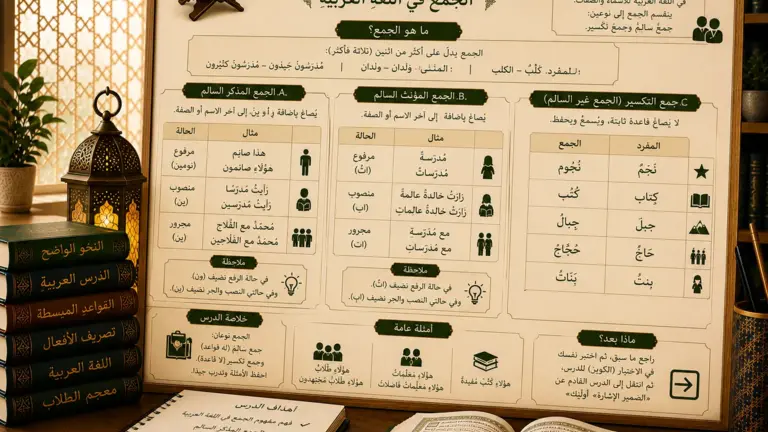
This lesson is especially useful for Arabic beginners, because it explains the three main forms of the Arabic plural: the sound masculine plural, the sound feminine plural and the broken plural.
Understanding the plural in Arabic
In English, the plural usually refers to two or more elements. In Arabic, the logic is different: the plural generally refers to three elements or more, because two elements are expressed with a special form called the dual.
To express number, Arabic generally distinguishes three categories:
- المُفْرَدُ: the singular, for one person or one thing;
- الْمُثَنَّى: the dual, for two people or two things;
- الْجَمْعُ: the plural, for three people or things, or more.
Examples:
| Category | Arabic | Translation |
|---|---|---|
| Singular | كَلْبٌ | a dog |
| Dual | وَلَدَانِ | two boys |
| Plural | مُدَرِّسُونَ جَيِّدُونَ | good teachers |
In this lesson, we will focus on the plural.
The three main forms of the Arabic plural
In Arabic, the plural of nouns and adjectives can take several forms. The three main forms are:
- اَلْجَمْعُ الْمُذَكَّرُ السَّالِمُ: the sound masculine plural;
- اَلْجَمْعُ الْمُؤَنَّثُ السَّالِمُ: the sound feminine plural;
- جَمْعُ التَّكْسِيرِ or اَلْجَمْعُ الْمُكَسَّرُ: the broken plural.
The sound masculine plural
The sound masculine plural generally concerns masculine nouns or adjectives referring to people. It is formed with suffixes added to the end of the word, without changing the internal structure of the noun.
The sound feminine plural
The sound feminine plural applies to many feminine nouns and adjectives. It is often formed with the suffix ات.
The broken plural
The broken plural, called جَمْعُ التَّكْسِيرِ, is not formed by simply adding a suffix. The internal structure of the word changes. This form often needs to be learned together with the singular.
The sound masculine plural: ونَ and ينَ
The sound masculine plural is called اَلْجَمْعُ الْمُذَكَّرُ السَّالِمُ. The word سَالِم indicates that the original form of the word remains mostly intact: an ending is added instead of changing the inside of the word.
The sound masculine plural is formed by adding one of the following two suffixes:
- ونَ in the nominative case;
- ينَ in the accusative and genitive cases.
Sound masculine plural in the nominative case
In the nominative case, the sound masculine plural takes the ending ونَ.
هَذَا صَائِمٌ
This is a fasting person.
هَؤُلاءِ صَائِمُونَ
These are fasting people.
Another example:
- مُسْلِمٌ: one Muslim man;
- مُسْلِمَانِ: two Muslim men;
- مُسْلِمُونَ: Muslim men.
Sound masculine plural in the accusative case
In the accusative case, the sound masculine plural takes the ending ينَ.
رَأَيْتُ مُدَرِّسًا
I saw a teacher.
رَأَيْتُ مُدَرِّسِينَ
I saw teachers.
With the word مُسْلِمٌ:
- مُسْلِمًا: one Muslim man, in the accusative case;
- مُسْلِمِينَ: Muslim men, in the accusative case.
Sound masculine plural in the genitive case
In the genitive case, after a preposition or in certain constructions, the sound masculine plural also takes the ending ينَ.
مُحَمَّدٌ مَعَ الْفَلَّاحِ
Muhammad is with the farmer.
مُحَمَّدٌ مَعَ الْفَلَّاحِينَ
Muhammad is with the farmers.
You should therefore remember that the sound masculine plural uses ونَ when the word is nominative, and ينَ when it is accusative or genitive.
The sound feminine plural: اتٌ and اتٍ
The sound feminine plural is called اَلْجَمْعُ الْمُؤَنَّثُ السَّالِمُ. It is generally formed by adding the suffix ات to the noun or adjective.
Its final ending changes according to grammatical case:
- اتٌ in the nominative case;
- اتٍ in the accusative and genitive cases.
Sound feminine plural in the nominative case
مُدَرِّسَةٌ
One female teacher.
مُدَرِّسَاتٌ
Female teachers.
Another example:
- مُسْلِمَةٌ: one Muslim woman;
- مُسْلِمَتَانِ: two Muslim women;
- مُسْلِمَاتٌ: Muslim women.
Sound feminine plural in the accusative case
زَارَتْ خَالِدَةُ عَالِمَةً
Khalida visited a female scholar.
زَارَتْ خَالِدَةُ عَالِمَاتٍ
Khalida visited female scholars.
Sound feminine plural in the genitive case
مَعَ مُدَرِّسَةٍ
With one female teacher.
مَعَ مُدَرِّسَاتٍ
With female teachers.
The sound feminine plural is therefore fairly easy to recognize because it usually contains the suffix ات.
Note on grammatical cases
In the singular, the nominative, accusative and genitive cases are often marked by the final vowel, called a ḥaraka:
- ـٌ for the indefinite nominative;
- ـً for the indefinite accusative;
- ـٍ for the indefinite genitive.
In regular dual and plural forms, grammatical cases are often indicated by final letters, such as:
- ـانِ and ـَيْنِ for the dual;
- ونَ and ينَ for the sound masculine plural;
- اتٌ and اتٍ for the sound feminine plural.
Quranic example with the regular plural
إِنَّ الْمُسْلِمِينَ وَالْمُسْلِمَاتِ
The Muslim men and the Muslim women. 33:35
In this example, الْمُسْلِمِينَ is a sound masculine plural, while الْمُسْلِمَاتِ is a sound feminine plural.
The broken plural in Arabic: جَمْعُ التَّكْسِيرِ
The broken plural in Arabic is called جَمْعُ التَّكْسِيرِ or اَلْجَمْعُ الْمُكَسَّرُ. Unlike the sound masculine plural and the sound feminine plural, it is not formed simply by adding a suffix to the end of the word.
In the broken plural, the form of the word changes. Letters may be added, removed or modified inside the word. This is why the broken plural often needs to be learned together with the singular.
Example with the word كِتَابٌ
| Form | Arabic | Translation |
|---|---|---|
| Singular | كِتَابٌ | one book |
| Dual | كِتَابَانِ | two books |
| Broken plural | كُتُبٌ | books |
Notice that كِتَابٌ does not simply receive a suffix. Its internal structure changes to form كُتُبٌ.
Examples of Arabic broken plurals
| Singular | Broken plural | Translation |
|---|---|---|
| نَجْمٌ | نُجُومٌ | star / stars |
| كِتَابٌ | كُتُبٌ | book / books |
| جَبَلٌ | جِبَالٌ | mountain / mountains |
| حَاجٌّ | حُجَّاجٌ | pilgrim / pilgrims |
| بِنْتٌ | بَنَاتٌ | girl / girls |
| وَلَدٌ | أَوْلَادٌ | boy / boys |
| مَدِينَةٌ | مُدُنٌ | city / cities |
| رَجُلٌ | رِجَالٌ | man / men |
| اِمْرَأَةٌ | نِسَاءٌ | woman / women |
| قَلَمٌ | أَقْلَامٌ | pen / pens |
| بَيْتٌ | بُيُوتٌ | house / houses |
The broken plural is very common in Arabic. To improve your Arabic vocabulary, it is recommended to learn each new word with its plural form whenever possible.
Quranic examples with the broken plural
وَجَنَّاتٌ تَجْرِي مِن تَحْتِهَا الْأَنْهَارُ
And gardens beneath which rivers flow. 3:136
In this example, جَنَّاتٌ is a sound feminine plural, while الْأَنْهَارُ is a broken plural.
أَأَرْبَابٌ مُّتَفَرِّقُونَ خَيْرٌ أَمِ اللّٰهُ الْوَاحِدُ الْقَهَّارُ
Are many different lords better, or Allah, the One, the Prevailing? 12:39
The word أَرْبَابٌ is a broken plural.
وَالْجِبَالَ أَوْتَادًا
And the mountains as pegs. 78:7
The word الْجِبَالَ is the broken plural of جَبَلٌ.
Summary table of the plural in Arabic
| Type of plural | Arabic name | Formation | Example |
|---|---|---|---|
| Sound masculine plural | اَلْجَمْعُ الْمُذَكَّرُ السَّالِمُ | ونَ or ينَ | مُدَرِّسُونَ / مُدَرِّسِينَ |
| Sound feminine plural | اَلْجَمْعُ الْمُؤَنَّثُ السَّالِمُ | اتٌ or اتٍ | مُدَرِّسَاتٌ / مُدَرِّسَاتٍ |
| Broken plural | جَمْعُ التَّكْسِيرِ | internal change of the word | كِتَابٌ / كُتُبٌ |
How to recognize the plural in Arabic
To recognize the plural in Arabic, observe the ending or the internal structure of the word.
- If the word ends with ونَ, it is often a sound masculine plural in the nominative case.
- If the word ends with ينَ, it may be a sound masculine plural in the accusative or genitive case.
- If the word contains ات, it may be a sound feminine plural.
- If the internal structure of the word changes, it may be a broken plural.
You also need to consider the context, because some words may have several forms or follow special rules.
Difference between regular plural and broken plural
The main difference is how the plural is formed.
| Type | Principle | Example |
|---|---|---|
| Regular plural | An ending is added to the word. | مُدَرِّسٌ → مُدَرِّسُونَ |
| Broken plural | The internal form of the word changes. | كِتَابٌ → كُتُبٌ |
The regular plural is easier to recognize, while the broken plural often needs to be memorized with the vocabulary.
Common mistakes with the Arabic plural
Here are some common mistakes made by students learning the plural in Arabic:
- using the plural for two elements, although Arabic normally uses the dual;
- confusing ونَ and ينَ in the sound masculine plural;
- forgetting that the sound feminine plural often takes اتٌ in the nominative and اتٍ in the accusative or genitive;
- thinking that all plurals are formed with a suffix;
- not learning the broken plural together with the singular;
- forgetting agreement between the plural noun and the adjective.
These mistakes are normal at the beginning. They decrease with reading, repetition, exercises and correction by a teacher.
Exercise on the Arabic plural
Match each singular word with its plural form.
| Singular | Complete |
|---|---|
| مُدَرِّسٌ | Teachers: ______ |
| مُدَرِّسَةٌ | Female teachers: ______ |
| كِتَابٌ | Books: ______ |
| جَبَلٌ | Mountains: ______ |
Correction:
- مُدَرِّسُونَ or مُدَرِّسِينَ, depending on the grammatical case.
- مُدَرِّسَاتٌ or مُدَرِّسَاتٍ, depending on the grammatical case.
- كُتُبٌ.
- جِبَالٌ.
Why learn the plural in Arabic?
The plural is essential for reading and building Arabic sentences. It helps students understand nouns, adjectives, agreements and relationships between words.
This concept helps students:
- improve Arabic reading;
- expand Arabic vocabulary;
- understand nominal and verbal sentences;
- recognize agreement between nouns and adjectives;
- better understand Modern Standard Arabic and classical Arabic texts;
- identify plural forms in the Quran.
Learning Arabic grammar with method
The plural is an essential foundation for learning Arabic online. It helps students understand nouns, adjectives, agreement and read more complete Arabic sentences.
To progress effectively as an Arabic beginner, it is recommended to study progressively:
- the Arabic alphabet;
- Arabic reading and pronunciation;
- basic Arabic vocabulary;
- the singular, the dual and the plural;
- adjectives and their agreement;
- nominal and verbal sentences;
- the first rules of Arabic grammar.
If your goal is to understand religious texts or the Quran, a path in Quranic Arabic can help you recognize plural forms in context. To read, write and understand Arabic more generally, studying Modern Standard Arabic is also very useful.
Learning Arabic with a teacher
This lesson helps you understand the main forms of the plural in Arabic. However, to master Arabic grammar, students need regular practice, varied examples and correction from an Arabic teacher.
Al-Dirassa offers online Arabic courses for adults and Arabic classes for children, with personalized support, adapted progression and a free trial.
You can also strengthen your foundations with our free Arabic books for beginners or follow a Modern Standard Arabic program according to your goal.
Book your free trial of 30 minutes
Registration form
FAQ — The plural in Arabic
How do you say plural in Arabic?
The plural is called اَلْجَمْعُ in Arabic.
What are the types of plural in Arabic?
The main forms are the sound masculine plural, اَلْجَمْعُ الْمُذَكَّرُ السَّالِمُ, the sound feminine plural, اَلْجَمْعُ الْمُؤَنَّثُ السَّالِمُ, and the broken plural, جَمْعُ التَّكْسِيرِ.
What is the ending of the sound masculine plural?
The sound masculine plural takes ونَ in the nominative case and ينَ in the accusative or genitive case.
What is the ending of the sound feminine plural?
The sound feminine plural usually takes اتٌ in the nominative case and اتٍ in the accusative or genitive case.
What is the broken plural in Arabic?
The broken plural is a form in which the internal structure of the word changes, such as كِتَابٌ, which becomes كُتُبٌ.
What is the difference between the dual and the plural in Arabic?
The dual refers to two elements, while the plural generally refers to three elements or more.
Conclusion
In this lesson, we studied the plural in Arabic: اَلْجَمْعُ. We saw that Arabic distinguishes between the singular, the dual and the plural, and that the plural generally refers to three elements or more.
We also studied the three main forms of the Arabic plural: the sound masculine plural, the sound feminine plural and the broken plural. Each form has its own rules and specific features.
Understanding the plural is an important step in Arabic grammar. However, to learn Arabic fully, students need to progress with method, practice regularly, expand their vocabulary and receive correction from a teacher. This is how students can progress sustainably in beginner Arabic, Modern Standard Arabic, classical Arabic or Quranic Arabic.





No Comments
No comments yet.
No comments yet.