
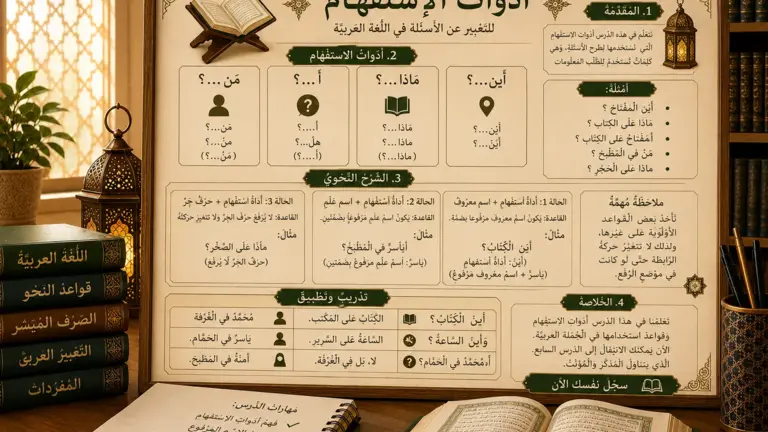
In this Arabic grammar lesson, we will study Arabic interrogative tools, called أَدَوَاتُ الاِسْتِفْهَامِ. These words allow students to ask simple questions and are essential for learning Arabic online, understanding dialogues and building correct sentences.
Interrogative tools are used to ask for information: a person, a place, a thing, a quantity, a time, a manner, a reason or a confirmation. They are part of the foundations of Arabic reading, Arabic grammar and spoken Arabic.
In this lesson, we will study the main Arabic interrogative tools, their meanings, their use, important grammar rules, simple examples and Quranic examples.
What are interrogative tools in Arabic?
Interrogative tools are words or particles used to form a question. In English, examples include: where, who, what, why, how many, how and do/does.
In Arabic, these tools are called:
أَدَوَاتُ الاِسْتِفْهَامِ
They often appear at the beginning of a sentence, but some may also appear after a preposition or inside a more complex structure.
Table of the main Arabic interrogative tools
| Interrogative tool | Meaning | Use |
|---|---|---|
| مَا / مَاذَا | what? | To ask about a thing or information |
| مَنْ | who? | To ask about a person |
| أَيْنَ | where? | To ask about a place |
| مَتَى | when? | To ask about time |
| أَيَّانَ | when? | Often used for a future or solemn event |
| لِمَاذَا / لِمَ | why? | To ask about a reason |
| كَيْفَ | how? | To ask about a manner or state |
| كَمْ | how many? how much? | To ask about quantity |
| أَيُّ | which? what? | To ask about a choice or identification |
| هَلْ | do? does? is? are? | To ask a yes/no question |
| أَ | do? does? is? are? | Interrogative particle placed at the beginning |
| لِمَنْ | for whom? to whom? | To ask about a beneficiary or possessor |
| عَمَّ / عَمَّا | about what? | Contraction with a preposition |
| مِمَّ / مِمَّا | from what? of what? | Contraction with a preposition |
The simplest interrogative tools for beginners
For a beginner, it is best to start with four very common tools:
- أَيْنَ: where?
- مَاذَا: what?
- مَنْ: who?
- أَ or هَلْ: used for yes/no questions.
These tools already allow students to ask many simple questions in Arabic.
How to use أَيْنَ
The word أَيْنَ means “where?”. It is used to ask about a place.
- أَيْنَ الْمِفْتَاحُ؟: where is the key?
- أَيْنَ مُحَمَّدٌ؟: where is Muhammad?
- أَيْنَ الْكِتَابُ؟: where is the book?
- وَأَيْنَ السَّاعَةُ؟: and where is the watch?
Quranic example:
أَيْنَ شُرَكَاؤُكُمُ الَّذِينَ كُنتُمْ تَزْعُمُونَ
Where are your partners whom you used to claim? (6:22)
How to use مَنْ
The word مَنْ means “who?”. It is used to ask about a person.
- مَنْ فِي الْمَطْبَخِ؟: who is in the kitchen?
- مَنْ عَلَىٰ الْحَجَرِ؟: who is on the rock?
- مَنْ فِي الْغُرْفَةِ؟: who is in the room?
Quranic example:
مَن ذَا الَّذِي يَشْفَعُ عِندَهُ إِلَّا بِإِذْنِهِ
Who can intercede with Him except by His permission? (2:255)
How to use مَا and مَاذَا
مَا and مَاذَا mean “what?”. They are used to ask about a thing or information.
- مَاذَا عَلَىٰ الْكِتَابِ؟: what is on the book?
- مَاذَا عَلَىٰ الْحَجَرِ؟: what is on the rock?
- مَاذَا عَلَىٰ الْمَكْتَبِ؟: what is on the desk?
Quranic examples:
وَمَا تِلْكَ بِيَمِينِكَ يَا مُوسَىٰ
And what is that in your right hand, O Moses? (20:17)
يَسْأَلُونَكَ مَاذَا يُنفِقُونَ
They ask you: “What should they spend?” (2:215)
How to use أَ and هَلْ
The particles أَ and هَلْ are used to ask yes/no questions. This type of question often expects an answer such as yes or no.
The particle أَ often attaches to the beginning of the following word, while هَلْ is a separate word.
- أَمِفْتَاحٌ عَلَى الْكِتَابِ؟: is there a key on the book?
- أَيَاسِرٌ فِي الْمَطْبَخِ؟: is Yassir in the kitchen?
- أَمُحَمَّدٌ فِي الْحَمَّامِ؟: is Muhammad in the bathroom?
- هَلْ هَذَا كِتَابٌ؟: is this a book?
Quranic example:
قَالُوا أَإِنَّكَ لَأَنتَ يُوسُفُ
They said: “Are you indeed Joseph?” (12:90)
How to use لِمَاذَا and لِمَ
لِمَاذَا and لِمَ mean “why?”. They are used to ask about a reason or cause.
Example:
لِمَاذَا خَرَجْتَ؟
Why did you go out?
Quranic example:
يَا أَيُّهَا الَّذِينَ آمَنُوا لِمَ تَقُولُونَ مَا لَا تَفْعَلُونَ
O you who believe, why do you say what you do not do? (61:2)
How to use كَيْفَ
The word كَيْفَ means “how?”. It is used to ask about a manner, state or way of doing something.
Examples:
- كَيْفَ حَالُكَ؟: how are you?
- كَيْفَ دَخَلْتَ؟: how did you enter?
Quranic example:
وَانظُرْ إِلَى الْعِظَامِ كَيْفَ نُنشِزُهَا
Look at the bones, how We assemble them and cover them with flesh. (2:259)
How to use مَتَى and أَيَّانَ
مَتَى means “when?”. It is used to ask about time.
أَيَّانَ also means “when?”, but it often appears in more solemn contexts or in relation to an important future event.
Quranic examples:
مَتَىٰ نَصْرُ اللّٰهِ
When will the help of Allah come? (2:214)
يَسْأَلُونَ أَيَّانَ يَوْمُ الدِّينِ
They ask: “When will be the Day of Recompense?” (51:12)
How to use لِمَنْ
لِمَنْ means “to whom?” or “for whom?”. It is formed with the preposition لِ and the interrogative tool مَنْ.
Example:
لِمَنْ هَذَا الْكِتَابُ؟
Whose book is this?
Quranic example:
لِمَنِ الْمُلْكُ الْيَوْمَ
To whom belongs the dominion today? (40:16)
Interrogative contractions: عَمَّ, مِمَّ and عَمَّنْ
Some interrogative tools combine with prepositions. This creates very common contracted forms.
- عَنْ + مَا becomes عَمَّ or عَمَّا: about what?
- مِنْ + مَا becomes مِمَّ or مِمَّا: from what? of what?
- عَنْ + مَنْ becomes عَمَّنْ: about whom?
Quranic examples:
عَمَّ يَتَسَاءَلُونَ
About what are they asking one another? (78:1)
فَلْيَنظُرِ الْإِنسَانُ مِمَّ خُلِقَ
Let man look at what he was created from. (86:5)
The interrogative tool كَمْ: how many?
The interrogative tool كَمْ means “how many?” or “how much?”. It is used to ask about a quantity, number or measure.
Example:
كَمْ كِتَابًا عِنْدَكَ؟
How many books do you have?
In Arabic, كَمْ is generally placed at the beginning of the question. It is followed by the noun whose quantity is being asked about.
- كَمْ كِتَابًا عِنْدَكَ؟: how many books do you have?
- كَمْ كُرَّاسَةً مَعَكَ؟: how many notebooks do you have with you?
- كَمْ سَاعَةً فِي حَقِيبَتِكَ؟: how many watches are in your bag?
Quranic example:
قَالَ كَمْ لَبِثْتَ
He said: “How long did you remain?” (2:259)
The grammar rule after كَمْ
After كَمْ, the noun that expresses the counted thing usually follows a precise rule. It is often:
- singular;
- indefinite;
- accusative.
In English, we say “how many books?” with a plural noun. In Arabic, after كَمْ, the noun is generally singular.
كَمْ كِتَابًا عِنْدَكَ؟
How many books do you have?
The word كِتَابًا is singular, indefinite and accusative. It therefore carries a double fatḥah.
Questions and answers with كَمْ
| Question | Answer |
|---|---|
| كَمْ أَخًا لَكَ يَا مُحَمَّدُ؟ How many brothers do you have, O Muhammad? |
لِي أَخٌ وَاحِدٌ I have one brother. |
| وَكَمْ أُخْتًا لَكَ؟ And how many sisters do you have? |
لِي أُخْتَانِ I have two sisters. |
| كَمْ عَجَلَةً لِلدَّرَّاجَةِ يَا حَامِدُ؟ How many wheels does the bicycle have, O Hamid? |
لَهَا عَجَلَتَانِ It has two wheels. |
| كَمْ عِيدًا فِي السَّنَةِ؟ How many festivals are there in the year? |
فِي السَّنَةِ عِيدَانِ In the year, there are two festivals. |
Difference between كَمْ and Arabic numbers
The word كَمْ is used to ask about a quantity. Arabic numbers are used to give a specific quantity.
Question:
كَمْ كِتَابًا عِنْدَكَ؟
How many books do you have?
Answer:
عِنْدِي ثَلاثَةُ كُتُبٍ
I have three books.
It is therefore useful to study كَمْ before or alongside the rules of Arabic numbers.
The interrogative tool أَيُّ: which, what
The Arabic word أَيُّ is an interrogative tool that means, depending on context, “which”, “what” or “which one”. It is used to ask about a choice, identity or category of a thing, person, place or element.
Examples:
- أَيُّ بَيْتٍ هَذَا؟: which house is this?
- أَيُّ مَدْرَسَةٍ هَذِهِ؟: which school is this?
- أَيُّ يَوْمٍ هَذَا؟: which day is this?
Quranic example:
قُلْ أَيُّ شَيْءٍ أَكْبَرُ شَهَادَةً
Say: “What thing is greatest in testimony?” (6:19)
Why does أَيُّ work like an idafa?
Unlike some other interrogative tools, أَيُّ often works like an idafa construction.
In the expression أَيُّ بَيْتٍ, the word أَيُّ is the مُضَافٌ, and بَيْتٍ is the مُضَافٌ إِلَيْهِ.
This is why the noun that follows أَيُّ is generally in the genitive case.
أَيُّ بَيْتٍ هَذَا؟
Which house is this?
The word بَيْتٍ carries a final kasrah because it is the second term of the idafa construction.
The forms of أَيُّ according to grammatical case
The word أَيُّ is declinable. Its final vowel changes according to its function in the sentence.
| Grammatical case | Arabic form | Final vowel | Example |
|---|---|---|---|
| Nominative | أَيُّ | Ḍammah | أَيُّ بَيْتٍ هَذَا؟ |
| Genitive | أَيِّ | Kasrah | فِي أَيِّ غُرْفَةٍ دَخَلْتَ؟ |
| Accusative | أَيَّ | Fatḥah | أَيَّ لُغَةٍ تُحِبُّ؟ |
أَيُّ in the nominative case
- أَيُّ بَيْتٍ هَذَا؟: which house is this?
- أَيُّ مَدْرَسَةٍ هَذِهِ؟: which school is this?
- أَيُّ يَوْمٍ هَذَا؟: which day is this?
أَيِّ in the genitive case
When أَيُّ is preceded by a preposition, it becomes genitive.
- فِي أَيِّ غُرْفَةٍ دَخَلْتَ؟: which room did you enter?
- فِي أَيِّ مَدْرَسَةٍ أَنْتَ؟: which school are you in?
- مِنْ أَيِّ بَلَدٍ أَنْتَ؟: which country are you from?
أَيَّ in the accusative case
When أَيُّ has an accusative function, for example when it is the object of the verb, it takes the form أَيَّ.
- أَيَّ لُغَةٍ تُحِبُّ؟: which language do you like?
- أَيَّ كِتَابٍ تُحِبُّونَ؟: which book do you like?
Answering a question with أَيُّ
| Question | Answer |
|---|---|
| أَيُّ يَوْمٍ هَذَا؟ Which day is this? |
هَذَا يَوْمُ السَّبْتِ This is Saturday. |
| أَيُّ شَهْرٍ هَذَا؟ Which month is this? |
هَذَا شَهْرُ رَجَبٍ This is the month of Rajab. |
| أَيُّ كُلِّيَّةٍ هَذِهِ؟ Which faculty is this? |
هَذِهِ كُلِّيَّةُ التِّجَارَةِ This is the Faculty of Commerce. |
| مِنْ أَيِّ بَلَدٍ أَنْتَ؟ Which country are you from? |
أَنَا مِنَ الأُرْدُن I am from Jordan. |
Questions and answers in Arabic
| Question | Answer |
|---|---|
| أَيْنَ مُحَمَّدٌ؟ Where is Muhammad? |
مُحَمَّدٌ فِي الْغُرْفَةِ Muhammad is in the room. |
| وَأَيْنَ يَاسِرٌ؟ And where is Yassir? |
يَاسِرٌ فِي الْحَمَّامِ Yassir is in the bathroom. |
| وَأَيْنَ آمِنَةُ؟ Where is Amina? |
آمِنَةُ فِي الْمَطْبَخِ Amina is in the kitchen. |
| أَيْنَ الْكِتَابُ؟ Where is the book? |
الْكِتَابُ عَلَىٰ الْمَكْتَبِ The book is on the desk. |
| أَمُحَمَّدٌ فِي الْحَمَّامِ؟ Is Muhammad in the bathroom? |
لا، بَلْ فِي الْغُرْفَةِ No, rather in the room. |
Grammar rules of Arabic interrogative sentences
In an Arabic interrogative sentence, students must observe the function of the word that follows the interrogative tool.
When an interrogative tool precedes a definite noun in a nominal sentence, this noun is often in the nominative case:
- أَيْنَ الْكِتَابُ؟: where is the book?
- أَيْنَ الْمِفْتَاحُ؟: where is the key?
When it precedes a proper noun or an indefinite noun, that noun can also be nominative:
- أَيْنَ مُحَمَّدٌ؟: where is Muhammad?
- أَيَاسِرٌ فِي الْمَطْبَخِ؟: is Yassir in the kitchen?
However, when an interrogative tool is preceded or followed by a preposition, the grammatical structure changes. Prepositions generally make the following noun or element genitive.
- مَاذَا عَلَى الصَّخْرِ؟: what is on the rock?
- مِنْ أَيِّ بَلَدٍ أَنْتَ؟: which country are you from?
Difference between أَيُّ and other interrogative tools
The word أَيُّ is not used exactly like the other interrogative tools. It is used to ask about a choice or identification among several possibilities.
- مَنْ means “who”;
- مَا means “what”;
- أَيْنَ means “where”;
- كَمْ means “how many” or “how much”;
- أَيُّ means “which” or “which one”.
The special feature of أَيُّ is that it is declinable and often works like an idafa construction.
Common mistakes with Arabic interrogative tools
- confusing مَنْ and مَا;
- using أَيْنَ to ask about a person instead of a place;
- forgetting that كَمْ is often followed by a singular indefinite accusative noun;
- putting the noun after كَمْ in the plural as in English;
- forgetting that أَيُّ often works like an idafa;
- not putting the noun after أَيُّ in the genitive case;
- using أَيُّ after a preposition instead of أَيِّ;
- using أَيُّ as an object of the verb instead of أَيَّ;
- always translating an interrogative tool the same way without considering context.
How to memorize Arabic interrogative tools
To memorize interrogative tools, learn them by function:
- أَيْنَ to ask about a place;
- مَنْ to ask about a person;
- مَا or مَاذَا to ask about a thing;
- لِمَاذَا or لِمَ to ask about a reason;
- كَيْفَ to ask about a manner;
- مَتَى to ask about a time;
- كَمْ to ask about a quantity;
- أَيُّ to ask about a choice;
- أَ and هَلْ to ask yes/no questions.
To progress well, memorize complete questions, repeat them aloud, then write your own examples with simple nouns.
Why are Arabic interrogative tools important?
Arabic interrogative tools are essential for:
- asking simple questions;
- understanding dialogues;
- reading vocalized Arabic texts;
- analyzing certain Quranic sentences;
- progressing in Arabic grammar;
- improving spoken Arabic;
- understanding number rules with كَمْ;
- mastering idafa-like structures with أَيُّ.
Learn Arabic questions with a teacher
Arabic interrogative tools require students to understand the meaning of the word, its place in the sentence and sometimes its grammatical case. Some tools are simple, such as أَيْنَ or مَنْ. Others require more attention, such as كَمْ and أَيُّ.
To learn Arabic effectively, an online Arabic course with an Arabic teacher helps students progress step by step. The teacher can correct your pronunciation, explain grammar rules and provide exercises adapted to your level.
At Al-Dirassa, you can follow a private Arabic course online, start as a beginner, progress in Classical Arabic, strengthen your Quranic Arabic or review the Arabic alphabet and our free books to learn Arabic.
Book your free trial of 30 minutes
Registration form
FAQ — Arabic interrogative tools
How do you say “where” in Arabic?
“Where” is أَيْنَ. Example: أَيْنَ الْكِتَابُ؟, where is the book?
How do you say “who” in Arabic?
“Who” is مَنْ. Example: مَنْ فِي الْغُرْفَةِ؟, who is in the room?
What is the difference between مَا and مَنْ?
مَا is generally used to ask about a thing, while مَنْ is used to ask about a person.
What does كَمْ mean?
كَمْ means “how many?” or “how much?”. It is used to ask about a quantity.
What rule does the noun after كَمْ follow?
In the structure studied here, the noun after كَمْ is generally singular, indefinite and accusative, as in كَمْ كِتَابًا عِنْدَكَ؟.
What does أَيُّ mean?
أَيُّ means “which”, “what” or “which one” depending on context. It is used to ask about a choice or identification.
Why is the noun after أَيُّ genitive?
Because أَيُّ often works like an idafa construction: أَيُّ is the مُضَافٌ, and the noun that follows is the مُضَافٌ إِلَيْهِ.
Conclusion
In this lesson, we studied Arabic interrogative tools, called أَدَوَاتُ الاِسْتِفْهَامِ. We learned how to use أَيْنَ, مَنْ, مَا, مَاذَا, أَ, هَلْ, كَيْفَ, مَتَى, كَمْ and أَيُّ.
These tools allow students to ask simple questions and understand Arabic dialogues. Some are easy to use from the beginning, while others require more grammatical attention, especially كَمْ and أَيُّ.
With a progressive method, regular examples and correction from a teacher, questions in Arabic become easier to understand and use in correct sentences.





No Comments
No comments yet.
No comments yet.