
Arabic verb conjugation is an essential foundation for learning Arabic and building correct sentences. In Arabic, the verb changes according to tense, person, gender and number. It can express an action in the present, past or imperative form.
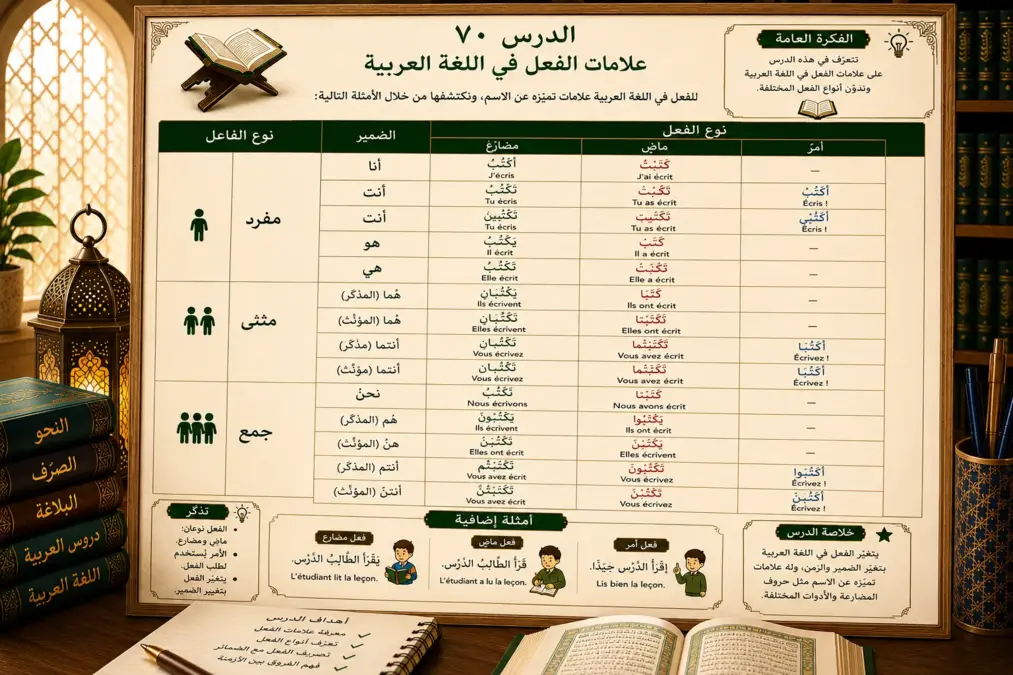
In this lesson, we will study Arabic verb conjugation using a simple model: كَتَبَ, which means “he wrote”. This verb helps students understand how verb forms change according to pronouns.
This lesson is useful for Arabic for beginners, but also for students who want to improve their Arabic grammar, Arabic reading, Modern Standard Arabic, Quranic Arabic and Arabic conjugation.
Understanding Arabic Verb Conjugation
In Arabic, a verb is called الفِعْلُ. It expresses an action connected to a time. To understand an Arabic sentence correctly, students need to recognize the verb and identify who performs the action.
An Arabic verb can vary according to:
- person: I, you, he, she, we, you all, they;
- gender: masculine or feminine;
- number: singular, dual or plural;
- tense: present, past or imperative.
The Arabic Verb كَتَبَ as a Model
The verb كَتَبَ means “he wrote”. It is often used as a model in Arabic conjugation because its letters are simple and regular.
From this verb, we can form:
- يَكْتُبُ: he writes;
- كَتَبَ: he wrote;
- اُكْتُبْ: write.
These three forms show the difference between the present tense, the past tense and the imperative.
Present Tense Conjugation
The Arabic present tense expresses an action in progress, a habit or a general action. It is often recognized by the present tense letters: أ، ن، ي، ت.
| Pronoun | Arabic form | Translation |
|---|---|---|
| I | أَكْتُبُ | I write |
| You masculine | تَكْتُبُ | You write |
| You feminine | تَكْتُبِينَ | You write |
| He | يَكْتُبُ | He writes |
| She | تَكْتُبُ | She writes |
| We | نَكْتُبُ | We write |
| They masculine | يَكْتُبُونَ | They write |
| They feminine | يَكْتُبْنَ | They write |
Past Tense Conjugation
The Arabic past tense expresses a completed action. With the verb كَتَبَ, suffixes indicate the person who performed the action.
| Pronoun | Arabic form | Translation |
|---|---|---|
| I | كَتَبْتُ | I wrote |
| You masculine | كَتَبْتَ | You wrote |
| You feminine | كَتَبْتِ | You wrote |
| He | كَتَبَ | He wrote |
| She | كَتَبَتْ | She wrote |
| We | كَتَبْنَا | We wrote |
| They masculine | كَتَبُوا | They wrote |
| They feminine | كَتَبْنَ | They wrote |
Imperative Conjugation
The imperative is used to give an order or make a request. In Arabic, the imperative mainly concerns the second person: you, you two or you all.
| Addressee | Arabic form | Translation |
|---|---|---|
| You masculine | اُكْتُبْ | Write |
| You feminine | اُكْتُبِي | Write |
| You two | اُكْتُبَا | Both of you write |
| You masculine plural | اُكْتُبُوا | Write |
| You feminine plural | اُكْتُبْنَ | Write |
Summary Table of Arabic Verb Conjugation
| Tense | Arabic example | Translation | Note |
|---|---|---|---|
| Present | يَكْتُبُ | He writes | Begins with a present tense letter |
| Past | كَتَبَ | He wrote | Completed action |
| Imperative | اُكْتُبْ | Write | Command or request |
How to Improve Your Arabic Conjugation
Understanding Arabic verb conjugation is essential, but students then need to practise with other verbs and complete sentences. The learner must learn how to recognize verb tenses, pronouns, masculine and feminine markers, as well as singular, dual and plural forms.
To strengthen the foundations, you can read our lesson on Arabic verb signs, then the lesson on Arabic verb tenses.
If you want to learn Arabic online with personalized support, online Arabic classes allow you to work on Arabic conjugation, Arabic reading, Arabic pronunciation and Arabic grammar with an Arabic teacher online.
To go further, you can also follow a course in Modern Standard Arabic. Students who want to understand Quranic texts can study Quranic Arabic.
For families, Al-Dirassa also offers Arabic classes for kids adapted to each student’s age and level.
Book your free trial of 30 minutes
Registration form
Conclusion
Arabic verb conjugation is based on several elements: tense, person, gender and number. The verb كَتَبَ helps students understand the main forms in the present tense, past tense and imperative.
This lesson helps you master an essential foundation of Arabic grammar. However, to learn Arabic fully, students need a progressive method, regular practice and personalized correction from a teacher. This is how learners make lasting progress in Arabic reading, understanding and expression.



No Comments
No comments yet.