
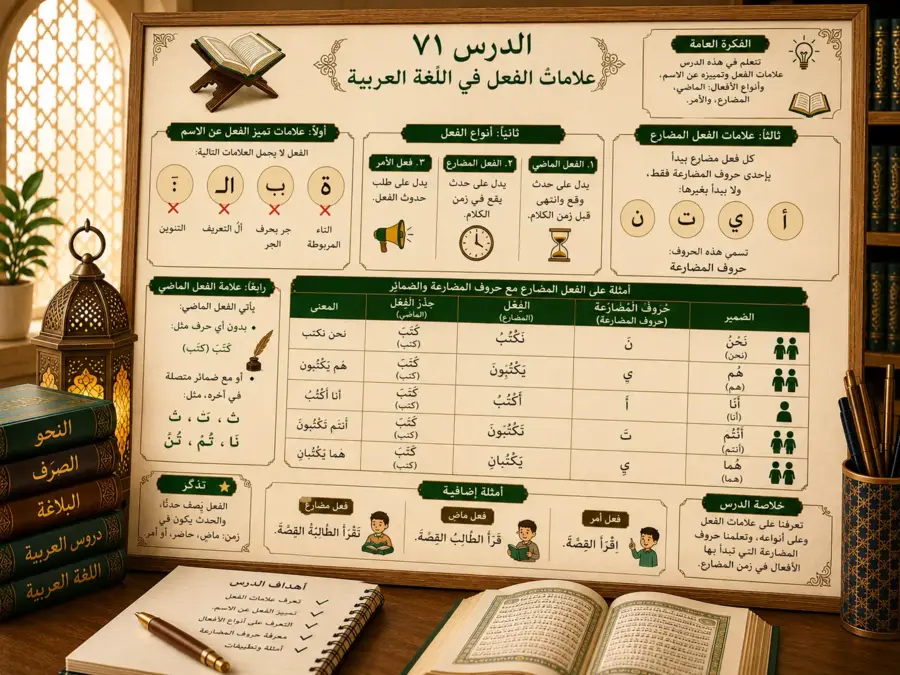
Identifying Arabic verbs is an essential step for understanding Arabic grammar and building correct sentences. In Arabic, a verb is called الفِعْلُ. It usually expresses an action connected to a time: past, present, future or imperative.
In this lesson, we will see how to identify Arabic verbs, how to distinguish them from nouns and which signs help you recognize present tense and past tense verbs.
This grammar point is important for Arabic for beginners, but also for students who want to improve Arabic reading, Arabic conjugation, Modern Standard Arabic, Quranic Arabic and Arabic sentence structure.
What Is a Verb in Arabic?
An Arabic verb, called الفِعْلُ, is a word that expresses an action or event associated with a time.
For example:
- كَتَبَ: he wrote;
- يَكْتُبُ: he writes;
- اُكْتُبْ: write.
These three forms show that the Arabic verb can express a past action, a present action or a command.
How to Distinguish a Verb from a Noun in Arabic
To learn Arabic correctly, students need to know how to distinguish a verb from a noun. A noun accepts certain grammatical signs that a verb does not accept.
The Arabic verb generally does not take the signs that are specific to nouns. This rule helps students recognize the nature of a word more easily in an Arabic sentence.
Signs That Arabic Verbs Do Not Take
Arabic verbs do not take the following signs:
- tanwīn: such as ـٌ، ـٍ، ـً;
- the definite article ال;
- the genitive case after a preposition;
- the suffix ة, which is typical of many feminine nouns.
For example, a noun such as كِتَابٌ can take tanwīn, while a verb such as كَتَبَ cannot.
Similarly, you can say الكِتَابُ, meaning “the book”, but you do not place ال before a verb like كَتَبَ.
The Letters of the Arabic Present Tense Verb
The Arabic present tense verb generally begins with one of the following four letters:
- أ: for “I”;
- نـ: for “we”;
- يـ: often for “he” or “they”;
- تـ: often for “you” or “she”.
These letters are called حُرُوفُ المُضَارَعَةِ, meaning the letters of the present tense verb.
Examples with the verb كَتَبَ:
- أَكْتُبُ: I write;
- نَكْتُبُ: we write;
- يَكْتُبُ: he writes;
- تَكْتُبُ: you write / she writes.
These letters are very important for recognizing a present tense verb in an Arabic sentence.
How to Identify Arabic Past Tense Verbs
The Arabic past tense verb is often recognized through its base form or through the conjugation suffixes that can attach to it.
The simple past tense form can appear without any added letter at the beginning:
كَتَبَ
He wrote.
The past tense verb can also take conjugation suffixes:
- كَتَبْتُ: I wrote;
- كَتَبْتَ: you wrote, masculine;
- كَتَبْتِ: you wrote, feminine;
- كَتَبْنَا: we wrote;
- كَتَبْتُمْ: you wrote, masculine plural;
- كَتَبْتُنَّ: you wrote, feminine plural.
These suffixes help identify the person who performs the action.
Summary Table of Arabic Verb Signs
| Element | Rule | Example |
|---|---|---|
| Tanwīn | The verb does not take tanwīn | كَتَبَ, not كَتَبٌ |
| Article ال | The verb does not take the definite article | كَتَبَ, not الكَتَبَ |
| Present tense | The verb often begins with أ، ن، ي، ت | يَكْتُبُ |
| Past tense | The verb can appear in a simple form or with a suffix | كَتَبَ، كَتَبْتُ |
| Imperative | The verb expresses a command | اُكْتُبْ |
How to Improve Your Arabic Grammar
Knowing how to identify Arabic verbs is an essential foundation, but learning does not stop there. To read and understand sentences correctly, students also need to study Arabic verb tenses, Arabic conjugation, pronouns, subjects and objects.
To go further, you can read our lesson on Arabic verb tenses, then the lesson on Arabic present and future tense verbs.
If you want to learn Arabic online with a structured method, online Arabic classes allow you to progress with an Arabic teacher online who corrects your mistakes and guides you step by step.
To strengthen Arabic grammar, Arabic reading and Arabic vocabulary, you can also follow a course in Modern Standard Arabic. Students who want to better understand Quranic texts can study Quranic Arabic.
For families, Al-Dirassa also offers Arabic classes for kids adapted to each student’s age and level.
Book your free trial of 30 minutes
Registration form
Conclusion
The verb in Arabic, called الفِعْلُ, can be recognized through several signs. It does not take noun-specific markers such as tanwīn or the definite article ال. The present tense verb generally begins with one of the letters أ، ن، ي، ت, while the past tense verb can appear in a simple form or with conjugation suffixes.
This lesson helps you understand an important foundation of Arabic grammar. However, to learn Arabic fully, students need a clear method, regular practice and personalized correction from a teacher. This combination allows learners to make lasting progress in Arabic reading, understanding and expression.



No Comments
No comments yet.