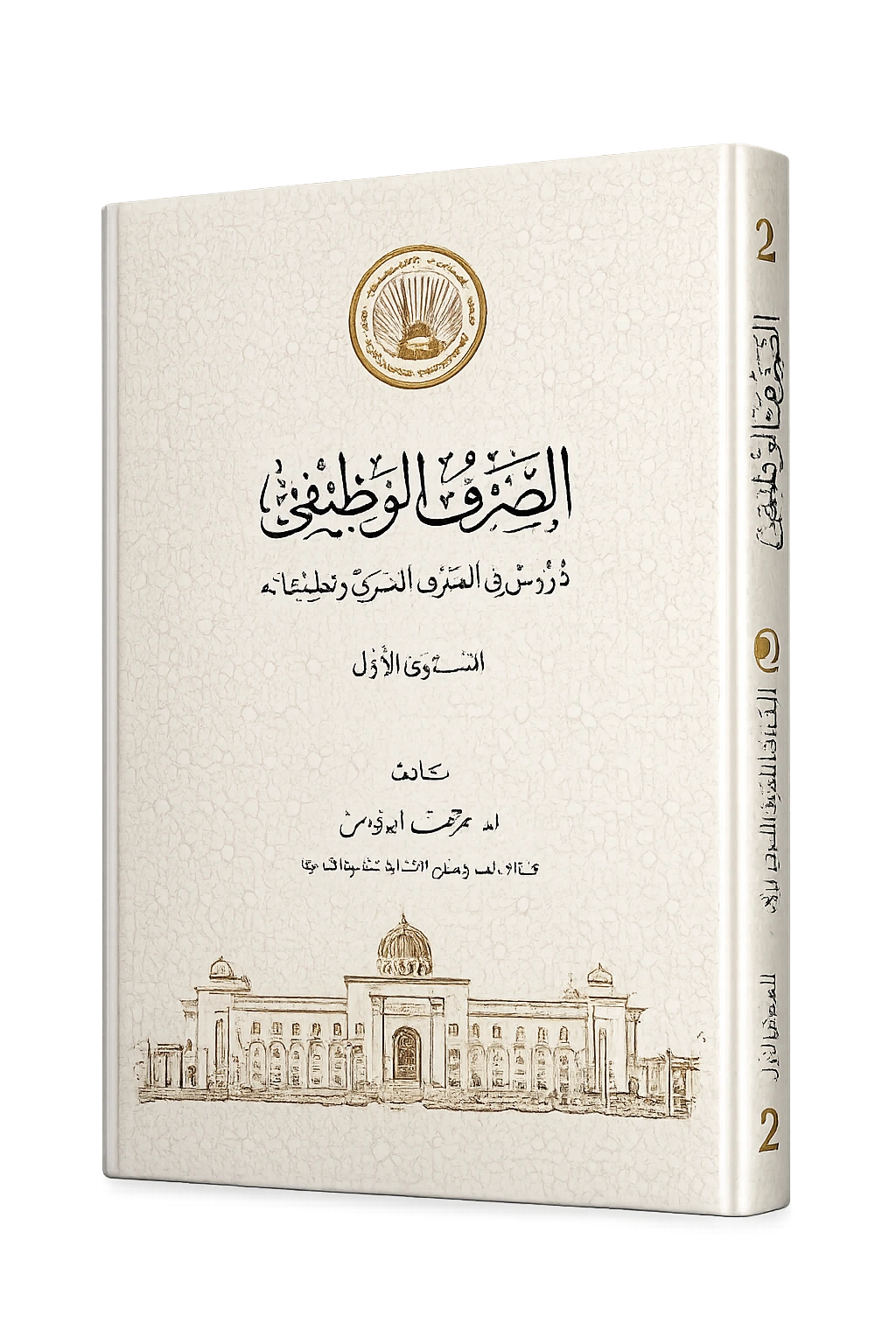
As-Sarf Al-Wazifi for learning Arabic morphology
Arabic morphology · الصرف العربي

Online Sarf Course: Learn Arabic Morphology

Study Sarf, the science of Arabic morphology, to understand how words are formed and transformed from their roots and patterns.

From word structure to traditional works

Start with As-Sarf Al-Wazifi, deepen your knowledge with As-Sarf At-Tatbiqi, then continue with a traditional work suited to your level.

Every lesson is one-to-one. The teacher connects morphological rules with reading, vocabulary, word analysis and practical language use.

علم الصرف

Understand how Arabic words are constructed

Sarf Sarf studies the internal structure of Arabic words and the transformations they undergo.

The student learns to identify the root, the morphological pattern and the different derived forms of the same word.

This knowledge makes it easier to understand vocabulary, conjugation and the relationships in meaning between words from the same root.

At an advanced level, Sarf also becomes an essential tool for reading Arabic works on language and Islamic sciences.

What you will learn

Identify roots

Find the core letters from which a word is built.

Recognise patterns

Understand the wazn and the morphological structure of words.

Conjugate verbs

Gradually study the main Arabic verb forms.

Understand derivatives

Analyse masdars, active participles, passive participles and other derivatives.

Analyse words

Break down the forms encountered in sentences and texts.

Expand your vocabulary

Understand more easily the meaning of words belonging to the same family.

The three pathways in the Sarf curriculum

The curriculum begins with a functional study of morphology, continues with a deeper application of the rules, then enables advanced students to move on to traditional Sarf works.

Level 1 · Product 38

As-Sarf Al-Wazifi

48 hours · 2 hrs/week · 6 months

Discover the essential mechanisms of Arabic morphology and immediately connect the rules studied with reading and practical language use.

  • Roots of Arabic words
  • Morphological patterns
  • Conjugation of basic verbs
  • Common morphological forms
  • Word formation
  • Understanding the meaning of forms
  • Application to reading
  • Oral and written use
Level 2 · Product 39

As-Sarf At-Tatbiqi

48 hours · 2 hrs/week · 6 months

Deepen your knowledge of morphological structures and learn to analyse precisely how Arabic words are formed in texts.

  • Advanced morphological forms
  • Mujarrad and mazid
  • Masdars
  • Derived words
  • Ism al-fa‘il
  • Ism al-maf‘ul
  • Intensive forms
  • Morphological analysis of words
Advanced level · Product 40

Traditional Sarf

96 hours · 2 hrs/week · 12 months

Move on to traditional Sarf works, master their terminology and deepen your analysis of Arabic morphological structures.

  • Traditional Sarf terminology
  • Reading a classical work
  • Advanced morphological questions
  • Analysis of different patterns
  • Analysis of derived forms
  • In-depth study of transformations
  • Reading classical Arabic texts
  • Preparation for works in Islamic sciences

Have you already studied Sarf?

Book a free 30-minute assessment . The teacher will review your existing knowledge and direct you to the appropriate level.

A steady progression to master Arabic morphology

Lessons are organised at a rate of 2 hours per week. Rules are studied progressively and then applied to words, sentences and texts.

  • Level 1: 48 hours spread over 6 monthly instalments of 8 hours.
  • Level 2: 48 hours spread over 6 monthly instalments of 8 hours.
  • Traditional Sarf: 96-hour credit spread over 12 monthly instalments of 8 hours.
  • One-to-one lessons: one student with a dedicated teacher.
  • Pace: 2 hours per week.
  • Application: rules are applied to real examples.
  • Progression: moving to the next level depends on acquired knowledge.
  • Credit retained: remaining hours can follow the student into the next stage of the curriculum.

After applied Sarf: study traditional works

The advanced pathway allows the student to begin studying a traditional work on Arabic morphology and become familiar with the terminology used by classical authors.

The work is chosen according to the student’s level, previous studies and learning goals.

  • Classical morphological terminology.
  • Advanced Sarf topics.
  • Detailed analysis of patterns.
  • Study of word transformations.
  • Guided reading of a traditional work.
  • Application to classical Arabic texts.
Important: the 96 hours are a training credit. They do not necessarily mean that the selected work will be completed in full during this period.

Who is this curriculum for?

  • Students who want to understand how Arabic words are formed.
  • Learners who want to improve their conjugation and vocabulary.
  • Students of Modern Standard Arabic who want to deepen their language skills.
  • Students of Islamic sciences.
  • Learners who want to analyse words encountered in Arabic texts.
  • Students wishing to access traditional Sarf works.
Prerequisite: it is recommended to be able to read Arabic and have a sufficient foundation in the language to benefit fully from studying Sarf.

Frequently asked questions

FAQ

Sarf is the science of Arabic morphology. It studies how words are formed and transformed, particularly from their roots and patterns.

Nahw mainly studies the function of words in a sentence, while Sarf studies the structure and transformations of the word itself.

Yes, if the assessment confirms that you already master the concepts covered in the first level.

Yes. Understanding roots and patterns helps you recognise relationships between words in the same family and grasp their meaning more easily.

Yes, if your level allows it. The assessment determines whether you can join the advanced pathway directly.

Start Sarf at the level that matches your knowledge

Book a free 30-minute assessment. The teacher will review your level and direct you to As-Sarf Al-Wazifi, As-Sarf At-Tatbiqi or directly to traditional Sarf.

Testimonials

Our students speak about us

Some testimonials from students who joined Al-Dirassa Institute and are happy to share their experience.

Laura Pociene

Online course
I want to say a big thanks to IMAN
5/5

Saida

Online course
Alhamdulillah I‘m very pleased with the arabic and Qur’an lessons I receive from teacher Umm Tasneem and I‘m also content with the al-dirassa administration team who were very quick in answering any questions I had. In a month I progressed a lot and I cannot wait to continue my studies with al-dirassa. May Allah reward everyone at al-dirassa.
5/5

Anonymous

Online course
Very good
3/5

Nabeela

Online course
My Qur’an teacher is fantastic, she teaches me in a loving and kind way where I look forward to the lessons and learn so much. My Arabic teacher is equally as nice and has a lot of patience with me, she has great expertise in the field and I’ve progressed really quickly with her. Thank you Al-dirassa!
5/5

Anonymous

Online course
Some of the teacher are very good
3/5

Anonymous

Online course
Very Good
5/5

Olumide Abdur Rahman

Online course
Definitely takes your arabic to the next level and Quran
5/5

William Jones

Online course
Good customer support. Great teachers
5/5

Hayet L.

Online course
Super prof, cela fait des années que mes enfants sont inscrits sur la plateforme et je suis satisfaite. Horaires à la carte, possibilité de reporter le cours en cas d'absence
5/5

Abdulqaadir

Online course
I have enjoyed the lessons from Al-dirassa and benefited tremendously thus far.
5/5