
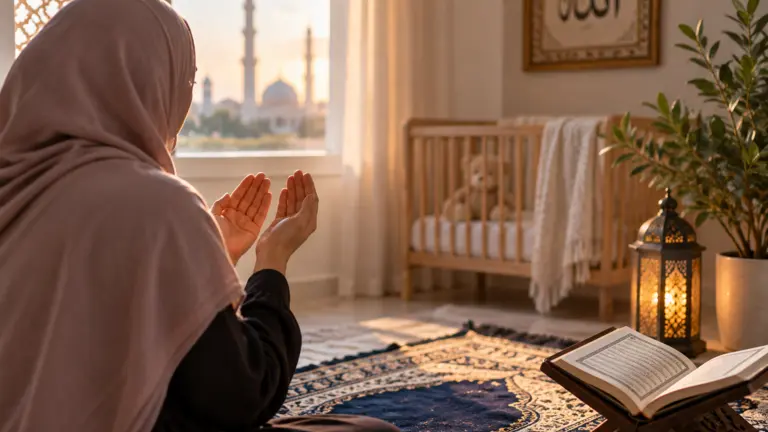
Is there a dua for becoming pregnant in Islam?
When a couple wishes to have a child, it is natural to turn to Allah and ask Him for offspring. The Quran specifically relates several supplications of prophets who asked Allah to grant them a child or righteous descendants.
An essential clarification is nevertheless necessary: there is no authentic Prophetic formula presented as a “dua to get pregnant quickly” or as a supplication that guarantees pregnancy. Dua is neither a magical formula nor a method that automatically causes conception.
On the other hand, several Quranic supplications directly correspond to this request. Among the most important are the supplications of the Prophet Zakariyyā عليه السلام, who asked Allah for good offspring although he was advanced in age and his wife was unable to have children.
These verses therefore provide people who wish to become parents with authentic Quranic words, while reminding them that the answer belongs to Allah.
Zakariyyā’s dua for asking for good offspring
One of the supplications most directly connected with the desire for a child is found in Surah Āl ‘Imrān:
رَبِّ هَبْ لِي مِنْ لَدُنْكَ ذُرِّيَّةً طَيِّبَةً إِنَّكَ سَمِيعُ الدُّعَاءِ
Transliteration:
Rabbi hab lī min ladunka dhurriyyatan ṭayyibatan, innaka samī‘u d-du‘ā’.
Translation:
My Lord, grant me from Yourself good offspring. Indeed, You are the Hearer of supplication.
Reference: Quran, Surah Āl ‘Imrān, 3:38.
This supplication is especially appropriate for someone asking Allah to grant them a child. Zakariyyā عليه السلام does not merely ask for a birth: he asks for a dhurriyyah ṭayyibah, meaning good offspring.
What does “Rabbi hab lī min ladunka dhurriyyatan ṭayyibah” mean?
Understanding a few words of this supplication helps one go beyond phonetic recitation.
« Rabbi hab lī »
رَبِّ هَبْ لِي
Rabbi means “my Lord”, and hab lī means “grant me”, carrying the meaning of a gift.
The wording reminds us that a child is asked for as a favor granted by Allah.
« Min ladunka »
مِنْ لَدُنْكَ
This expression means “from Yourself”. Zakariyyā عليه السلام addresses Allah directly and recognizes that the fulfillment of his wish depends on Him.
« Dhurriyyatan ṭayyibah »
ذُرِّيَّةً طَيِّبَةً
Dhurriyyah means offspring. The adjective ṭayyibah conveys goodness and upright quality.
The supplication therefore does not simply ask for “a baby”. It links the desire for a child with the wish for good and righteous descendants.
A second dua of Zakariyyā for having a child
The Quran reports another well-known supplication of the Prophet Zakariyyā عليه السلام:
رَبِّ لَا تَذَرْنِي فَرْدًا وَأَنْتَ خَيْرُ الْوَارِثِينَ
Transliteration:
Rabbi lā tadharnī fardan wa Anta khayru l-wārithīn.
Translation:
My Lord, do not leave me without offspring, while You are the best of inheritors.
Reference: Quran, Surah Al-Anbiyā’, 21:89.
The verse explicitly presents Zakariyyā calling upon his Lord so that he would not remain without a child. The following verse relates that Allah answered his supplication and granted him Yaḥyā.
For someone who has been waiting for a long time or who finds childlessness difficult, this dua allows that longing to be expressed with the very words reported in the Quran, without searching for a supposedly “miraculous” invocation of uncertain origin.
Ibrāhīm’s dua for asking for a righteous child
Another Quranic supplication also corresponds to the desire for offspring. Ibrāhīm عليه السلام called upon Allah saying:
رَبِّ هَبْ لِي مِنَ الصَّالِحِينَ
Transliteration:
Rabbi hab lī mina ṣ-ṣāliḥīn.
Translation:
My Lord, grant me a child among the righteous.
Reference: Quran, Surah Aṣ-Ṣāffāt, 37:100.
This formula is particularly short and can easily be memorized by someone beginning Arabic.
It also adds an important dimension: the believer is not only asking to become a parent, but is asking Allah that the child granted be among the righteous.
What is the best dua for becoming pregnant?
There is no single authentic text designated as “the best dua for becoming pregnant” with a guarantee of pregnancy attached to it.
For asking for offspring, however, the Quranic supplications of Zakariyyā and Ibrāhīm are especially appropriate because their context specifically concerns asking for a child:
| Supplication | Request | Reference |
|---|---|---|
| Rabbi hab lī min ladunka dhurriyyatan ṭayyibah... | Ask for good offspring | Quran 3:38 |
| Rabbi lā tadharnī fardan... | Ask not to remain without a child | Quran 21:89 |
| Rabbi hab lī mina ṣ-ṣāliḥīn | Ask for a righteous child | Quran 37:100 |
It is not necessary to choose only one formula. A person may recite these verses and then continue the supplication in their own words.
Can you ask Allah directly to become pregnant?
Yes. A supplication does not have to be a formula transmitted word for word in the Quran or a hadith for a believer to express a personal request.
A woman or a couple may therefore clearly ask Allah to grant them a child, a pregnancy, righteous offspring and what is good for their family.
For example, one may supplicate with wording such as:
اللَّهُمَّ ارْزُقْنِي ذُرِّيَّةً صَالِحَةً طَيِّبَةً
Transliteration:
Allāhumma-rzuqnī dhurriyyatan ṣāliḥatan ṭayyibah.
Meaning:
O Allah, grant me good and righteous offspring.
This sentence is a permissible personal formulation. It is not presented here as a Quranic verse or as a supplication specifically transmitted from the Prophet ﷺ.
This distinction matters: a believer may speak sincerely to Allah and express a specific need, but should not artificially attribute to the Sunnah a formula whose origin it does not report.
Can you make a dua for pregnancy in your own language?
Yes. A person may ask Allah for a pregnancy or a child in the language they understand and in which they can sincerely express their need.
For example, one may say:
“O Allah, grant us good offspring, make it easy for us to become parents and grant us what is good for us in this life and the Hereafter.”
Quranic supplications remain especially precious because they use words transmitted in the Quran. It is therefore beneficial to learn them in Arabic with their meaning, without treating transliteration as a permanent religious requirement.
How many times should the dua for pregnancy be recited?
No specific number of repetitions is established for the Quranic supplications of Zakariyyā or Ibrāhīm when a person wishes to have a child.
One should therefore avoid prescriptions such as “recite this dua 7 times for 40 days” or “repeat this verse 100 times to become pregnant” when no reliable religious evidence establishes that number or practice.
The believer may supplicate regularly, repeat the invocations that matter to them and ask Allah persistently, without turning an arbitrary number into a religious rule.
To understand more broadly how to formulate a request, persist in dua and avoid common misconceptions, see our guide on how to make dua when asking Allah for a wish.
Is there a surah to become pregnant quickly?
No surah of the Quran is authentically prescribed as a method that causes or guarantees pregnancy.
It is of course permissible to recite the Quran and ask Allah for offspring. But claiming that Surah Maryam, Yāsīn or another surah must be recited a precise number of times to “unlock” a pregnancy requires religious evidence that must not be invented.
Surah Maryam notably contains the story of Zakariyyā and the birth of Yaḥyā, followed by the story of Maryam and ‘Īsā. Reading it may nourish reflection, patience and trust in Allah. This does not mean that it constitutes a religious treatment that guarantees conception.
Does dua guarantee pregnancy?
No. A supplication is not a mechanical guarantee that one will necessarily obtain what one asks for at the desired time.
The believer calls upon Allah with hope, trust and humility. They may persist in their request, ask for good offspring and use the Quranic supplications of Zakariyyā and Ibrāhīm. The answer, its timing and its form nevertheless belong to Allah.
This nuance is especially important on such an intimate subject. The absence of pregnancy should not automatically be interpreted as the consequence of weak faith, an incorrectly recited dua or too few repetitions.
Are dua and medical care compatible?
Yes. Calling upon Allah and using medical means are not opposed to one another.
When a person has questions about fertility or experiences difficulty conceiving, they may continue to make dua while seeking advice from a healthcare professional. Dua accompanies trust in Allah; it does not replace medical assessment when that is needed.
One should also be cautious of content presenting a supplication, plant, food or religious practice as a guarantee of pregnancy. Religious texts and medicine should not be confused.
How should one make dua when waiting for a child becomes difficult?
The desire for a child can become a painful trial when the wait continues. In this context, Zakariyyā’s supplications are especially meaningful because the Quran does not portray his situation as easy.
In Surah Āl ‘Imrān, Zakariyyā refers to his advanced age and his wife’s condition. Despite this, he directs his request to Allah. The account therefore does not provide a recipe for becoming pregnant quickly; rather, it shows a servant who continues to call upon his Lord while circumstances appear difficult.
This attitude allows two realities to be held together: sincerely hoping for offspring while acknowledging that the outcome is not under our control.
Can you make dua for a righteous child even before pregnancy?
Yes. The Quranic supplications are not limited to the biological fact of having a child. They also ask for the quality of the offspring.
Zakariyyā asks for:
Zakariyyā asks for:
ذُرِّيَّةً طَيِّبَةً
good offspring.
Ibrāhīm asks for:
مِنَ الصَّالِحِينَ
a child among the righteous.
The believer may therefore ask Allah both to grant a child and to make that child righteous, believing and beneficial.
Once the child is present, the intention changes. Parents who wish to supplicate for the child’s protection, faith and guidance can consult our guide to duas for one’s children in Islam.
Dua for becoming pregnant and dua for childbirth: what is the difference?
These two topics are close in a woman’s life journey, but they correspond to completely different situations.
The dua for becoming pregnant concerns a person or couple who still wishes to obtain a pregnancy and asks Allah for offspring.
The dua for childbirth concerns a woman who is already pregnant and is preparing for birth or going through labor and contractions.
| Situation | Main intention | Resource |
|---|---|---|
| Desire for a child | Ask for pregnancy and good offspring | Current article |
| Pregnancy and labor | Ask for ease, protection and help with pain | Duas to recite during childbirth |
| Child already present | Ask for protection, faith, health and guidance | Duas for one’s children |
Keeping these three intentions separate helps the reader find the supplications suited to their situation without mixing conception, birth and upbringing.
A supplication for a family that brings joy
The Quran also reports a broader supplication concerning one’s spouse and offspring:
رَبَّنَا هَبْ لَنَا مِنْ أَزْوَاجِنَا وَذُرِّيَّاتِنَا قُرَّةَ أَعْيُنٍ وَاجْعَلْنَا لِلْمُتَّقِينَ إِمَامًا
Transliteration:
Rabbanā hab lanā min azwājinā wa dhurriyyātinā qurrata a‘yunin wa-j‘alnā lil-muttaqīna imāmā.
Translation:
Our Lord, grant us in our spouses and offspring comfort to our eyes, and make us an example for the righteous.
Reference: Quran, Surah Al-Furqān, 25:74.
This supplication is not exclusively about conception. It broadens the request to building a family that is a source of joy and uprightness.
How can you memorize the duas for asking for a child?
There is no need to learn four supplications at once. Begin with the one that most directly matches your request:
رَبِّ هَبْ لِي مِنْ لَدُنْكَ ذُرِّيَّةً طَيِّبَةً إِنَّكَ سَمِيعُ الدُّعَاءِ
Then divide it into three parts:
- Rabbi hab lī min ladunka;
- dhurriyyatan ṭayyibatan;
- innaka samī‘u d-du‘ā’.
Learn the meaning at the same time: “my Lord”, “grant me”, “good offspring”, “You hear supplication”. Memorization then becomes less mechanical.
Those who wish to discover other authentic words spoken by the prophets can consult our selection of prophetic supplications in the Quran.
Understand Quranic supplications more deeply
Transliteration helps when one cannot yet read Arabic, but it does not reproduce Arabic sounds perfectly. Understanding the original text also helps one grasp terms such as dhurriyyah — offspring, ṭayyibah — good, and ṣāliḥ — righteous.
Studying supplications is part of a broader study of the Quran and Islamic sciences. Anyone wishing to understand these texts, their context and the principles of dua can deepen their knowledge through a structured path to learn Islam.
Al-Dirassa also offers individual online Islamic studies courses to study belief, fiqh, hadith, tafsir and teachings related to acts of worship progressively.
Book your free trial of 30 minutes
Registration form
FAQ about duas for becoming pregnant
What dua should be recited to become pregnant?
One of the most appropriate supplications is that of Zakariyyā: Rabbi hab lī min ladunka dhurriyyatan ṭayyibatan, innaka samī‘u d-du‘ā’, meaning: “My Lord, grant me from Yourself good offspring. You are indeed the Hearer of supplication.” It appears in Quran 3:38.
Is there a dua to become pregnant quickly?
No authentic supplication is established as a formula that quickly causes or guarantees pregnancy. A believer may ask Allah for offspring using Quranic supplications or personal words, without attributing a guaranteed effect to a formula without evidence.
What is Zakariyyā’s dua for having a child?
Two supplications of Zakariyyā are especially relevant: Rabbi hab lī min ladunka dhurriyyatan ṭayyibah... in Surah Āl ‘Imrān 3:38 and Rabbi lā tadharnī fardan wa Anta khayru l-wārithīn in Surah Al-Anbiyā’ 21:89.
How many times should a dua be recited to have a baby?
No particular number of repetitions is established for these Quranic supplications for the purpose of obtaining pregnancy. They may be recited regularly without turning an arbitrary number into a religious prescription.
Can you ask Allah for a child in English?
Yes. A person may make a personal request to Allah in a language they understand. Quranic supplications can also be learned in Arabic together with their translation in order to understand their meaning.
Does Surah Maryam help you become pregnant?
It is permissible to recite and reflect on Surah Maryam like the rest of the Quran, but no authentic evidence establishes that it guarantees or causes pregnancy when recited according to a particular method.
Quranic references
- Surah Āl ‘Imrān, 3:38: Zakariyyā’s supplication asking Allah for good offspring.
- Surah Al-Anbiyā’, 21:89: Zakariyyā’s supplication asking not to remain without a child.
- Surah Aṣ-Ṣāffāt, 37:100: Ibrāhīm’s supplication asking for a child among the righteous.
- Surah Al-Furqān, 25:74: Supplication asking that one’s spouse and offspring be a joy to the eyes.





No Comments
No comments yet.
No comments yet.