
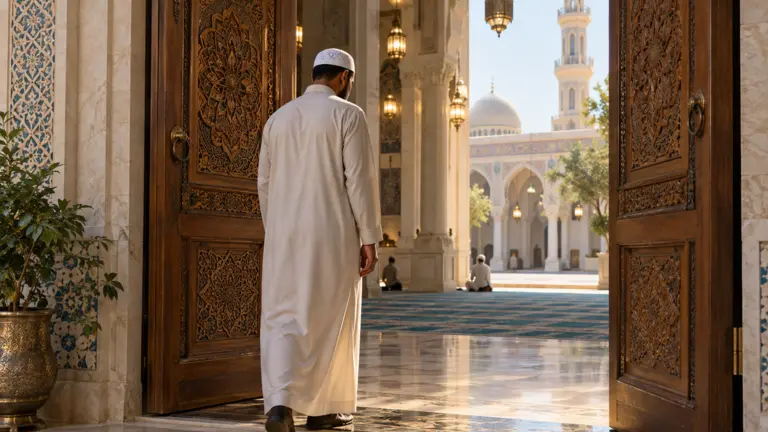
What dua should be recited when entering and leaving the mosque?
When a Muslim enters a mosque, they are not simply crossing the threshold of a building: they are entering a place devoted to prayer, the remembrance of Allah, Quran recitation and worship. The Sunnah teaches a short supplication to say upon entering and another when leaving the mosque.
The dua for entering the mosque asks Allah to open the gates of His mercy. When leaving, the believer asks Him for His bounty.
These two formulas are reported together in an authentic hadith in Sahih Muslim. They are short, easy to memorize and can quickly become a natural habit for anyone who regularly goes to the mosque.
Dua for entering the mosque: Arabic, transliteration and English
When entering the mosque, the Prophet ﷺ taught us to say:
اللَّهُمَّ افْتَحْ لِي أَبْوَابَ رَحْمَتِكَ
Transliteration:
Allāhumma-ftaḥ lī abwāba raḥmatik.
Meaning:
O Allah, open for me the gates of Your mercy.
This supplication is narrated from Abu Humayd or Abu Usayd رضي الله عنهما in Sahih Muslim, no. 713.
The Prophetic text directly associates this formula with the moment the worshipper enters the mosque. A long supplication is therefore not required to apply this Sunnah.
What does “Allāhumma-ftaḥ lī abwāba raḥmatik” mean?
The supplication contains only a few words, but its meaning is profound.
« Allāhumma »
اللَّهُمَّ
Allāhumma means “O Allah”. The worshipper addresses Allah directly at the very moment of entering a place of worship.
« Iftaḥ lī »
افْتَحْ لِي
This expression means “open for me”.
The believer is therefore not merely asking for physical access to the mosque. They ask Allah to open something far more precious: the gates of His mercy.
« Abwāba raḥmatik »
أَبْوَابَ رَحْمَتِكَ
Abwāb means “gates” and raḥmah means “mercy”.
The supplication perfectly suits the context: the worshipper has come to pray, recite the Quran, invoke Allah or attend a lesson. They ask Allah to make entering the mosque an opportunity to receive His mercy.
Learning words such as masjid, raḥmah, ṣalāt and du‘ā gradually helps one understand the formulas rather than relying only on transliteration. Our guide to Islamic Arabic vocabulary explains these terms in greater detail.
What dua should be recited when leaving the mosque?
When leaving the mosque, the same hadith teaches us to say:
اللَّهُمَّ إِنِّي أَسْأَلُكَ مِنْ فَضْلِكَ
Transliteration:
Allāhumma innī as’aluka min faḍlik.
Meaning:
O Allah, I ask You for Your bounty.
This formula is likewise reported in Sahih Muslim, no. 713.
The two supplications therefore form a very simple pair to memorize:
- When entering: ask for Allah’s mercy
- When leaving: ask Allah for His bounty
Why ask for mercy when entering and bounty when leaving?
The hadith establishes the two formulas but does not itself provide a lengthy explanation of the difference. We should therefore avoid attributing to the Prophet ﷺ an interpretation that is not contained in the narration.
We can nevertheless observe the coherence of the two supplications.
Inside the mosque, the believer devotes themselves especially to worship: prayer, dhikr, Quran recitation, supplication or learning. They therefore ask Allah to open the gates of His mercy.
When they leave and return to their activities in the outside world, they ask Allah to grant them from His bounty.
This reading helps us understand the logic of the words while clearly distinguishing the wording of the hadith from explanatory reflection.
Table of the two mosque supplications
| Moment | Arabic | Transliteration | Meaning |
|---|---|---|---|
| When entering | اللَّهُمَّ افْتَحْ لِي أَبْوَابَ رَحْمَتِكَ | Allāhumma-ftaḥ lī abwāba raḥmatik | O Allah, open for me the gates of Your mercy. |
| When leaving | اللَّهُمَّ إِنِّي أَسْأَلُكَ مِنْ فَضْلِكَ | Allāhumma innī as’aluka min faḍlik | O Allah, I ask You for Your bounty. |
Should Bismillah be said before entering the mosque?
Some supplication collections contain longer versions including Bismillāh, prayers upon the Prophet ﷺ or other phrases before the main dua.
For an article that gives priority to the most firmly established wording, the simplest reference remains the hadith in Sahih Muslim:
اللَّهُمَّ افْتَحْ لِي أَبْوَابَ رَحْمَتِكَ
when entering, then:
اللَّهُمَّ إِنِّي أَسْأَلُكَ مِنْ فَضْلِكَ
when leaving.
This approach avoids mixing several variants or chains of transmission when the reader simply wants the authentic dua for entering and leaving the mosque.
Should you enter the mosque with the right foot?
It is commonly taught to enter the mosque with the right foot and leave with the left.
This practice fits within a broader Sunnah principle of giving preference to the right in honorable matters and beginning with the left in certain opposite situations. Authentic hadiths establish, for example, putting on the right shoe first and removing the left shoe first.
However, this rule of etiquette should be distinguished from the supplication itself: Sahih Muslim 713 explicitly teaches the two duas, but this text does not mention the right or left foot.
This distinction is important so that elements deriving from different evidence are not presented as one single Prophetic statement.
What should you do after entering the mosque?
The entrance supplication is only the first step. When the worshipper enters the mosque to pray, other rules and manners apply depending on the situation.
One should notably avoid disturbing people who are praying, preserve the calm of the place and prepare for salāt with concentration and humility.
For beginners who want to master the actions and words of salāt, our guide to learning how to pray in Islam step by step covers the structure of each rak‘ah, Al-Fatiha, rukū‘, sujūd, tashahhud and taslīm.
Should you perform two rak‘ahs when entering the mosque?
There is a prayer commonly known as taḥiyyat al-masjid, the “greeting of the mosque”.
In an authentic hadith, the Prophet ﷺ teaches that when a person enters the mosque, they should not sit down before praying two rak‘ahs.
This practice is distinct from the entrance dua. It is therefore useful not to confuse them:
- the dua is said when entering;
- the two rak‘ahs are the prayer of greeting the mosque.
Particular situations — for example when an obligatory prayer has already begun — belong to the fiqh of prayer and should be studied according to their specific rulings.
Mosque dua and dua after prayer: two different moments
A person going to the mosque may recite several supplications in succession during the same outing, so it is easy to mix up the moments to which they belong.
The mosque entrance dua is said at the moment of entering:
اللَّهُمَّ افْتَحْ لِي أَبْوَابَ رَحْمَتِكَ
The adhkār after prayer are recited after finishing salāt with the taslīm.
The mosque exit dua is finally said when leaving the place:
اللَّهُمَّ إِنِّي أَسْأَلُكَ مِنْ فَضْلِكَ
The adhkār recited after salāt are explained separately in our article on dua and supplications after prayer .
How can you memorize the mosque duas?
These two supplications are short enough to memorize without a complicated method. The most effective approach is to associate them directly with their context.
When you cross the entrance:
اللَّهُمَّ افْتَحْ لِي أَبْوَابَ رَحْمَتِكَ
Then when you leave the mosque:
اللَّهُمَّ إِنِّي أَسْأَلُكَ مِنْ فَضْلِكَ
It is better to repeat each formula in the situation where it is actually used than to memorize the two abstractly dozens of times.
You can also remember two keywords:
- entrance = raḥmah — mercy;
- exit = faḍl — bounty, favor.
This association is particularly helpful for someone beginning to learn Arabic.
Why learn the Arabic meaning of the supplications?
Transliteration helps when you cannot yet read the Arabic alphabet. It should nevertheless remain a temporary aid, because some Arabic sounds cannot be reproduced exactly in Latin letters.
Understanding a few words also makes recitation more conscious. In these two mosque supplications, it is already useful to recognize:
- iftah: open;
- abwāb: the gates;
- raḥmah: mercy;
- as’aluka: I ask You;
- faḍl: bounty, favor.
Anyone who wants to go further can also consult our guide to understanding prayer and supplications in Arabic.
Learn daily supplications gradually
The mosque duas belong to a wider group of adhkār connected with specific situations: entering or leaving home, eating, sleeping, waking, performing wudu or entering the restroom.
It is generally more effective to learn one or two at a time and genuinely integrate them into daily life.
Once the mosque supplications are learned, the Islamic Supplications – Dua category allows you to continue gradually with other common situations.
Study mosque and prayer rulings methodically
Memorizing two supplications is simple. Understanding all the rules connected with the mosque and prayer requires more structure: purification, conditions of salāt, obligatory and voluntary prayers, conduct in the mosque and particular situations.
These questions belong in particular to the fiqh of worship. Studying them systematically helps avoid building one’s practice from isolated rules found in different places.
Al-Dirassa offers individual online Islamic studies courses in which the essential rules of purification and prayer can be studied with a teacher according to the student’s level.
Book your free trial of 30 minutes
Registration form
FAQ about the duas when entering and leaving the mosque
What dua should you say when entering the mosque?
When entering the mosque, recite Allāhumma-ftaḥ lī abwāba raḥmatik — “O Allah, open for me the gates of Your mercy.” This supplication is reported in Sahih Muslim 713.
What dua should you say when leaving the mosque?
When leaving, recite Allāhumma innī as’aluka min faḍlik — “O Allah, I ask You for Your bounty.” This formula is reported in the same hadith.
What is the mosque entrance dua in Arabic?
اللَّهُمَّ افْتَحْ لِي أَبْوَابَ رَحْمَتِكَ
It means: “O Allah, open for me the gates of Your mercy.”
What is the mosque exit dua in Arabic?
اللَّهُمَّ إِنِّي أَسْأَلُكَ مِنْ فَضْلِكَ
It means: “O Allah, I ask You for Your bounty.”
Should you enter the mosque with the right foot?
It is traditionally recommended to enter with the right foot and leave with the left, in accordance with the general principle of giving preference to the right in honorable actions. This etiquette should nevertheless be distinguished from Sahih Muslim 713, which directly establishes the duas but does not mention the feet.
Should you pray two rak‘ahs when entering a mosque?
An authentic hadith teaches not to sit down after entering a mosque until two rak‘ahs have been prayed. This prayer, commonly called taḥiyyat al-masjid, is distinct from the entrance supplication. Particular situations should however be studied according to the relevant fiqh rules.
Hadith references
- Sahih Muslim, no. 713: supplication to recite when entering the mosque and supplication to recite when leaving it.
- Sunan an-Nasa’i, no. 729: transmission of the same two supplications.
- Sahih al-Bukhari and Sahih Muslim: recommendation to perform two rak‘ahs before sitting down after entering the mosque.





No Comments
No comments yet.
No comments yet.