
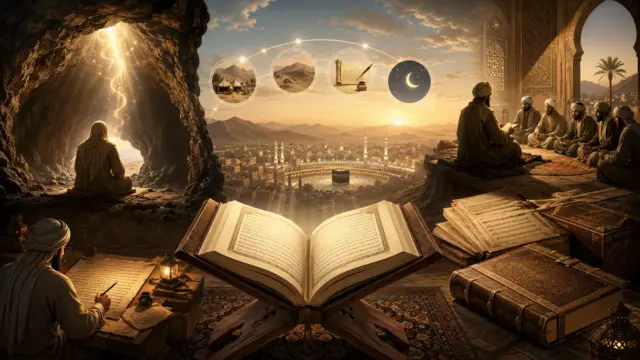
The revelation of the Quran holds a central place in the history of Islam. It marks the beginning of the prophetic mission of Muhammad ﷺ and the gradual descent of the Book of Allah as guidance for believers.
Understanding the history of the Quran’s revelation helps us better grasp its context, timeline, transmission and preservation. It also allows the reader to approach the Quran with more respect, method and attention.
In this article, we will look at the context of Arabia before Islam, the first revelation in the Cave of Hira, the progressive revelation over 23 years, and the way the Quran was memorized, transmitted and compiled.
Why Study the History of the Quran’s Revelation?
Studying the history of the Quran’s revelation is not only about remembering dates. It helps us understand how the Quranic message accompanied the life of the Prophet ﷺ and the first Muslim community.
The Quran was revealed in specific circumstances, in response to events, questions, trials and spiritual needs. Knowing this context helps the learner better understand certain verses, their meaning and their wisdom.
This field belongs to the Quranic sciences. It can encourage the learner to learn Quran online with more awareness, by connecting recitation, understanding and reflection.
The Context of Arabia Before Revelation
Before the revelation of the Quran, the Arabian Peninsula was strongly shaped by tribal organization. Makkah held an important place because of the Kaaba, which was visited by many Arab tribes.
Society at that time also included unjust practices and social imbalances. The Quran would later call people back to the oneness of Allah, moral responsibility, justice, mercy and human dignity.
A Tribal Society Marked by Polytheism
In pre-Islamic Arabia, many tribes practiced polytheism. The Kaaba, originally built for the worship of Allah alone, was surrounded by idols. Tribal rivalries, injustices and certain oppressive social practices were also present.
This context shows the depth of the change brought by the Quranic revelation. The Quran called men and women to worship Allah alone, abandon injustice and build a life based on faith, responsibility and righteousness.
The Search for Pure Monotheism Among Some Arabs
Despite this context, some people rejected idolatry and searched for a purer form of monotheism connected to the legacy of Prophet Ibrahim, peace be upon him. These people are often referred to in Islamic sources as the hanifs.
This search shows that the revelation of the Quran came to a world where there was both great spiritual confusion and a need for guidance.
The First Revelation in the Cave of Hira
Before revelation began, Muhammad ﷺ was known in Makkah for his honesty, noble character and trustworthiness. He would sometimes withdraw to the Cave of Hira, near Makkah, to reflect and distance himself from the idolatrous practices of his people.
It was in this cave, during the month of Ramadan, that the first revelation came through the angel Jibril, peace be upon him.
Ramadan and the Beginning of the Prophetic Mission
The first revelation marked the beginning of the prophetic mission. It was not only a personal event in the life of the Prophet ﷺ, but the beginning of a guidance that would transform beliefs, actions and societies.
The connection between the Quran and the month of Ramadan remains central in Muslim life. Ramadan is the month of the Quran, recitation, prayer, reflection and returning to Allah.
The First Verses Revealed
The first verses revealed were the opening verses of Surah Al-‘Alaq, in which Allah commands reading and reminds the human being of his creation. These verses place knowledge, reading and dependence upon Allah at the heart of the Islamic message from the very beginning.
This first revelation shows that the Quran is both spiritual guidance, an invitation to knowledge and a reminder of the relationship between the human being and the Creator.
A Progressive Revelation Over 23 Years
The Quran was not revealed to the Prophet ﷺ all at once. Its revelation took place gradually over about 23 years, from the beginning of the prophetic mission in Makkah until the end of his life in Madinah.
This gradual process allowed the first Muslims to learn, understand, memorize and apply the teachings of the Quran step by step.
Why the Quran Was Revealed Gradually
The gradual revelation responded to the needs of the community. Some verses strengthened faith, others answered questions, corrected behavior, established rulings or brought comfort during trials.
This divine pedagogy shows that learning religion requires time, understanding and a suitable progression. It also reminds us of the importance of studying the Quran with method.
The Meccan and Medinan Periods
Scholars generally distinguish between verses or surahs revealed before the Hijrah and those revealed after the Hijrah. Meccan revelations often emphasize the oneness of Allah, faith, the Last Day, patience and the stories of the prophets.
Medinan revelations more often address the organization of the community, social rulings, family relations, acts of worship and collective responsibilities.
This distinction helps us better understand the timeline of the Quran’s revelation and the gradual formation of the Muslim community.
How the Quran Was Transmitted and Preserved
The Quran was transmitted through both memorization and writing. The companions learned the verses, recited them, transmitted them and put them into practice.
This dual transmission, oral and written, has an important place in the history of the Quran and in the way Muslims preserved the Book of Allah.
Memorization by the Prophet ﷺ and His Companions
The Prophet ﷺ received the revelation, recited it to his companions and taught them the verses. Many companions memorized the Quran or large parts of it.
Quran memorization is therefore an ancient tradition within the Muslim community. Today, learners who follow a Quran memorization program continue this tradition, with the need to recite, correct and revise regularly.
The Writing Down of Revelation
Alongside memorization, revelation was also written down by companions appointed as scribes. The verses were recorded on different materials available at the time.
This writing supported memorization and contributed to the preservation of the Quranic text.
The Compilation of the Quran After the Prophet’s Death
After the death of the Prophet ﷺ, the companions continued to preserve the Quran with great care. The compilation of the Quranic text into a single volume took place in a context where it became necessary to preserve all the verses in an organized way.
The Compilation Under Abu Bakr
During the caliphate of Abu Bakr, may Allah be pleased with him, a compilation of the Quran was carried out to gather the verses into a single collection. This initiative aimed to preserve the Quran, especially after the death of several memorizers in battles.
This stage shows the care of the companions in protecting the Book of Allah and faithfully transmitting what they had received from the Prophet ﷺ.
The Standardization of Copies Under Uthman
Later, during the caliphate of Uthman, may Allah be pleased with him, copies were prepared and sent to different regions in order to unify the public recitation of the Quran and prevent disagreements between communities.
This standardization played a major role in the preservation and spread of the Quranic text throughout the Muslim world.
What the History of Revelation Teaches Us Today
The history of the Quran’s revelation shows that the Book of Allah came down as progressive guidance connected to faith, education, transformation of character and the building of a just community.
It also reminds us that learning the Quran requires patience, consistency and respect. The first Muslims received the verses, memorized them, understood them and sought to apply them.
This approach remains valuable today for anyone who wants to better read, recite, understand and reflect upon the Quran.
How to Deepen Your Understanding of the Quran
To better understand the Quran, it is useful to combine several dimensions: correct reading, recitation, Tajweed, memorization, study of the general meaning and gradual learning of Quranic Arabic.
A learner can begin by reading regularly, studying the main themes of the Quran, discovering the basics of Quranic sciences and progressing with the help of a teacher.
Al-Dirassa offers online Quran classes to help students progress in reading, recitation, memorization and understanding of the Quran with suitable support.
To better grasp the meaning of the verses in their original language, you can also explore our Quranic Arabic course.
Book your free trial of 30 minutes
Registration form
Conclusion: A Progressive Revelation and Living Guidance
The history of the Quran’s revelation shows guidance that came down gradually, in a specific context, to transform beliefs, behavior and the lives of believers.
From the first revelation in the Cave of Hira to transmission through memorization and writing, and then to the compilation of the Quranic text, each stage reminds us of the importance of the Quran in Muslim life.
Studying this history helps strengthen respect for the Book of Allah and better understand the value of learning it. With method, consistency and guidance, every learner can progress in reading, reciting and understanding the Quran.





No Comments
No comments yet.