
Ramadan is a month of fasting, prayer, Quran recitation and spiritual renewal. For many Muslims, especially beginners or people who want to reconnect with their religious practice, one common question is: what is prohibited during Ramadan?
Understanding these rules helps Muslims observe this blessed month with more clarity and serenity. Fasting is not only about avoiding food and drink. It also trains the believer in patience, sincerity, self-control and obedience to Allah.
In this article, we will explain the main things prohibited during Ramadan, what breaks the fast, the behaviors to avoid, the valid exemptions in Islam and how to learn these rules step by step.
Why Are There Prohibitions During Ramadan?
Fasting in Ramadan is one of the pillars of Islam. Allah says in the Quran:
O you who believe, fasting has been prescribed for you as it was prescribed for those before you, so that you may attain piety.
This verse shows that fasting has a deep spiritual purpose: developing taqwa, meaning consciousness and fear of Allah. The prohibitions of Ramadan are therefore not just restrictions. They help the Muslim discipline the body, the tongue, the heart and daily behavior.
The Fiqh of fasting explains the practical rules of Ramadan: what breaks the fast, what is allowed, what should be avoided and who may be exempt from fasting in specific situations.
The Main Things Prohibited During the Fasting Hours
The main things that break the fast are usually intentional acts committed between true dawn and sunset. It is important to distinguish between doing something deliberately, doing it by mistake, doing it out of forgetfulness or being forced into it.
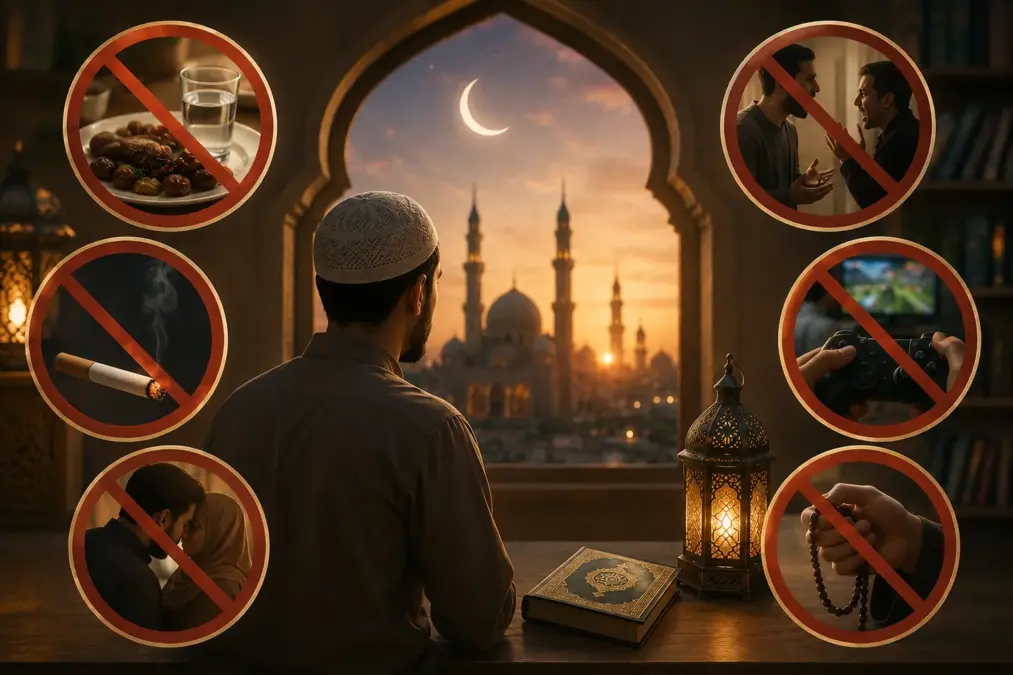
Eating and drinking intentionally
The first major prohibition during Ramadan is eating or drinking intentionally during the fasting hours. This includes food, drinks and anything deliberately consumed to nourish or hydrate the body.
If a person eats or drinks out of forgetfulness, they should stop as soon as they remember and continue their fast. However, eating or drinking intentionally without a valid excuse breaks the fast and requires making up that day.
Smoking or consuming a substance intentionally
Smoking during the fasting hours is prohibited and breaks the fast. This also includes intentionally consuming substances that enter the body through inhalation or absorption.
Ramadan can be an opportunity to work on habits, addictions and self-discipline. Fasting teaches the believer to leave what is harmful and strengthen personal willpower.
Marital relations during the day
Marital relations are prohibited during the fasting hours, from dawn until sunset. They are permitted during the nights of Ramadan, between the breaking of the fast and the entrance of dawn.
The Quran clearly mentions this night-time permission while reminding believers that the fast must be completed until night. This is an important topic in the Fiqh of Ramadan.
Vomiting intentionally
Making oneself vomit intentionally is among the acts that can break the fast. However, if a person vomits unintentionally, without causing it deliberately, they continue their fast according to the well-known scholarly view.
This type of rule shows why it is important to learn Islam with precision. Some situations require careful distinctions between what is voluntary, involuntary, excused or not excused.
Behaviors to Avoid During Ramadan
Some behaviors may not always break the fast in the legal sense, but they can greatly reduce its spiritual value. Ramadan is not only physical abstinence. It is also a school of character.
Lying, insults and bad speech
A Muslim should avoid lying, backbiting, insults, obscene speech and unnecessary arguments. The Prophet ﷺ taught that a person who does not leave false speech and bad actions does not fully benefit from fasting.
The tongue must therefore be carefully guarded during Ramadan. Fasting also means learning to speak with justice, modesty and sincerity.
Anger, arguments and lack of self-control
Excessive anger, useless disputes and aggressive reactions go against the spirit of fasting. The believer should try to remain composed, even when tired, hungry or tested.
Ramadan is a school of patience. It teaches Muslims to respond calmly, avoid conflict and purify their behavior.
Neglecting prayer and religious duties
Fasting while neglecting prayer is a serious contradiction in religious practice. Prayer is a central pillar of Islam. Ramadan should therefore be an opportunity to return to prayer, perform it on time and improve concentration in worship.
Anyone who wants to learn the basics of Islam should give special attention to prayer, purification, Islamic belief, the Quran and the Sunnah.
Things That Do Not Necessarily Break the Fast
Many Muslims have practical questions during Ramadan. Some situations do not necessarily break the fast, especially when they are not intentional or when they are not related to food and drink.
Common examples include:
- eating or drinking out of forgetfulness;
- rinsing the mouth without intentionally swallowing water;
- taking a shower;
- smelling a scent without intentionally inhaling a nourishing substance;
- having a thought or temptation without acting upon it;
- vomiting unintentionally.
These questions should be treated with caution. Details may vary depending on the case, the school of Fiqh and the scholarly opinion followed. In personal situations, it is better to ask a qualified person.
Who Is Exempt from Fasting?
Islam is a religion of mercy and ease. Some people may be exempt from fasting when they have a valid excuse.
These may include:
- a sick person;
- a traveler;
- a pregnant or breastfeeding woman if fasting causes real difficulty;
- an elderly person who is unable to fast;
- a child who has not reached puberty;
- a woman during menstruation or postnatal bleeding.
Some people must make up the missed days later. Others, when they are permanently unable to fast, may be concerned by feeding compensation according to their situation.
It is important not to give one single answer for every case. The Fiqh of fasting takes into account the real condition of each person.
What Should You Do If You Break Your Fast?
If a person breaks their fast deliberately, they should first sincerely repent to Allah. Repentance includes regret, stopping the sin and having a firm intention not to return to it.
Then they should verify what their situation requires: making up the day, offering compensation or, in specific cases, performing an expiation. The rulings are not the same for eating intentionally, drinking intentionally, marital relations during the day, sickness, travel or other situations.
To avoid mistakes, it is better to learn these rules from an Islamic teacher or a qualified person in Islamic sciences.
Learn the Rules of Ramadan Step by Step
The prohibitions of Ramadan are part of the Fiqh of fasting. But to practise Islam properly, it is not enough to know a list of forbidden acts. A Muslim also needs to understand the basics of Islamic belief, purification, prayer, the pillars of Islam, Muslim character and the relationship with the Quran.
If you want to study Islamic sciences online with a clear and progressive method, Al-Dirassa offers courses adapted to beginners, adults and students who want to strengthen their foundations with a teacher.
You can also discover our guide to learn Islam, read more Islamic articles, or help your children benefit from structured Islamic classes for kids.
To complete your learning, it can also be beneficial to study the Quran, Tajweed and the Arabic language. Our pages dedicated to online Quran and Tajweed classes and Quranic Arabic can help you better understand Islamic texts.
Book your free trial of 30 minutes
Registration form
Conclusion
The main things prohibited during Ramadan are eating, drinking, smoking, marital relations during the fasting hours and intentionally doing acts that break the fast. But Ramadan is not limited to these visible rules.
A Muslim should also avoid lying, insults, disputes, neglecting prayer and any behavior that goes against the spirit of fasting. This month is an opportunity to purify the heart, strengthen religious practice and come closer to Allah.
Understanding what is prohibited during Ramadan is a first step. To learn Islam properly, a person needs method, regularity, reliable sources and guidance from a qualified teacher.




No Comments
No comments yet.