
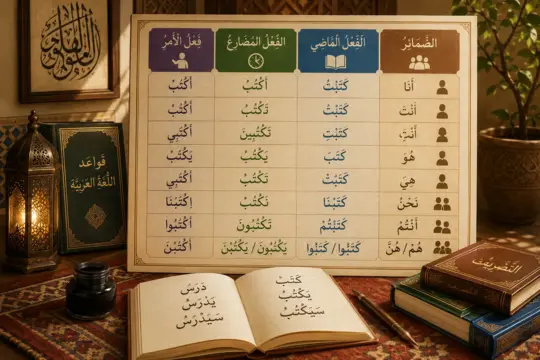
Arabic verbs are essential for understanding Arabic grammar, reading sentences correctly and building your own expressions. In Arabic, the verb is called الفِعْلُ. It expresses an action linked to a tense, a person, a gender and sometimes a number.
To learn Arabic properly, it is essential to understand the main verb forms: the past, the present, the future and the imperative. You also need to recognize prefixes, endings, pronouns and the changes related to Arabic conjugation.
In this complete lesson, we will study Arabic verb tenses, the three main verb forms, the conjugation of the verb كَتَبَ, the present tense, the past tense, the formation of the future with سـ and سَوْفَ, as well as practical examples to make everything clearer.
This lesson is useful for Arabic beginners, but also for students who want to progress in Modern Standard Arabic, classical Arabic, Quranic Arabic, Arabic reading and Arabic conjugation.
Understanding the verb in Arabic
In Arabic, the verb expresses an action. This action can be completed, ongoing, habitual, future or requested as an order.
An Arabic verb can vary according to several elements:
- tense: past, present, future or imperative;
- person: I, you, he, she, we, you plural, they;
- gender: masculine or feminine;
- number: singular, dual or plural;
- context: affirmative, negative, interrogative or conditional sentence.
Understanding these elements helps students recognize verbs in Arabic sentences and avoid common conjugation mistakes.
The three main forms of the Arabic verb
In Arabic grammar, there are generally three main verb forms:
- the past: الفِعْلُ المَاضِي;
- the present or imperfect: الفِعْلُ المُضَارِعُ;
- the imperative: فِعْلُ الأَمْرِ.
These three forms allow you to express an action that has already been completed, an action that is ongoing or habitual, or an order addressed to someone.
The past tense in Arabic: الفِعْلُ المَاضِي
The Arabic past tense, also called the perfect verb, expresses a completed action. Depending on the context, it often corresponds to the English simple past or present perfect.
اِلْتَحَقَ أَخِي بِالْجَامِعَةِ
My brother joined the university.
In this sentence, the verb اِلْتَحَقَ indicates an action that has already been completed.
Other examples:
- كَتَبَ: he wrote;
- دَرَسَ: he studied;
- جَلَسَ: he sat down;
- نَامَ: he slept;
- ذَهَبَ: he went;
- خَرَجَ: he went out.
The basic Arabic verb form is often given in the third person masculine singular. This is why dictionaries and grammar books usually present verbs in forms such as فَعَلَ, كَتَبَ, ذَهَبَ or خَرَجَ.
The present tense in Arabic: الفِعْلُ المُضَارِعُ
The Arabic present tense, also called the imperfect verb, expresses an ongoing action, a habit, a general action or sometimes a future action depending on the context.
تَعْمَلُ أُمِّي مُوَظَّفَةً فِي الشَّرِكَةِ
My mother works as an employee in a company.
In this example, the verb تَعْمَلُ expresses a present action. It may mean that the person is working now or that she usually works in that job.
Other examples:
- يَكْتُبُ: he writes;
- يَدْرُسُ: he studies;
- يَجْلِسُ: he sits down;
- يَنَامُ: he sleeps;
- يُحِبُّ: he loves.
The letters of the present tense verb
The Arabic present tense verb often begins with one of the following letters:
- أَ: for “I”;
- نَ: for “we”;
- يَ: often for “he”;
- تَ: for “you” or “she”, depending on the context.
These letters are sometimes summarized by the formula أَنَيْتُ, used in traditional Arabic conjugation learning.
Examples:
- أَكْتُبُ: I write;
- نَكْتُبُ: we write;
- يَكْتُبُ: he writes;
- تَكْتُبُ: you write / she writes.
The future tense in Arabic: المُسْتَقْبَل
The Arabic future tense expresses an action that will happen later. It can be indicated by the context, by a time adverb or by markers such as سـ and سَوْفَ.
Forming the future with سـ
The future can be formed simply by adding the prefix سـ before the present tense verb.
يَذْهَبُ مُحَمَّدٌ إِلَى العَمَلِ
Muhammad goes to work.
سَيَذْهَبُ مُحَمَّدٌ إِلَى العَمَلِ
Muhammad will go to work.
The verb يَذْهَبُ is in the present tense. When سـ is added, it becomes سَيَذْهَبُ, which expresses the future.
Forming the future with سَوْفَ
The word سَوْفَ also indicates a future action. It is placed before the present tense verb.
سَوْفَ أَحُجُّ فِي العَامِ القَادِمِ
I will perform Hajj next year.
سَيُسَافِرُ أَبِي غَدًا إِلَى بَاكِسْتَانَ
My father will travel to Pakistan tomorrow.
In the last sentence, the prefix سـ and the word غَدًا, which means “tomorrow”, indicate that the action will happen in the future.
The imperative in Arabic: فِعْلُ الأَمْرِ
The imperative in Arabic is used to give an order, instruction or direct request. It is generally addressed to the second person.
Examples:
- اُكْتُبْ: write;
- اُدْرُسْ: study;
- اِجْلِسْ: sit down;
- نَمْ: sleep.
The imperative is very useful in everyday communication, in Arabic grammar exercises and in understanding certain expressions found in Arabic texts.
Comparison table: past, present, future and imperative
| Concept | Arabic form | Example | Translation |
|---|---|---|---|
| Past | الفِعْلُ المَاضِي | كَتَبَ | He wrote |
| Present | الفِعْلُ المُضَارِعُ | يَكْتُبُ | He writes |
| Future | سـ + present | سَيَكْتُبُ | He will write |
| Imperative | فِعْلُ الأَمْرِ | اُكْتُبْ | Write |
Conjugation of the verb كَتَبَ
The verb كَتَبَ means “he wrote”. It is often used as a model in Arabic conjugation because its letters are simple and regular.
From this verb, we can form:
- كَتَبَ: he wrote;
- يَكْتُبُ: he writes;
- اُكْتُبْ: write;
- سَيَكْتُبُ: he will write.
Conjugation of كَتَبَ in the present tense
| Pronoun | Arabic form | Translation |
|---|---|---|
| I | أَكْتُبُ | I write |
| You masculine | تَكْتُبُ | You write |
| You feminine | تَكْتُبِينَ | You write |
| He | يَكْتُبُ | He writes |
| She | تَكْتُبُ | She writes |
| We | نَكْتُبُ | We write |
| They masculine | يَكْتُبُونَ | They write |
| They feminine | يَكْتُبْنَ | They write |
Conjugation of كَتَبَ in the past tense
| Pronoun | Arabic form | Translation |
|---|---|---|
| I | كَتَبْتُ | I wrote |
| You masculine | كَتَبْتَ | You wrote |
| You feminine | كَتَبْتِ | You wrote |
| He | كَتَبَ | He wrote |
| She | كَتَبَتْ | She wrote |
| We | كَتَبْنَا | We wrote |
| They masculine | كَتَبُوا | They wrote |
| They feminine | كَتَبْنَ | They wrote |
Conjugation of كَتَبَ in the imperative
| Addressee | Arabic form | Translation |
|---|---|---|
| You masculine | اُكْتُبْ | Write |
| You feminine | اُكْتُبِي | Write |
| You two | اُكْتُبَا | Both of you write |
| You masculine plural | اُكْتُبُوا | Write |
| You feminine plural | اُكْتُبْنَ | Write |
The verb يُحِبُّ in the present tense: to love
The verb يُحِبُّ means “he loves”. It comes from the verb حَبَّ. It helps students understand how prefixes work in the present tense.
| Arabic form | Translation | Note |
|---|---|---|
| أُحِبُّ | I love | The prefix indicates “I”. |
| تُحِبُّ | You love / she loves | The meaning depends on context. |
| يُحِبُّ | He loves | Masculine singular form. |
| نُحِبُّ | We love | The prefix indicates “we”. |
Examples with يُحِبُّ
| English | Arabic |
|---|---|
| I love Allah. | أُحِبُّ اللهَ |
| Khalid loves the Arabic language. | يُحِبُّ خَالِدٌ اللُّغَةَ الْعَرَبِيَّةَ |
| Fatima loves reading. | تُحِبُّ فَاطِمَةُ الْقِرَاءَةَ |
| We love our religion. | نُحِبُّ دِينَنَا |
| You love your classmate. | تُحِبُّ زَمِيلَكَ |
| That is my father; I love him. | ذَلِكَ أَبِي، أَنَا أُحِبُّهُ |
| That is my mother; I love her. | تِلْكَ أُمِّي، أَنَا أُحِبُّهَا |
The subject and object with the present tense verb
In an Arabic verbal sentence, the verb can be followed by a subject and an object. The subject indicates who performs the action. The object indicates what receives the action.
يُحِبُّ أَكْبَرُ الْكِتَابَةَ
Akbar loves writing.
In this sentence:
- يُحِبُّ is the present tense verb;
- أَكْبَرُ is the subject;
- الْكِتَابَةَ is the object.
The object of the verb is generally in the accusative case. In this example, الْكِتَابَةَ carries a final fatha because it is the object of the verb.
Conjugation of the verb ذَهَبَ in the past tense
The verb ذَهَبَ means “to go” or “to leave”. In its basic form, ذَهَبَ means “he went”.
| Personal pronoun | Arabic form | Translation |
|---|---|---|
| أَنْتَ | ذَهَبْتَ | You went |
| أَنْتِ | ذَهَبْتِ | You went |
| هُوَ | ذَهَبَ | He went |
| هِيَ | ذَهَبَتْ | She went |
| أَنَا | ذَهَبْتُ | I went |
| نَحْنُ | ذَهَبْنَا | We went |
Conjugation of the verb خَرَجَ in the past tense
The verb خَرَجَ means “to go out” or “to leave”. In its basic form, خَرَجَ means “he went out”.
| Personal pronoun | Arabic form | Translation |
|---|---|---|
| أَنْتَ | خَرَجْتَ | You went out |
| أَنْتِ | خَرَجْتِ | You went out |
| هُوَ | خَرَجَ | He went out |
| هِيَ | خَرَجَتْ | She went out |
| أَنَا | خَرَجْتُ | I went out |
| نَحْنُ | خَرَجْنَا | We went out |
Examples of sentences with the past tense verb
| English | Arabic |
|---|---|
| Ahmad went to Iraq. | ذَهَبَ أَحْمَدُ إِلَى الْعِرَاقِ |
| Amina left the classroom. | خَرَجَتْ آمِنَةُ مِنَ الْفَصْلِ |
| Where did you go, Aisha? | أَيْنَ ذَهَبْتِ يَا عَائِشَةُ؟ |
| Why did you leave the mosque? | لِمَاذَا خَرَجْتَ مِنَ الْمَسْجِدِ؟ |
| Did Bilqis go to the kitchen? | أَذَهَبَتْ بِلْقِيسُ إِلَى الْمَطْبَخِ؟ |
| I went to the hospital. | ذَهَبْتُ إِلَى الْمُسْتَشْفَىٰ |
| We left the university. | خَرَجْنَا مِنَ الْجَامِعَةِ |
Examples of Arabic verbs in the present and future
Here are several examples to compare the present and future in Arabic.
يَبْدَأُ العَامُ الدِّرَاسِيُّ الجَدِيدُ
The new school year begins.
سَيَبْدَأُ العَامُ الدِّرَاسِيُّ الجَدِيدُ بَعْدَ شَهْرٍ
The new school year will begin in a month.
نُصَلِّي صَلَاةَ العِيدِ
We perform the Eid prayer.
سَنُصَلِّي صَلَاةَ العِيدِ بَعْدَ شُرُوقِ الشَّمْسِ
We will perform the Eid prayer after sunrise.
يَنْجَحُ الطَّالِبُ المُجْتَهِدُ
The hardworking student succeeds.
سَيَنْجَحُ الطَّالِبُ المُجْتَهِدُ
The hardworking student will succeed.
Words that indicate the time of the action
In Arabic, certain words help specify when the action takes place. These words are very useful for identifying the tense expressed by the verb.
- أَمْسِ: yesterday;
- اليَوْمَ: today;
- غَدًا: tomorrow;
- بَعْدَ: after.
غَدًا
Tomorrow.
اليَوْمَ
Today.
بَعْدَ سَاعَةٍ
After an hour / in an hour.
To study this vocabulary further, you can read the lesson on Arabic time adverbs.
When the present tense can express another time
In Arabic, the present tense can sometimes express a future meaning or be used in specific constructions. Context then plays an important role.
إِنْ ذَاكَرَ مُحَمَّدٌ جَيِّدًا يَنْجَحْ
If Muhammad studies seriously, he will succeed.
In this example, the verb يَنْجَحْ can be understood with a future meaning because it depends on a condition.
أُرِيدُ أَنْ أَلْعَبَ مَعَ أَصْدِقَائِي
I want to play with my friends.
Here, the verb أَلْعَبَ depends on أَنْ. This type of construction is frequent in Arabic grammar and should be studied progressively.
Arabic verb roots
In Arabic, many verbs are built from a root. This root can be composed of three, four, five or six letters. The number of letters can sometimes influence the form of the verb in the present tense or imperative.
| Number of letters | Past | Present | Imperative | Meaning |
|---|---|---|---|---|
| Three letters | جَلَسَ | يَجْلِسُ | اِجْلِسْ | to sit down |
| Four letters | أَصْلَحَ | يُصْلِحُ | أَصْلِحْ | to reform |
| Five letters | اِقْتَرَبَ | يَقْتَرِبُ | اِقْتَرِبْ | to come closer |
| Six letters | اِسْتَخْرَجَ | يَسْتَخْرِجُ | اِسْتَخْرِجْ | to extract |
For a beginner, it is not necessary to master all forms from the start. The first goal is to recognize the main forms: past, present, future and imperative.
How to quickly recognize the tense of an Arabic verb
| Clue | Likely tense | Example |
|---|---|---|
| Basic form often ending with a fatha | Past | كَتَبَ |
| Prefix أ، ن، ي، ت | Present | يَكْتُبُ |
| سـ + present | Future | سَيَكْتُبُ |
| سَوْفَ + present | Future | سَوْفَ أَكْتُبُ |
| Order form addressed to someone | Imperative | اُكْتُبْ |
Arabic conjugation exercises
Exercise 1: complete with the verb يُحِبُّ
Complete the following sentences with the correct form of the verb يُحِبُّ.
- I love reading: ___ الْقِرَاءَةَ
- We love our religion: ___ دِينَنَا
- Khalid loves the Arabic language: ___ خَالِدٌ اللُّغَةَ الْعَرَبِيَّةَ
- Fatima loves writing: ___ فَاطِمَةُ الْكِتَابَةَ
Correction:
- أُحِبُّ الْقِرَاءَةَ
- نُحِبُّ دِينَنَا
- يُحِبُّ خَالِدٌ اللُّغَةَ الْعَرَبِيَّةَ
- تُحِبُّ فَاطِمَةُ الْكِتَابَةَ
Exercise 2: complete in the past tense with ذَهَبَ or خَرَجَ
- I went to school: ___ إِلَى الْمَدْرَسَةِ with ذَهَبَ.
- She left the house: ___ مِنَ الْبَيْتِ with خَرَجَ.
- You went, masculine: ___ with ذَهَبَ.
- We left: ___ with خَرَجَ.
Correction:
- ذَهَبْتُ إِلَى الْمَدْرَسَةِ
- خَرَجَتْ مِنَ الْبَيْتِ
- ذَهَبْتَ
- خَرَجْنَا
Common mistakes made by beginners
- Confusing the past and present because of overly literal translation.
- Forgetting that the present tense can sometimes express a future meaning depending on the context.
- Not recognizing the present tense prefixes: أ، ن، ي، ت.
- Forgetting past tense endings such as ـتُ, ـتَ, ـتِ, ـنَا.
- Confusing the imperative with the present tense.
- Adding سـ to the wrong verb form.
- Studying tables without practicing in complete sentences.
Why learn Arabic verbs progressively?
Arabic conjugation may seem difficult at first because the verb changes according to person, gender, number and tense. However, with a clear method, learning becomes much easier.
Progressive learning helps you:
- recognize verbs more easily in Arabic sentences;
- improve Arabic reading and text comprehension;
- expand your Arabic vocabulary;
- build correct sentences;
- progress in Modern Standard Arabic and classical Arabic;
- better understand certain Quranic Arabic passages.
Learning Arabic conjugation with method
Understanding Arabic verbs is an important step, but students must then practice with other verbs and in complete sentences. They need to learn how to recognize verb tenses, pronouns, masculine and feminine markers, as well as singular, dual and plural forms.
To progress effectively, it is recommended to study step by step:
- the Arabic alphabet;
- Arabic reading and pronunciation;
- Arabic personal pronouns;
- the past tense verb;
- the present tense verb;
- future formation;
- the imperative;
- basic Arabic vocabulary;
- the first rules of Arabic grammar.
If you want to learn Arabic online with a structured method, online Arabic courses allow you to progress with an Arabic teacher who corrects your mistakes and guides you step by step.
To strengthen Arabic grammar, Arabic reading, pronunciation and vocabulary, you can also follow a path in Modern Standard Arabic. Students who want to better understand Quranic texts can study Quranic Arabic.
For beginners, you can also consult our free online Arabic course and our free Arabic books for beginners.
For families, Al-Dirassa also offers Arabic classes for children, adapted to each student’s age, pace and level.
Book your free trial of 30 minutes
Registration form
FAQ — Arabic verbs and conjugation
What are the main Arabic verb tenses?
The main concepts are the past الماضي, the present المضارع, the future المستقبل and the imperative فعل الأمر.
How do you recognize the past tense verb in Arabic?
The past tense verb expresses a completed action. Its basic form is often like كَتَبَ, ذَهَبَ or خَرَجَ.
How do you recognize the present tense verb in Arabic?
The present tense verb often begins with one of the letters أ، ن، ي، ت, as in أَكْتُبُ, نَكْتُبُ, يَكْتُبُ and تَكْتُبُ.
How do you form the future tense in Arabic?
The future is often formed with سـ or سَوْفَ before the present tense verb, as in سَيَذْهَبُ or سَوْفَ أَكْتُبُ.
What is the imperative in Arabic?
The imperative is used to give an order or direct request, such as اُكْتُبْ “write” or اِجْلِسْ “sit down”.
Why is the verb كَتَبَ often used as a model?
Because it is simple, regular and helps students easily understand the main forms: كَتَبَ, يَكْتُبُ and اُكْتُبْ.
Conclusion
Arabic verbs are at the heart of Arabic grammar. They allow students to express an action in the past, present, future or as an order. The past is called الماضي, the present is called المضارع, the future is often formed with سـ or سَوْفَ, and the imperative is used to give an order.
In this lesson, we studied the main forms of the Arabic verb, the conjugation of كَتَبَ, the present tense with يُحِبُّ, the past tense with ذَهَبَ and خَرَجَ, as well as the formation of the future.
To learn Arabic fully, students need a structured method, regular practice and personalized correction from a teacher. This is how they progress sustainably in reading, comprehension and Arabic expression.




No Comments
No comments yet.