
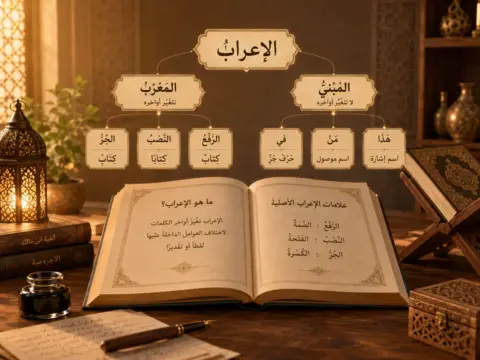
To progress in Arabic grammar, it is essential to understand the difference between declinable and indeclinable words. This distinction helps students read Arabic sentences more accurately, recognize the function of words and understand the role of final vowels.
In Arabic, declension is called الإِعْرَابُ. It indicates the grammatical function of a word in a sentence. Some words change their ending according to their role: they are declinable. Other words always keep the same form: they are indeclinable.
This lesson is intended for Arabic beginners, but also for students who want to strengthen their Arabic grammar, Arabic reading, Modern Standard Arabic, classical Arabic or Quranic Arabic.
What is i‘rab in Arabic?
The term الإِعْرَابُ refers to the grammatical analysis of a word according to its position in the sentence. It helps explain why the final vowel of a word changes.
For example, a word may change according to:
- its role in the sentence;
- the presence of a preposition;
- its function after a verb;
- its place in a nominal sentence;
- its role in an annexation structure;
- whether it is definite or indefinite.
Understanding i‘rab helps students read vocalized Arabic correctly and better understand sentence structure.
Declinable and indeclinable words
In Arabic, words can be divided into two main categories:
- مُعْرَبٌ: a declinable word;
- مَبْنِيٌّ: an indeclinable word.
A declinable word can change its final vowel according to its grammatical case. An indeclinable word generally keeps the same form, even when its function changes in the sentence.
| Type of word | Arabic term | Grammatical behavior | Example |
|---|---|---|---|
| Declinable word | مُعْرَبٌ | The final vowel can change | رَجُلٌ، رَجُلًا، رَجُلٍ |
| Indeclinable word | مَبْنِيٌّ | The final form remains stable | مَنْ، أَيْنَ، هَذَا |
What is a declinable word in Arabic?
A declinable word is a word whose ending changes according to its function in the sentence. In Arabic, it is called مُعْرَبٌ.
Most Arabic nouns are declinable. This means that their final vowel may vary according to the grammatical case: nominative, accusative or genitive.
For example, a noun may be:
- in the nominative case when it is the subject or a main element of the sentence;
- in the accusative case when it is a direct object or appears in certain constructions;
- in the genitive case when it comes after a preposition or in an annexation structure.
Example with the word كِتَاب
| Case | Arabic sentence | Translation | Final sign |
|---|---|---|---|
| Nominative | هَذَا كِتَابٌ | This is a book. | ḍammah / dammatain |
| Accusative | أَخَذْتُ كِتَابًا | I took a book. | fatḥah / fathatain |
| Genitive | لَوْنُ الْكِتَابِ جَمِيلٌ | The color of the book is beautiful. | kasrah |
In these three examples, the word كِتَاب changes its ending according to its grammatical function.
The three grammatical cases in Arabic
Arabic uses three main grammatical cases for declinable nouns:
- الرَّفْعُ or حَالَةُ الرَّفْعِ: the nominative case;
- النَّصْبُ or حَالَةُ النَّصْبِ: the accusative case;
- الجَرُّ or حَالَةُ الْجَرِّ: the genitive case.
Each case corresponds to certain functions in the sentence. To learn Arabic properly, students therefore need to understand the function of the word before determining its ending.
The nominative case in Arabic: الرَّفْعُ
The nominative case is called الرَّفْعُ or حَالَةُ الرَّفْعِ in Arabic. It is often marked by a damma or dammatain at the end of the word.
- ـُ: damma;
- ـٌ: dammatain.
The nominative case applies especially to:
- the subject of the verb: الْفَاعِلُ;
- the beginning of a nominal sentence: الْمُبْتَدَأُ;
- the information that completes the nominal sentence: الْخَبَرُ;
- the passive subject: نَائِبُ الْفَاعِلِ.
| Arabic example | Translation | Function |
|---|---|---|
| شَرَحَ الْمُدَرِّسُ الدَّرْسَ | The teacher explained the lesson. | Subject of the verb |
| الْقِطُّ جَمِيلٌ | The cat is beautiful. | Beginning of a nominal sentence |
| الْحَجَرُ ثَقِيلٌ | The stone is heavy. | Predicate of the nominal sentence |
| سُرِقَتِ الْحَقِيبَةُ | The bag was stolen. | Passive subject |
The accusative case in Arabic: النَّصْبُ
The accusative case is called النَّصْبُ or حَالَةُ النَّصْبِ in Arabic. It is often marked by a fatha or fathatain at the end of the word.
- ـَ: fatha;
- ـً: fathatain.
The accusative case applies especially to:
- the direct object: الْمَفْعُولُ بِهِ;
- the noun of إِنَّ and its sisters;
- the predicate of كَانَ and its sisters;
- the circumstantial complement of state: الْحَالُ.
| Arabic example | Translation | Function |
|---|---|---|
| شَرَحَ الْمُدَرِّسُ الدَّرْسَ | The teacher explained the lesson. | Direct object |
| إِنَّ الْقِطَّ جَمِيلٌ | Indeed, the cat is beautiful. | Noun of إِنَّ |
| أَصْبَحَ الْحَجَرُ ثَقِيلًا | The stone became heavy. | Predicate of أَصْبَحَ |
| جَلَسَ الْوَلَدُ وَحِيدًا | The boy sat alone. | State |
The genitive case in Arabic: الجَرُّ
The genitive case is called الجَرُّ or حَالَةُ الْجَرِّ in Arabic. It is often marked by a kasra or kasratain at the end of the word.
- ـِ: kasra;
- ـٍ: kasratain.
The genitive case applies especially to:
- the noun after a preposition: الاسْمُ بَعْدَ حَرْفِ الجَرِّ;
- the complement of annexation: الْمُضَافُ إِلَيْهِ.
| Arabic example | Translation | Function |
|---|---|---|
| وَقَفَ الْمُدَرِّسُ فِي الْفَصْلِ | The teacher stood in the classroom. | Noun after a preposition |
| هَذِهِ قِطَّةُ الْبِنْتِ | This is the girl’s cat. | Complement of annexation |
| فِي الْبَيْتِ | In the house. | Noun after a preposition |
| عَلَىٰ مَكْتَبٍ | On a desk. | Noun after a preposition |
Why are final vowels important?
In Arabic, final vowels often indicate the role of a word in the sentence. They help determine whether a noun is a subject, a direct object or a complement after a preposition.
The three basic signs are:
- ḍammah: ـُ;
- fatḥah: ـَ;
- kasrah: ـِ.
This concept is very important for learning Modern Standard Arabic, classical Arabic and Quranic Arabic.
Difference with English
In English, the function of words depends mainly on word order. For example:
- The man killed the snake.
- The snake killed the man.
In these two sentences, word order indicates who performs the action and who receives it.
In Arabic, word order can be more flexible because final vowels often indicate the grammatical function.
Example: the man and the snake
Let us look at two very similar Arabic sentences:
قَتَلَ الرَّجُلُ الثُّعْبَانَ
The man killed the snake.
Here, الرَّجُلُ carries a ḍammah: it is therefore the subject. The word الثُّعْبَانَ carries a fatḥah: it is the direct object.
قَتَلَ الرَّجُلَ الثُّعْبَانُ
The snake killed the man.
Here, الثُّعْبَانُ carries a ḍammah: it is the subject. The word الرَّجُلَ carries a fatḥah: it is the direct object.
These examples clearly show the importance of Arabic declension.
Signs of noun declension
In the basic form, a noun in the nominative case carries a ḍammah, a noun in the accusative case carries a fatḥah, and a noun in the genitive case carries a kasrah.
However, some nouns take other signs depending on their form. This is the case for the dual, the sound masculine plural, the sound feminine plural, the five nouns and some diptotes.
| Case | Main sign | Other possible signs | Example |
|---|---|---|---|
| Nominative | ḍammah | alif for the dual, wāw for the sound masculine plural and the five nouns | الْكِتَابُ جَمِيلٌ |
| Accusative | fatḥah | yā for the dual and sound masculine plural, alif for the five nouns, kasrah for the sound feminine plural | قَرَأْتُ الْكِتَابَ |
| Genitive | kasrah | yā for the dual, sound masculine plural and the five nouns, fatḥah for some diptotes | فِي الْكِتَابِ دَرْسٌ |
Examples of special declension signs
| Form | Arabic example | Translation | Sign |
|---|---|---|---|
| Dual in the nominative | الطَّبِيبَانِ مَاهِرَانِ | The two doctors are skilled. | alif |
| Dual in the accusative | رَأَيْتُ الطَّبِيبَيْنِ | I saw the two doctors. | yā |
| Sound masculine plural in the nominative | حَضَرَ الْمُوَظَّفُونَ | The employees came. | wāw |
| Sound masculine plural in the genitive | تَحَدَّثْتُ مَعَ الْمُوَظَّفِينَ | I spoke with the employees. | yā |
| Sound feminine plural in the accusative | رَأَيْتُ الطَّبِيبَاتِ الْمَاهِرَاتِ | I saw the skilled female doctors. | kasrah |
| Diptote in the genitive | هَذِهِ الْمَرْأَةُ مِنْ دِمَشْقَ | This woman is from Damascus. | fatḥah |
Fully declinable nouns: الْمُنْصَرِفُ
Among declinable words, some are fully declinable. In Arabic, they are called الْمُنْصَرِفُ. They are also called triptotes.
These nouns usually accept the three cases with their regular signs and can receive tanwin when they are indefinite.
Examples:
- مُسْلِمٌ: a Muslim;
- خَادِمٌ: a servant;
- كِتَابٌ: a book;
- رَجُلٌ: a man.
Diptotes: المَمْنُوعُ مِنَ الصَّرْفِ
Some nouns are partially declinable. In Arabic, they are called المَمْنُوعُ مِنَ الصَّرْفِ. In grammar, they are often called diptotes.
Diptotes generally do not take tanwin and often take a fatḥah in the genitive instead of a kasrah when they are not defined by ال and are not in an annexation structure.
Common categories of diptotes include:
- some proper nouns of non-Arabic origin;
- some geographical names;
- some color adjectives;
- some adjectives with specific patterns.
Examples:
- أَسْوَدُ: black;
- أَحْمَرُ: red;
- إِبْرَاهِيمُ: Ibrāhīm;
- دَاوُودُ: Dāwūd;
- فِرْعَوْنُ: Pharaoh;
- غَضْبَانُ: angry.
Quranic examples with diptotes
قَالَ الْمَلَأُ مِن قَوْمِ فِرْعَوْنَ إِنَّ هَـٰذَا لَسَاحِرٌ عَلِيمٌ
The chiefs from Pharaoh’s people said: “Indeed, this is a learned magician.” 7:109
In this example, فِرْعَوْنَ is a diptote proper noun.
قُلْ بَلْ مِلَّةَ إِبْرَاهِيمَ حَنِيفًا
Say: “Rather, the religion of Ibrāhīm, devoted exclusively to Allah.” 2:135
The name إِبْرَاهِيمَ belongs to the proper nouns that do not take tanwin.
وَقَتَلَ دَاوُودُ جَالُوتَ
And Dāwūd killed Jālūt. 2:251
The proper nouns دَاوُودُ and جَالُوتَ illustrate special forms of proper nouns.
إِنَّهَا بَقَرَةٌ صَفْرَاءُ فَاقِعٌ لَّوْنُهَا
Indeed, it is a yellow cow, bright in color. 2:69
The word صَفْرَاءُ belongs to the vocabulary of colors and follows a special rule.
What is an indeclinable word in Arabic?
An indeclinable word is a word whose final form does not change according to its position in the sentence. In Arabic, it is called مَبْنِيٌّ.
These words do not take the usual declension marks such as damma, fatha or kasra according to grammatical case. They also do not take tanwin like declinable nouns.
Indeclinable words are called الْكَلِمَاتُ الْمَبْنِيَّةُ.
The main categories of indeclinable words
Indeclinable words are easier to memorize by category. They include:
- interrogative particles and words;
- personal pronouns;
- some demonstrative pronouns;
- some relative pronouns;
- prepositions;
- some particles;
- some adverbs or fixed words.
Indeclinable interrogative words
Interrogative words are generally indeclinable in Arabic. They keep their form even when they appear in different grammatical positions.
- مَنْ: who?
- أَيْنَ: where?
- مَاذَا: what?
- هَلْ: is / do / does?
Examples:
- مَنْ أَنْتَ؟: who are you?
- أَيْنَ الأَسَدُ؟: where is the lion?
- مَاذَا عَلَىٰ الْمَكْتَبِ؟: what is on the desk?
Indeclinable personal pronouns
Personal pronouns are generally indeclinable. They keep their form and do not take tanwin.
- أَنَا: I;
- أَنْتَ: you, masculine;
- هُوَ: he;
- هِيَ: she;
- هُمْ: they, masculine;
- هُمَا: they two, masculine or feminine.
Examples:
- هُوَ بَعِيدٌ: he is far away;
- مَنْ أَنْتَ؟: who are you?
- هُوَ تَحْتَ السَّيَّارَةِ: he is under the car.
Indeclinable demonstrative pronouns
Many demonstrative pronouns are indeclinable. They are used to point to a person, object or idea.
- هَذَا: this, masculine;
- ذَلِكَ: that, masculine and distant;
- هَذِهِ: this, feminine;
- تِلْكَ: that, feminine and distant;
- أُولَئِكَ: those.
Examples:
- هَذَا رَجُلٌ: this is a man;
- هَذِهِ بَطَّةٌ: this is a duck;
- هَذَا بَيْتُ حَامِدٍ: this is Hamid’s house;
- وَذَلِكَ بَيْتُ خَالِدٍ: and that is Khalid’s house.
Indeclinable relative pronouns
Several relative pronouns are also indeclinable, especially frequent forms such as:
- الَّذِي: the one who, masculine;
- الَّتِي: the one who, feminine;
- الَّذِينَ: those who.
These words have a fixed form and are often recognized by their role in connecting a noun to a relative clause.
Indeclinable prepositions
Arabic prepositions, called حُرُوفُ الْجَرِّ, are also indeclinable. Their form does not change.
- عَلَىٰ: on;
- فِي: in;
- إِلَىٰ: to, toward;
- مِنْ: from, since;
- حَتَّىٰ: until.
Examples:
- مَاذَا عَلَىٰ الْمَكْتَبِ؟: what is on the desk?
- سَيَّارَةُ عَبَّاسٍ فِي الشَّارِعِ: Abbas’s car is in the street;
- خَرَجَ الْمُدَرِّسُ مِنْ غُرْفَةِ الْمُدِيرِ: the teacher left the director’s office.
Indeclinable particles
Many particles are indeclinable. They keep a fixed form and sometimes influence the word that follows them.
Among them are:
- لَمْ: a particle of negation and jussive;
- لَنْ: a particle of negation and subjunctive;
- إِنْ: if;
- لَا: no / not.
These particles are fixed in form, even though they may affect the conjugation or case of other words.
Nouns ending with alif maqṣūra ى
Some nouns ending with alif maqṣūra ى keep a stable written form, even when their grammatical case changes. This alif is called الأَلِفُ المَقْصُورَةُ.
Examples:
- مُوسَىٰ: Mūsā;
- عِيسَىٰ: ʿĪsā;
- كُبْرَىٰ: greater / greatest;
- بُشْرَىٰ: glad tidings;
- هُدَى: guidance.
According to detailed grammatical analysis, the declension of these nouns may be estimated or not visible. For beginners, the important point is to remember that the visible ending does not change like regular nouns.
Quranic examples with indeclinable words
ذَٰلِكَ الْكِتَابُ لَا رَيْبَ فِيهِ هُدًى لِّلْمُتَّقِينَ
This is the Book about which there is no doubt, a guidance for the God-conscious. 2:2
In this example, ذَٰلِكَ is an indeclinable demonstrative, and لَا is a particle.
قَالَ أَلْقِهَا يَا مُوسَىٰ
He said: “Throw it down, O Mūsā.” 20:19
The name مُوسَىٰ ends with an alif maqṣūra and keeps a stable visible form.
فَلَا تَقْعُدْ بَعْدَ الذِّكْرَىٰ مَعَ الْقَوْمِ الظَّالِمِينَ
So do not sit, after the reminder, with the wrongdoing people. 6:68
The word الذِّكْرَىٰ also ends with an alif maqṣūra.
لَقَدْ رَأَىٰ مِنْ آيَاتِ رَبِّهِ الْكُبْرَىٰ
He certainly saw some of the greatest signs of his Lord. 53:18
The word الْكُبْرَىٰ ends with an alif maqṣūra.
Example sentences with indeclinable words
| Arabic sentence | Translation | Indeclinable word |
|---|---|---|
| حَقِيبَةُ مَنْ هَذِهِ؟ | Whose bag is this? | مَنْ, هَذِهِ |
| أَيْنَ بَيْتُ الْمُدَرِّسِ؟ | Where is the teacher’s house? | أَيْنَ |
| الْقُرْآنُ كِتَابُ اللهِ | The Quran is the Book of Allah. | — |
| الْكَعْبَةُ بَيْتُ اللهِ | The Kaaba is the House of Allah. | — |
| بَابُ الْمَسْجِدِ مَفْتُوحٌ | The mosque door is open. | — |
How to memorize indeclinable words
To memorize indeclinable words in Arabic, it is useful to learn them by category.
- interrogative words: مَنْ, أَيْنَ, مَاذَا;
- personal pronouns: أَنَا, أَنْتَ, هُوَ, هِيَ;
- demonstrative pronouns: هَذَا, ذَلِكَ, هَذِهِ;
- prepositions: عَلَىٰ, فِي, إِلَىٰ, مِنْ;
- particles: هَلْ, لَمْ, لَنْ, لَا.
This method makes it easier to learn Arabic grammar, Arabic vocabulary and Arabic reading progressively.
Why learn Arabic declension?
Arabic declension is an essential foundation for understanding the function of words in a sentence. It helps students know whether a noun is a subject, an object, a noun after a preposition or part of an annexation structure.
This concept is useful for:
- improving Arabic reading;
- progressing in Arabic grammar;
- understanding Modern Standard Arabic and classical Arabic;
- studying Arabic texts more accurately;
- analyzing certain Quranic Arabic passages;
- building correct Arabic sentences.
To strengthen your foundations, you can read our guide to learning Arabic online, review the Arabic alphabet or use our free Arabic books for beginners.
Learning Arabic grammar with a teacher
Declinable nouns, indeclinable words and grammatical cases may seem difficult at first. However, with a progressive method, simple examples and regular correction, they become much clearer.
An Arabic teacher can help you recognize noun functions, understand declension signs and read sentences accurately.
At Al-Dirassa, you can follow online Arabic courses with personalized support. These courses are suitable for adults, children, beginners and students who want to progress in Modern Standard Arabic, classical Arabic or Quranic Arabic.
To go further in the study of religious texts, you can also discover our Quranic Arabic courses. Families can also choose Arabic classes for children, adapted to each student’s age, pace and level.
Book your free trial of 30 minutes
Registration form
FAQ — I‘rab and Arabic declension
What does الإِعْرَابُ mean?
الإِعْرَابُ refers to grammatical analysis and the variation of a word’s ending according to its function in the sentence.
What is a declinable word in Arabic?
A declinable word, called مُعْرَبٌ, is a word whose ending can change according to its grammatical case.
What is an indeclinable word in Arabic?
An indeclinable word, called مَبْنِيٌّ, keeps a stable final form, even when its grammatical function changes.
What are the three grammatical cases in Arabic?
The three main cases are the nominative الرَّفْعُ, the accusative النَّصْبُ and the genitive الجَرُّ.
What is the difference between الْمُنْصَرِفُ and المَمْنُوعُ مِنَ الصَّرْفِ?
الْمُنْصَرِفُ refers to a fully declinable noun that usually accepts regular case signs and tanwin. المَمْنُوعُ مِنَ الصَّرْفِ refers to a diptote noun, which generally does not take tanwin and follows specific rules.
Why are final vowels important in Arabic?
Final vowels often help determine whether a word is a subject, a direct object, a noun after a preposition or a complement of annexation.
Conclusion
In Arabic, declension, called الإِعْرَابُ, helps students understand the grammatical function of words in the sentence. Some words are declinable: their endings change according to their role. Others are indeclinable: their form remains stable.
Declinable words, called مُعْرَبٌ, can be in the nominative, accusative or genitive case. Indeclinable words, called مَبْنِيٌّ, include pronouns, interrogative words, prepositions, particles and several demonstratives.
Understanding this difference is an important foundation of Arabic grammar. With a clear method, regular examples and correction from a teacher, students can read, analyze and understand Arabic sentences with greater confidence.



No Comments
No comments yet.