
Introduction
Allah, the Most High, only accepts deeds that are correct and sincere. For an action to be accepted by Allah, it must therefore conform to the rules of Islamic law and be performed for Allah alone.
Thus, a reciter must observe certain principles when reading the Quran. Below, we will study the main points to respect.
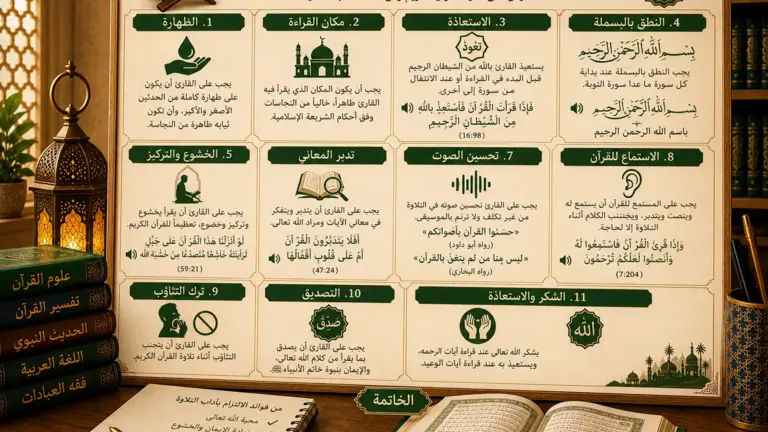
1. Being in a State of Ritual Purity
The reciter should be free from anything that invalidates minor ablution — الوُضوءُ — as well as anything that requires major ritual purification — غُسْل. Therefore, the reader of the Holy Quran should remain in a state of ritual purity.
This also applies to clothing, which should be purified from any impurity.
2. The Place of Recitation
The place where the recitation is performed should be legally pure — طَهَار — according to the criteria of Islamic legislation.
3. Seeking Refuge
The reciter of the Quran seeks protection with Allah, the Most High, by saying the formula of refuge against Satan — تَعَوُّذٌ. This should be pronounced at the beginning of the recitation, whether starting at the beginning or in the middle of a surah, in accordance with the words of Allah:
فَإِذَا قَرَأْتَ الْقُرْآنَ فَاسْتَعِذْ بِاللَّـهِ مِنَ الشَّيْطَانِ الرَّجِيمِ
“So when you recite the Quran, seek refuge in Allah from Satan, the expelled.” (Surah 16, verse 98)
4. Pronouncing the Basmala
The reader should pronounce the basmala at the beginning of every surah, except Surah At-Tawbah, chapter 9:
بِسْمِ اللَّـهِ الرَّحْمَـٰنِ الرَّحِيمِ
In the name of Allah, the Most Gracious, the Most Merciful.
5. Concentration
The reciter should read with spiritual awareness and concentration out of respect for the Holy Quran. Allah, the Most High, says:
لَوْ أَنزَلْنَا هَـٰذَا ٱلْقُرْءَانَ عَلَىٰ جَبَلٍ لَّرَأَيْتَهُۥ خَـٰشِعًا مُّتَصَدِّعًا مِّنْ خَشْيَةِ ٱللَّـهِ
“If We had sent down this Quran upon a mountain, you would have seen it humbled and splitting apart from fear of Allah.”
6. Reflecting on the Meaning of the Verses
The reader should recite attentively and reflect on the meaning of what is being read. Allah, the Most High, says:
أَفَلَا يَتَدَبَّرُونَ ٱلْقُرْءَانَ أَمْ عَلَىٰ قُلُوبٍ أَقْفَالُهَآ
“Do they not reflect upon the Quran, or are there locks upon their hearts?” (47:24)
7. Beautifying the Voice
The reader should beautify the voice during recitation, without arrogance. Bara’ ibn Azib, may Allah be pleased with him, reported that the Messenger of Allah (peace be upon him) said:
“Beautify the Quran with your voices.”
(Source: Sunan Abi Dawud, vol. 2, Book of Prayer, chapter: Istihbab at-Tarteel fi al-Qira’a, Hadith 1468, Al-Maktaba Al-Asriya, Sayda, Beirut)
Abu Hurayrah, may Allah be pleased with him, reported:
“He is not one of us who does not recite the Quran with a melodious voice.”
(Source: Sahih Al-Bukhari, vol. 9, Book of Tajweed, p. 188, Dar Ihya Al-Turath Al-Arabi, Cairo, 1378 AH / 1958)
The purpose of beautifying the voice is to facilitate understanding of the meaning of the text and to encourage the listener to appreciate the beauty of its style and words.
Melodious recitation intended merely for entertainment is prohibited — حَرام. Likewise, it is forbidden to recite according to musical notes or melodies.
An authentic, melodious and beautiful recitation consists of correctly pronouncing the letters and words of the Quran while perfectly applying the rules of Tajweed.
8. Listening to the Recitation
Anyone who hears the recitation of the Quran, whether from a qari, the radio, television, a computer or any other source, is asked to listen attentively, meditate and reflect on the meaning of the verses. Indeed, Allah, the Most High, says:
وَإِذَا قُرِئَ ٱلْقُرْءَانُ فَٱسْتَمِعُوا۟ لَهُۥ وَأَنصِتُوا۟ لَعَلَّكُمْ تُرْحَمُونَ
“So when the Quran is recited, listen to it and remain silent that you may receive mercy.” (7:204)
Likewise, the reader should avoid interrupting a recitation in order to speak to people, unless this is necessary.
9. Restraining Oneself from Yawning
Among the proper manners to observe, the reader should try to restrain the urge to yawn during the recitation.
10. Testifying to the Truthfulness of Allah’s Words
The reader should testify to the truthfulness of the words of Allah, the Most High, and bear witness to His call and to the testament of the Prophet (peace be upon him).
11. Showing Gratitude
The reader should thank Allah, the Most High, for His generosity when reciting verses about mercy, and seek refuge in Allah, the Most High, when reciting verses of warning.
Conclusion
In this twenty-third Tajweed lesson, we have learned the main rules of etiquette to observe when reciting the Holy Quran.
The Quran is not an ordinary book. It is the speech and word of Allah, the Most High. It should therefore be treated in the best possible manner, in accordance with Islamic legislation.
Insha’Allah, in the next lesson, we will study the three permitted modes of Quran recitation.
Book your free trial of 30 minutes
Registration form





No Comments
No comments yet.
No comments yet.