
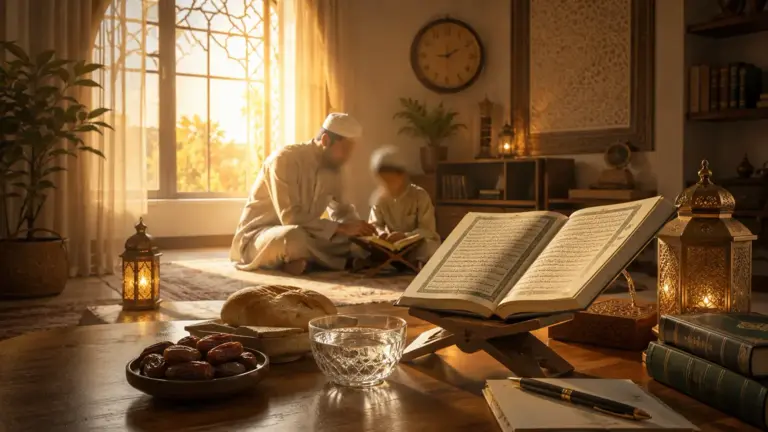
Barakah in Islam is an important concept in the life of a Muslim. People often speak about barakah in time, wealth, family, food, knowledge or work. But what does barakah really mean?
Simply put, barakah is a blessing that Allah places in something, a person, an action or a situation. It brings good, benefit, increase or lasting value. It does not always mean having more in quantity. Sometimes barakah means that a small amount is enough, a short time becomes useful, a family lives with serenity or knowledge truly transforms behavior.
To review the foundations of faith, supplication, halal and good character, visit our page to learn Islam.
Key points about barakah in Islam
Barakah is the blessing Allah places in what He grants. It may appear in time, money, family, food, knowledge, actions, health or a person’s life.
- barakah comes from Allah alone;
- it is not limited to material increase;
- it can make a small thing very beneficial;
- it may appear in time, wealth, family or knowledge;
- it is sought through faith, gratitude, halal, taqwa and supplication;
- it is not superstition or simple luck;
- it does not guarantee a life without tests.
What is barakah in Islam?
Barakah may be translated as blessing. It refers to the good and benefit Allah places in time, wealth, family, food, knowledge, actions or a person’s life.
It is not limited to material increase. A person may have modest income, yet Allah places blessing in it so that it covers needs and brings peace. Another may possess much money but, without barakah, it disappears quickly or becomes a source of anxiety.
Barakah comes from Allah
The source of barakah is Allah alone. No person, object or action grants blessing independently. When a Muslim asks for barakah, one asks Allah to place goodness, benefit and stability in life.
This belief protects the heart from superstition. Islam teaches the believer to take lawful means, supplicate, act sincerely and place trust in Allah.
Barakah and rizq: what is the difference?
Rizq is the provision Allah grants: money, food, health, family, knowledge, opportunities, faith or peace of heart. Barakah is the blessing Allah places in that rizq.
A person may have much apparent rizq but little barakah. Another may have modest rizq but great benefit, stability and peace. Read more in our article on rizq in Islam.
Barakah in time
Barakah in time means that a person uses hours beneficially: worshipping Allah, studying, working, helping family and doing what has meaning.
Without barakah, a person may have much free time but lose it in distraction, delay and confusion.
Barakah in wealth and provision
Barakah in wealth does not always mean becoming rich. It may mean that lawful income is enough, expenses are managed well, the heart is content and money is used in what pleases Allah.
For supplications related to provision and useful wealth, read our article on dua to become rich in Islam.
Barakah in family
Barakah in family may appear through love, mercy, respect, patience and mutual support. A blessed family is not necessarily free from problems, but its members try to resolve difficulties with faith, justice and good character.
Barakah in knowledge
Knowledge with barakah benefits the heart and behavior. It does not remain simple information. It helps a person pray better, speak better, act sincerely and avoid what displeases Allah.
Barakah in actions
A blessed action may be small but sincere. A good word, a short supplication, a lesson learned, charity given discreetly or regular worship may have a great effect when Allah places blessing in it.
Causes of barakah in Islam
There is no mechanical formula that forces barakah to appear. However, Islamic teachings mention causes that help the believer seek Allah’s blessing.
Taqwa and obedience to Allah
Taqwa means being conscious of Allah, obeying Him and avoiding what displeases Him. It is among the greatest causes of good and blessing.
Gratitude
Gratitude, or shukr, is essential. The Muslim recognizes Allah’s blessings, thanks Him for them and uses them in what pleases Him.
Supplications
The Muslim should ask Allah for barakah in life, time, family, wealth, knowledge, work, studies and decisions.
Generosity and sadaqah
Charity purifies the heart from greed and helps the believer use wealth in what pleases Allah.
Halal income
Seeking halal income is an important means of seeking barakah. Money obtained through injustice, deception or the forbidden may seem large, but it does not carry the same peace or blessing.
What barakah is not
Barakah should not be confused with superstition, luck or guaranteed material success.
A person may be tested while being loved by Allah. Another may possess much wealth without barakah. Barakah does not mean that the Muslim will never face hardship.
How to ask Allah for barakah
A Muslim may simply ask Allah to bless time, wealth, family, work, studies and faith.
For example: O Allah, place barakah in what You have given me, bless my time, family, wealth, knowledge and actions, and make all of it a means of drawing closer to You.
Learning Islam to understand barakah
Barakah is connected to several foundations of Islam: belief in Allah, sincerity, prayer, supplication, halal and haram, gratitude, charity, family rights and good character.
You can study these subjects through our Islamic studies online courses, deepen your connection with Quran through Quran and Tajweed online, or understand religious vocabulary with our Quranic Arabic course.
Book your free trial of 30 minutes
Registration form
FAQ — Barakah in Islam
What does barakah mean in Islam?
Barakah means the blessing Allah places in something, a person, time, action or situation. It brings good, benefit and lasting value.
Does barakah mean having more money?
Not necessarily. Barakah may mean that a modest income is enough, useful and accompanied by serenity.
How can one seek barakah in rizq?
Through halal income, gratitude, charity, avoiding injustice, maintaining family ties, supplication and living with taqwa.
Is barakah a form of luck?
No. Barakah comes from Allah and should not be confused with superstition or objects believed to bring luck.
Conclusion
Barakah in Islam is the blessing, good and lasting benefit that Allah places in a person’s life. It may appear in time, wealth, family, knowledge, food, work and actions.
The Muslim seeks barakah through taqwa, gratitude, supplication, generosity, halal income and sincere obedience to Allah, while remembering that barakah comes from Allah alone.




No Comments
No comments yet.
No comments yet.