
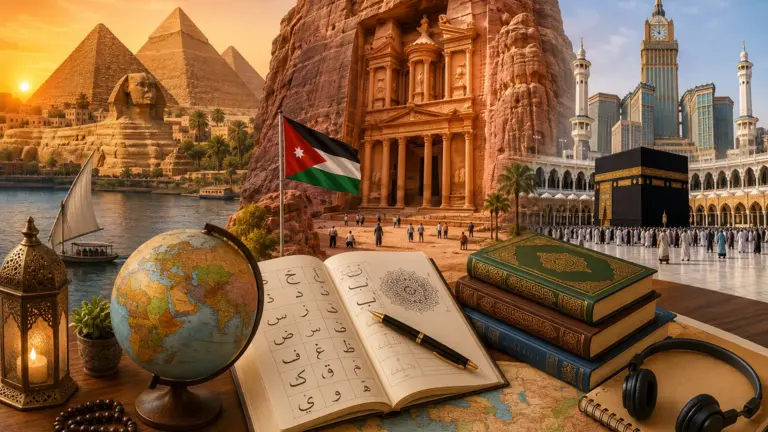
Discover Arab Countries Through Language and Culture
Discovering Arab countries is not only about travelling through landscapes, monuments or traditions. It also means entering a linguistic world where the Arabic language holds a central place. Arabic connects peoples, texts, cultures, histories and different ways of thinking.
For many learners, the desire to learn Arabic begins with an encounter with Arab culture: a trip, a Quran recitation, a conversation with an Arabic speaker, an interest in Islamic history or simply the wish to better understand a rich and ancient civilization.
In this article, we will discover three particularly inspiring Arab countries: Egypt, Jordan and Saudi Arabia. Each of them shows, in its own way, why the Arabic language remains an essential key to accessing the culture, heritage and spirituality of the Arab world.
Why discovering Arab countries helps you learn Arabic
Language learning becomes more meaningful when it is connected to culture. Learning Arabic vocabulary, working on Arabic reading or improving pronunciation makes more sense when you understand the context in which the language is used.
Arabic is present in daily life, literature, religious sciences, poetry, family exchanges, media and education. It can be studied in several forms: Modern Standard Arabic, Quranic Arabic or local dialects.
For beginner students, this diversity may seem impressive. Yet, with progressive learning, proper guidance and a clear method, it becomes possible to move forward step by step: Arabic alphabet, reading, pronunciation, vocabulary, comprehension and expression.
To understand the broader cultural context, you can read our pillar article on Arab culture, language and traditions.
Egypt: history, Arabic language and civilization
Egypt is one of the most influential countries in the Arab world. Its history crosses several periods: ancient civilization, Mediterranean heritage, Coptic period, Islamic civilization and modern Arab culture.
Cairo, Alexandria, Luxor and Aswan evoke centuries of knowledge, architecture, trade, religion and transmission. Egypt is also a country where Arabic holds an important place in daily life, media, religious education and cultural production.
For learners, Egypt shows that Arabic is both a living language and a language of heritage. It is used to communicate, but also to access a very rich intellectual, artistic and spiritual history.
A gateway to Modern Standard Arabic and Quranic Arabic
Many students become interested in Arabic because they want to better understand Islamic texts, read classical works or access religious lessons in Arabic.
Egyptian Arabic is a well-known dialect in the Arab world, especially through media, cinema and cultural exchange. However, for structured learning, many students begin with Modern Standard Arabic, because it allows them to read, write and understand a form of Arabic shared across the Arab world.
Those who want to go further in understanding religious texts can then move toward Quranic Arabic.
Jordan: heritage, hospitality and living Arabic
Jordan is another fascinating Arab country. It is known for its historical heritage, desert landscapes, ancient cities and hospitality. Its emblematic places remind us that this region has been a crossroads of civilizations for centuries.
But Jordan is also a country where Arabic can be discovered through human interaction. Greetings, polite expressions, everyday phrases and simple conversations help learners understand the link between language and culture.
In an Arabic-speaking country, learning a few expressions often changes the quality of exchanges. Saying hello, thanking someone, asking for directions or answering politely can create a more natural connection with people.
Understanding Arab culture through places and exchanges
Learning a language is not only about memorizing rules. It is also about understanding how words are used in real situations.
Hospitality, greetings, invitations, shared meals and respectful expressions all show that the Arabic language also carries a way of relating to others.
To explore this aspect further, you can read our article on Arab hospitality and welcome expressions.
Saudi Arabia: Arabic, Islam and spiritual heritage
Saudi Arabia holds a special place in the Muslim world. Makkah and Madinah are connected to the history of Islam, pilgrimage, prayer, Quran recitation and religious transmission.
For many Muslims, learning Arabic is also connected to the desire to better understand the Quran, supplications, prayer and Islamic sciences.
Arabic is seen not only as a language of communication, but also as a language of religious transmission. This is why many learners begin with the Arabic alphabet and reading, then want to progress toward Quranic Arabic.
Why Quranic Arabic has a special place
Quranic Arabic helps learners better understand the vocabulary, structures and expressions found in the Quran. It does not replace Tafsir or Islamic sciences, but it gives the student strong linguistic foundations to read more consciously and recognize recurring words.
Students interested in recitation can also complete their learning with online Quran and Tajweed lessons, in order to work on reading, pronunciation rules and correction with a qualified teacher.
Shared Arabic and local dialects
Arab countries share a reference language, but they also have many dialects. This diversity can surprise beginners, because the Arabic spoken in one country may be different from the Arabic used in another.
Modern Standard Arabic is used in books, media, education, lectures and many official contexts. Dialects are used in daily life, family conversations and local exchanges.
For a non-Arabic-speaking student, starting with Modern Standard Arabic is often the most structured choice. It helps build a strong foundation before possibly learning a dialect according to a specific country or goal.
Useful words for travelling in Arab countries
Even a few words can help create a first connection with Arabic speakers. Here are some simple and widely understood expressions:
| English | Arabic | Pronunciation |
|---|---|---|
| Hello / welcome | مرحبا | Marhaba |
| Thank you | شكرا | Shukran |
| Yes | نعم | Na‘am |
| No | لا | Lâ |
| Please | من فضلك | Min fadlik |
| Where? | أين؟ | Ayna? |
| I do not understand | لا أفهم | Lâ afham |
These expressions do not replace complete learning, but they show how the language can become immediately useful in a real situation.
Learning Arabic to better understand Arab culture
Egypt, Jordan and Saudi Arabia show that the Arabic language is connected to history, culture and spirituality. But to make real progress, learners need a structured method.
A good learning path should help students move forward in a logical order:
- discover the Arabic alphabet;
- recognize letters according to their position in the word;
- work on Arabic reading and pronunciation;
- memorize useful Arabic vocabulary;
- understand the first rules of grammar;
- read simple sentences;
- progress toward Modern Standard Arabic or Quranic Arabic depending on the goal.
To begin alone, it is possible to use free resources such as free Arabic books for beginners. But as soon as you want to correct your reading, improve pronunciation or progress regularly, the help of a teacher becomes very valuable.
Learn Arabic with a teacher
If Arab culture inspires you and you want to move from discovery to practice, you can follow online Arabic courses with a teacher.
Personalized support makes it possible to adapt the course to your level, pace and goal: beginner Arabic, Quran reading, Modern Standard Arabic or conversation.
Adults can follow a progressive program to learn Arabic from the basics. Families can also choose Arabic classes for kids, with teaching adapted to the child’s age, level and attention span.
At Al-Dirassa, the goal is to help each student learn with method: an Arabic teacher, regular follow-up, personalized correction and the possibility to start with a free trial lesson.
Book your free trial of 30 minutes
Registration form
Conclusion: turning cultural inspiration into regular learning
Egypt, Jordan and Saudi Arabia illustrate three important dimensions of the Arab world: history, heritage, language, religion and human exchange. Discovering them can inspire learners to go further and understand Arab culture from within.
This article helps you see why the Arabic language is a key to accessing this richness. But to learn Arabic fully, inspiration is not enough: you need a method, regular practice, correction and suitable guidance.
With a teacher, learning becomes clearer and more progressive. You can work on the Arabic alphabet, reading, pronunciation, grammar and vocabulary while moving toward the goal that suits you: Modern Standard Arabic, Quranic Arabic, adult courses or Arabic classes for children.




No Comments
No comments yet.
No comments yet.