
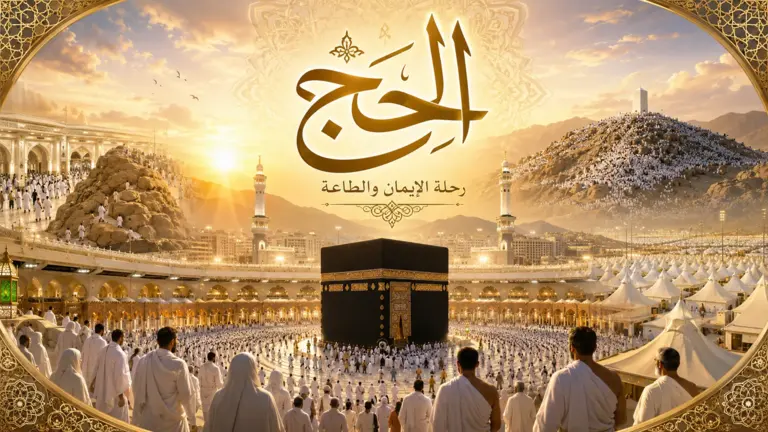
Hajj is the major pilgrimage to Makkah and one of the five pillars of Islam. It is obligatory once in a lifetime for every Muslim who has the physical, financial and practical ability to perform it.
However, Hajj is not only a journey to a sacred place. It is a complete act of worship that involves the body, the heart, wealth, patience and sincerity. It reminds Muslims of unity, obedience to Allah, and the story of Prophet Ibrahim, his son Isma’il and Hajar, peace be upon them.
Understanding Hajj also helps Muslims understand the pillars of Islam and the foundations of Islamic practice. To study these topics more deeply, it is useful to learn Islam through a clear and gradual method.
What does Hajj mean in Islam?
The word الحج Hajj refers to the pilgrimage performed in Makkah during specific days of the month of Dhul-Hijjah, the last month of the Islamic calendar. It includes defined rituals performed in sacred places such as the Kaaba, Arafat, Muzdalifah and Mina.
Hajj is one of the major acts of worship in Islam. It cannot be performed at any time of the year and it is not simply a visit to Makkah. It has a specific time, specific places and specific rites.
Why is Hajj one of the five pillars of Islam?
Hajj is a pillar of Islam because it represents a complete form of worship. The believer leaves behind daily habits, comfort, ordinary clothing and sometimes his country in order to respond to the call of Allah.
This pilgrimage reminds Muslims that all believers are equal before their Lord. Differences of wealth, language, origin and social status become less visible as pilgrims gather in the same places, invoke Allah and perform the same acts of worship.
Hajj also teaches patience, humility, repentance and detachment from worldly distractions. It reminds the Muslim that life should be directed toward Allah and that returning to Him is a reality.
Who must perform Hajj?
Hajj is obligatory for the Muslim who fulfils the necessary conditions. It is not required from someone who does not have the real ability to perform it.
Being Muslim and accountable
Hajj concerns the adult Muslim who is of sound mind and religiously accountable. A child may accompany parents and perform the rites, but this Hajj does not replace the obligation that will apply when the child becomes an adult, if he or she has the ability.
Having physical and financial ability
Ability means being able to make the journey without putting one’s health at serious risk and without neglecting the essential needs of one’s family. The cost of Hajj should also come from lawful means.
A person who cannot afford Hajj or whose health does not allow the journey is not required to perform it as long as this inability remains.
Having safe and organized conditions
Hajj also requires practical conditions: safety, visa, transport, accommodation, guidance and reliable organization. A pilgrim should prepare seriously, seek information from trustworthy organizers and learn the essential rules before travelling.
When does Hajj take place?
Hajj takes place during the month of Dhul-Hijjah. Its main rites are performed on specific days, especially the Day of Arafat, which is one of the most important moments of the pilgrimage.
Unlike Umrah, which can be performed at different times of the year, Hajj can only be performed during its specific period.
The main rituals of Hajj in brief
Hajj includes several rituals, such as ihram, tawaf around the Kaaba, sa’i between Safa and Marwa, standing at Arafat, passing through Muzdalifah, the rites of Mina, the symbolic stoning, the sacrifice and the farewell tawaf.
Each of these rituals carries a spiritual meaning: humility, effort, trust in Allah, repentance, rejection of evil and obedience to the Lord.
To understand their order and practical details, read our beginner-friendly Hajj guide step by step.
What is the difference between Hajj and Umrah?
Hajj and Umrah are both pilgrimages to Makkah, but they are not the same. Hajj is a pillar of Islam and is obligatory once in a lifetime for the person who has the ability to perform it. It can only be performed during a specific time of the year.
Umrah is a lesser pilgrimage that can be performed at different times of the year. It includes fewer rituals than Hajj and does not replace the obligation of Hajj.
The spiritual meaning of Hajj
Hajj reminds Muslims of several essential realities of faith: the oneness of Allah, obedience, patience, equality between believers, repentance, unity of the Muslim community and preparation for the meeting with Allah.
The pilgrimage also teaches the Muslim to control behavior, avoid arguments, remain patient through fatigue and increase supplication. It is a school of inner purification.
This spiritual dimension shows that Hajj cannot be understood only as a sequence of actions. It belongs to a broader understanding of Islamic belief, Sunnah, Quran, Fiqh and Islamic education.
Learning the pillars of Islam step by step
Understanding Hajj requires knowledge of the basics of Islam: Islamic belief, purification, prayer, fasting, zakat, Quran, Sunnah and the main rules of worship.
For a beginner, studying alone can be difficult. Learning with an Islamic teacher online allows the student to progress step by step, ask questions and avoid confusion between culture, local customs and religious rulings.
Al-Dirassa offers structured programs to learn Islam online, with courses adapted to adults, beginners and students who want to study Islamic sciences progressively. These Islamic courses online cover Aqeedah, Fiqh, purification, prayer, the pillars of Islam and the foundations of Islamic practice.
Families can also guide their children through an Islam course for children, designed to provide clear Islamic education adapted to their age and level.
Book your free trial of 30 minutes
Registration form
To go further
Hajj belongs to a wider set of acts of worship and Islamic knowledge. To deepen your understanding, you can read our Islamic articles, study the Quran through online Quran and Tajweed classes, or learn Quranic Arabic to better understand religious vocabulary.
Conclusion
Hajj is one of the five pillars of Islam and a major act of worship. It brings together the body, the heart and wealth in a journey toward Allah, through rites that recall the history of the prophets, the unity of Muslims and the reality of returning to the Lord.
This article helps explain the general meaning of Hajj, but a complete understanding of Islam requires method, consistency, reliable sources and guidance from a qualified teacher. Studying the basics of Islam seriously helps Muslims better understand acts of worship and practise them with greater awareness.




No Comments
No comments yet.
No comments yet.