
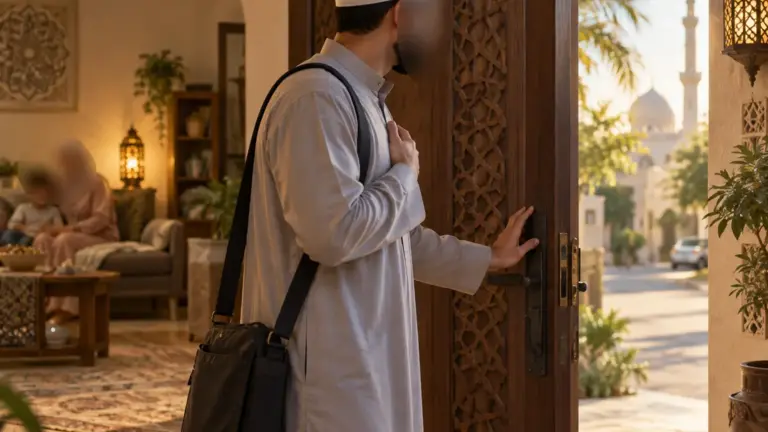
What dua should be said when entering and leaving the house?
Entering one’s home or stepping through the door to go out may seem ordinary. Yet the Sunnah connects these everyday moments with the remembrance of Allah. A Muslim is encouraged to mention Allah when entering the home, and a specific supplication is reported for leaving it.
The best-known dua for leaving the house begins with Bismillāh, tawakkaltu ‘ala-Llāh. It expresses reliance upon Allah before facing whatever awaits outside.
When entering the home, an important nuance is needed. An authentic hadith in Sahih Muslim clearly establishes mentioning Allah’s name upon entering. Longer formulas are also circulated, but they do not all have the same degree of authenticity.
The essential point is therefore to distinguish correctly what is said when entering from what is recited when leaving, and to understand the meaning rather than memorize the words mechanically.
Dua when leaving the house: Arabic, transliteration and English
When leaving one’s home, it is reported to say:
بِسْمِ اللَّهِ، تَوَكَّلْتُ عَلَى اللَّهِ، لَا حَوْلَ وَلَا قُوَّةَ إِلَّا بِاللَّهِ
Transliteration:
Bismillāh, tawakkaltu ‘ala-Llāh, lā ḥawla wa lā quwwata illā bi-Llāh.
Meaning:
In the name of Allah, I place my trust in Allah. There is no power and no strength except through Allah.
This supplication is narrated from Anas ibn Mālik رضي الله عنه in Sunan Abi Dawud, no. 5095.
What is the virtue of the dua when leaving home?
The hadith associates this supplication with three benefits: the person is guided, safeguarded and protected. It also states that the devils withdraw from them.
Bismillāh means beginning by mentioning Allah. Tawakkaltu ‘ala-Llāh expresses reliance upon Him. Lā ḥawla wa lā quwwata illā bi-Llāh reminds us that human beings possess neither strength nor ability independently of Allah.
The protection mentioned in the hadith should not be understood as a magical mechanism. The supplication is an act of dhikr and reliance upon Allah as one leaves the familiar space of the home.
What does “Bismillāh, tawakkaltu ‘ala-Llāh” mean?
“Bismillāh”
بِسْمِ اللَّهِ
Bismillāh means “In the name of Allah” and allows a lawful everyday action to begin with the remembrance of Allah.
“Tawakkaltu ‘ala-Llāh”
تَوَكَّلْتُ عَلَى اللَّهِ
It means “I place my trust in Allah”. Tawakkul does not mean abandoning practical means or precautions; it means acting while recognizing that the final outcome depends upon Allah.
A person may lock the door, take precautions, prepare the journey and at the same time place their trust in Allah.
“Lā ḥawla wa lā quwwata illā bi-Llāh”
لَا حَوْلَ وَلَا قُوَّةَ إِلَّا بِاللَّهِ
This formula reminds us that every real ability to change a situation or accomplish an action depends on the will and power of Allah.
Understanding these words helps recite the dua with greater presence and also makes the Arabic vocabulary of supplications easier to learn.
Is there another supplication for leaving the house?
Another supplication is narrated from Umm Salamah رضي الله عنها for when the Prophet ﷺ left his home:
اللَّهُمَّ إِنِّي أَعُوذُ بِكَ أَنْ أَضِلَّ أَوْ أُضَلَّ، أَوْ أَزِلَّ أَوْ أُزَلَّ، أَوْ أَظْلِمَ أَوْ أُظْلَمَ، أَوْ أَجْهَلَ أَوْ يُجْهَلَ عَلَيَّ
Transliteration:
Allāhumma innī a‘ūdhu bika an aḍilla aw uḍalla, aw azilla aw uzalla, aw aẓlima aw uẓlama, aw ajhala aw yujhala ‘alayya.
Meaning:
O Allah, I seek refuge in You from going astray or being led astray, from slipping or being made to slip, from wronging others or being wronged, and from acting ignorantly or being treated with ignorance.
This supplication is narrated by Abu Dawud and At-Tirmidhi and also appears in Riyad as-Salihin.
It complements the first supplication well: the believer asks not only to be protected from what may happen to them, but also from wrongs they themselves might commit against others.
What should be said when entering the house?
An authentic hadith in Sahih Muslim teaches the believer to mention Allah when entering.
The hadith of Jābir ibn ‘Abdillah رضي الله عنه states that when a person enters the house mentioning Allah and also mentions Allah when eating, Satan says that there is neither a place to spend the night nor a meal for him there.
The simplest and safest habit is therefore to say:
بِسْمِ اللَّهِ
Transliteration: Bismillāh.
Meaning: In the name of Allah.
What is explicitly established is mentioning Allah’s name upon entering. This precision should be preserved when presenting the Sunnah.
Should “Bismillāhi walajnā wa bismillāhi kharajnā” be said?
A longer supplication is frequently taught for entering the house:
اللَّهُمَّ إِنِّي أَسْأَلُكَ خَيْرَ الْمَوْلَجِ وَخَيْرَ الْمَخْرَجِ، بِسْمِ اللَّهِ وَلَجْنَا، وَبِسْمِ اللَّهِ خَرَجْنَا، وَعَلَى اللَّهِ رَبِّنَا تَوَكَّلْنَا
Transliteration:
Allāhumma innī as’aluka khayra-l-mawlaji wa khayra-l-makhraji, bismillāhi walajnā, wa bismillāhi kharajnā, wa ‘ala-Llāhi Rabbinā tawakkalnā.
Meaning:
O Allah, I ask You for the good of our entrance and the good of our exit. In the name of Allah we enter, in the name of Allah we leave, and upon Allah, our Lord, we place our trust.
This wording is reported in Sunan Abi Dawud, no. 5096. The chain of this version has however been judged weak by some hadith specialists.
It should therefore not be presented as having exactly the same level of authenticity as the hadith in Sahih Muslim establishing the mention of Allah upon entering.
For someone who wants to prioritize what is most firmly established, saying Bismillāh when entering is a simple practice supported by authentic evidence.
Should you greet your family when entering the home?
Entering a house is not limited to pronouncing a supplication. The Islamic greeting is also among the good habits to establish in the home.
When people are present, it is natural to say:
السَّلَامُ عَلَيْكُمْ
As-salāmu ‘alaykum — “Peace be upon you.”
This connects entering the home with remembrance of Allah, peace and kindness toward family members.
For parents, these simple actions are also a practical way to pass religious practice on to children. Our article on easy supplications for Muslim children to learn presents several short formulas that can gradually be incorporated into family life.
Dua for the house and dua for travel: what is the difference?
The supplication recited when leaving home concerns an ordinary outing: going to work, running an errand, accompanying children or making a daily journey.
The traveler’s supplication concerns a different situation. It accompanies departure on a journey, the journey itself and the return.
It is therefore not necessary to recite the entire travel supplication every time one crosses the doorstep for an ordinary outing.
This distinction respects the context specific to each supplication and avoids turning several different adhkār into one indistinct routine.
How can you learn the two supplications without confusing them?
The most effective method is to associate each formula with a specific movement.
When leaving:
بِسْمِ اللَّهِ، تَوَكَّلْتُ عَلَى اللَّهِ، لَا حَوْلَ وَلَا قُوَّةَ إِلَّا بِاللَّهِ
When returning home:
بِسْمِ اللَّهِ
Rather than repeating the formulas ten times in a row, it is more effective to use them consistently in their real context.
The door handle or putting on shoes can become the mental cue for the leaving-home dua. Crossing the threshold on the way in becomes the cue to say Bismillāh and then greet those present.
This association supports long-term memorization for adults as well as children.
How can you teach the house dua to children?
Supplications connected with the home are particularly suitable for children because they correspond to very concrete situations.
There is no need to begin with several long formulas. A child can first learn:
- Bismillāh when entering;
- As-salāmu ‘alaykum when meeting the family;
- then gradually Bismillāh, tawakkaltu ‘ala-Llāh… when leaving.
The goal is to create a habit that is understood rather than a recitation performed under pressure.
Al-Dirassa also presents a gradual method in its guide on teaching Islam to children at home: daily supplications then become small habits linking religious practice to family life.
Daily supplications: build a routine gradually
House supplications become more meaningful when they are integrated into a coherent routine.
A Muslim can gradually associate different moments of the day with their authentically reported supplications: leaving home, returning, entering the restroom, eating, going to sleep or beginning a journey.
It is better to learn a few formulas correctly, understand their meaning and recite them regularly than to try to memorize a long list in a few days.
After the house supplications, you can continue with the dua before and after the restroom or the evening and bedtime adhkār.
The Islamic Supplications – Dua category then allows you to expand this routine gradually to other situations.
Understand supplications rather than reciting them mechanically
Transliteration is useful when you cannot yet read Arabic, but it remains imperfect: some Arabic sounds cannot be reproduced precisely with the Latin alphabet.
Understanding the vocabulary also improves memorization. In the leaving-home dua, remember three ideas: Bismillāh, begin with Allah; tawakkaltu, trust Him; lā ḥawla wa lā quwwata illā bi-Llāh, recognize that true strength comes from Him.
Anyone who wants to deepen these concepts and study the religious rules of everyday life can take online Islamic studies courses with a dedicated teacher.
Book your free trial of 30 minutes
Registration form
FAQ about the dua when entering and leaving the house
What dua should be recited when leaving the house?
When leaving, one may say: Bismillāh, tawakkaltu ‘ala-Llāh, lā ḥawla wa lā quwwata illā bi-Llāh. This supplication is reported in Sunan Abi Dawud 5095.
What should you say when entering your home?
An authentic hadith in Sahih Muslim teaches mentioning Allah when entering. Saying Bismillāh is a simple way to apply this recommendation.
What is the dua for leaving the house in Arabic?
بِسْمِ اللَّهِ، تَوَكَّلْتُ عَلَى اللَّهِ، لَا حَوْلَ وَلَا قُوَّةَ إِلَّا بِاللَّهِ
It means: “In the name of Allah, I place my trust in Allah. There is no power and no strength except through Allah.”
Is the formula “Bismillāhi walajnā” authentic?
It is reported in Sunan Abi Dawud 5096, but its chain has been judged weak by some specialists. It should therefore not be presented as having the same level of authenticity as the Sahih Muslim hadith about mentioning Allah when entering.
Can house supplications be recited only in English?
A Muslim may supplicate in their own language for personal requests. To apply a specific Prophetic formula transmitted in Arabic, it is preferable to learn it gradually in its original wording while understanding its translation.
Which supplication should a child learn first?
Begin simply with Bismillāh when entering. Once this habit is established, the child can gradually learn the leaving-home formula Bismillāh, tawakkaltu ‘ala-Llāh….
Hadith references
- Sahih Muslim, no. 2018: mentioning Allah’s name when entering the house and when eating.
- Sunan Abi Dawud, no. 5095: the supplication Bismillāh, tawakkaltu ‘ala-Llāh, lā ḥawla wa lā quwwata illā bi-Llāh. when leaving the house.
- Riyad as-Salihin, no. 82: a supplication seeking protection from misguidance, error, injustice and ignorance when leaving home.
- Sunan Abi Dawud, no. 5096: the formula Allāhumma innī as’aluka khayra-l-mawlaji..., whose chain is noted as weak in the consulted version.





No Comments
No comments yet.
No comments yet.