
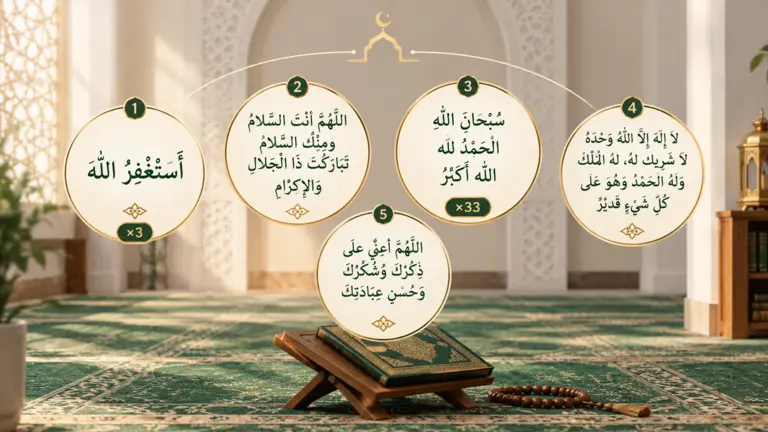
After completing an obligatory prayer, a Muslim can prolong this moment of worship with several authentically reported adhkār and supplications. Among the best known are asking Allah for forgiveness three times, saying Allāhumma anta-s-Salām, and then reciting tasbīḥ, taḥmīd and takbīr.
There is therefore not just one “dua after prayer”, but several formulas transmitted in the Sunnah. Some are very short and easy to memorise; others can be added gradually to a routine after the five obligatory prayers.
The important point is to distinguish formulas genuinely transmitted from the Prophet ﷺ from personal habits, and not to treat a long list as obligatory. Below are the main adhkār, with Arabic, transliteration and meaning.
What should you say immediately after finishing the prayer?
After the final salām, the Prophet ﷺ would ask Allah for forgiveness three times and then recite a formula mentioning Allah as the Source of peace. This dhikr is reported from Thawbān in Sahih Muslim 591.
Begin by saying three times:
أَسْتَغْفِرُ اللَّهَ
Transliteration: Astaghfirullāh.
Meaning: I ask Allah for forgiveness.
Then say:
اللَّهُمَّ أَنْتَ السَّلَامُ وَمِنْكَ السَّلَامُ تَبَارَكْتَ ذَا الْجَلَالِ وَالْإِكْرَامِ
Transliteration: Allāhumma anta-s-Salāmu wa minka-s-Salām, tabārakta dhā-l-jalāli wa-l-ikrām.
Meaning: O Allah, You are Peace and from You comes peace. Blessed are You, Possessor of majesty and honour.
Beginning with istighfār may seem surprising after an act of worship, yet this practice is directly established in the Sunnah: even after salāt, the believer recognises shortcomings and asks Allah for forgiveness.
Why say Astaghfirullah three times after prayer?
Sahih Muslim explicitly reports that the Messenger of Allah ﷺ asked for forgiveness three times after finishing the prayer. This reminds the believer that performing an act of worship does not necessarily mean performing it perfectly. Concentration can weaken and distractions can affect the quality of the prayer.
Istighfār therefore reflects humility: the believer worships Allah while recognising an ongoing need for His forgiveness.
Subhanallah, Alhamdulillah and Allahu Akbar after prayer
Among the best-established adhkār after prayer are Subḥānallāh, Al-ḥamdu lillāh and Allāhu akbar. According to Abu Hurayra, the Prophet ﷺ taught that after each prayer one may say:
- Subḥānallāh: 33 times;
- Al-ḥamdu lillāh: 33 times;
- Allāhu akbar: 33 times.
This makes 99. The hundredth dhikr is:
لَا إِلَهَ إِلَّا اللَّهُ وَحْدَهُ لَا شَرِيكَ لَهُ، لَهُ الْمُلْكُ وَلَهُ الْحَمْدُ وَهُوَ عَلَى كُلِّ شَيْءٍ قَدِيرٌ
Transliteration: Lā ilāha illa-Llāhu waḥdahu lā sharīka lah, lahu-l-mulku wa lahu-l-ḥamd, wa huwa ʿalā kulli shay'in qadīr.
Meaning: There is no deity worthy of worship except Allah alone, without partner. To Him belongs sovereignty and to Him belongs all praise, and He is capable of all things.
This form is reported in Sahih Muslim 597a.
What do Subhanallah, Alhamdulillah and Allahu Akbar mean?
Subḥānallāh — سُبْحَانَ اللَّهِ expresses Allah's perfection and freedom from every imperfection. Al-ḥamdu lillāh — الْحَمْدُ لِلَّهِ means that all praise belongs to Allah. Allāhu akbar — اللَّهُ أَكْبَرُ affirms Allah's greatness.
Understanding the meaning prevents dhikr from becoming mere counting. Reciting more slowly with attention is better than focusing only on completing repetitions.
Which dua asks Allah to help us worship Him better?
The Prophet ﷺ taught Muʿādh ibn Jabal an especially important supplication:
اللَّهُمَّ أَعِنِّي عَلَى ذِكْرِكَ وَشُكْرِكَ وَحُسْنِ عِبَادَتِكَ
Transliteration: Allāhumma aʿinnī ʿalā dhikrika wa shukrika wa ḥusni ʿibādatik.
Meaning: O Allah, help me to remember You, thank You and worship You in the best manner.
In Sunan Abi Dawud 1522, the Prophet ﷺ advised Muʿādh not to neglect this supplication after every prayer. It asks Allah for help in three central dimensions: remembrance, gratitude and worship.
Can Ayat al-Kursi be recited after every prayer?
Reciting Ayat al-Kursī, verse 255 of Surah al-Baqara, after the obligatory prayers is also reported in hadith sources.
اللَّهُ لَا إِلَهَ إِلَّا هُوَ الْحَيُّ الْقَيُّومُ...
A report from Abu Umāma states that whoever recites Ayat al-Kursī after every obligatory prayer is separated from entering Paradise only by death. The report is attributed to al-Nasā'ī and was authenticated by several hadith specialists.
For precision, this report is not in Sahih al-Bukhari or Sahih Muslim. Its authenticity was assessed by hadith scholars, so it should not be attributed to a different source.
For someone who already knows Ayat al-Kursī, it is easy to integrate into post-prayer adhkār. A beginner can first learn the shorter formulas and memorise the full verse gradually.
Which surahs are recited after prayer?
It is also reported that the Prophet ﷺ instructed ʿUqba ibn ʿĀmir to recite the Muʿawwidhāt after each prayer. This is reported in Sunan Abi Dawud 1523.
- Al-Ikhlāṣ — Surah 112;
- Al-Falaq — Surah 113;
- An-Nās — Surah 114.
These short surahs can gradually be integrated into the dhikr routine after salāt. Learning Qur'an reading and pronunciation also helps avoid permanent dependence on transliteration.
In what order should post-prayer adhkār be done?
For a simple routine, the main adhkār can be organised as follows:
- Say Astaghfirullāh three times;
- recite Allāhumma anta-s-Salāmu wa minka-s-Salām...;
- say other transmitted post-prayer formulas;
- Subḥānallāh 33 times;
- Al-ḥamdu lillāh 33 times;
- Allāhu akbar 33 times;
- complete with Lā ilāha illa-Llāhu waḥdahu lā sharīka lah...;
- recite other known adhkār, including Ayat al-Kursī and the protective surahs.
This order is a memorisation aid. The prophetic texts report several formulas and variants, so a practical checklist should not be turned into an additional ritual regarded as obligatory in every detail.
Dua and dhikr after prayer: what is the difference?
In everyday language, “dua after prayer” often refers to everything recited after the salām. Strictly speaking, however, dhikr and duʿā are not identical. Dhikr is remembrance of Allah, such as Subḥānallāh, Al-ḥamdu lillāh, Allāhu akbar, Astaghfirullāh and tahlīl. Duʿā is more specifically a supplication in which the believer asks Allah for forgiveness, guidance, protection, ease or another lawful good.
Allāhumma aʿinnī ʿalā dhikrika... is therefore a true supplication, whereas the repeated formulas of Subḥānallāh and Al-ḥamdu lillāh are dhikr.
Can you make a personal dua after prayer?
A Muslim may call upon Allah and ask Him for lawful needs. However, personal duʿā should be distinguished from the specific adhkār transmitted after obligatory prayers. A personal supplication should not be presented as an obligatory prophetic formula.
There are also moments inside the prayer associated with duʿā, especially prostration. Sahih Muslim reports that the servant is closest to his Lord while prostrating.
Al-Dirassa has a separate guide to supplications in prostration during prayer, which helps distinguish duas within salāt from adhkār after the final salām.
Should adhkār be said after all prayers?
The cited texts especially concern adhkār after the prescribed obligatory prayers, particularly Fajr, Dhuhr, ʿAsr, Maghrib and ʿIshā'. The simplest approach is to connect the adhkār automatically to the final salām. With five repetitions each day, the principal formulas are usually memorised naturally.
How can you learn the post-prayer supplications without becoming discouraged?
There is no need to memorise everything on the first day. A beginner can start for a few days with Astaghfirullāh × 3 and Allāhumma anta-s-Salām.... Once these are secure, add Subḥānallāh × 33, Al-ḥamdu lillāh × 33 and Allāhu akbar × 33, then gradually learn the closing tahlīl, Allāhumma aʿinnī..., Ayat al-Kursī and the protective surahs.
This is more robust than permanently reading a sheet containing many texts without truly knowing them. The goal is for the adhkār to become increasingly natural and independent.
A simple post-prayer adhkār chart
| Dhikr or supplication | Number | When |
|---|---|---|
| أَسْتَغْفِرُ اللَّهَ — Astaghfirullāh | 3 times | Immediately after prayer |
| اللَّهُمَّ أَنْتَ السَّلَامُ وَمِنْكَ السَّلَامُ تَبَارَكْتَ ذَا الْجَلَالِ وَالْإِكْرَامِ... | Once | After istighfār |
| سُبْحَانَ اللَّهِ — Subḥānallāh | 33 times | After the obligatory prayer |
| الْحَمْدُ لِلَّهِ — Al-ḥamdu lillāh | 33 times | After the obligatory prayer |
| اللَّهُ أَكْبَرُ — Allāhu akbar | 33 times | After the obligatory prayer |
| لَا إِلَهَ إِلَّا اللَّهُ وَحْدَهُ ... | Once | To complete 100 |
| اللَّهُمَّ أَعِنِّي عَلَى ذِ... | Once | After prayer |
Make post-prayer dhikr a lasting habit
The main difficulty is usually not knowing the words but remaining consistent. The five daily prayers already structure the day, so post-prayer dhikr can become a pillar of a daily dhikr, adhkār and istighfār routine. Once established, morning, evening, mealtime and bedtime supplications can be added gradually.
To broaden your learning, see the guide to daily duas in Islam.
Understanding the rules of prayer and dhikr
Memorising a list of adhkār is useful, but understanding their sources and place in religious practice helps avoid two opposite errors: neglecting authentically transmitted formulas or treating non-obligatory practices as obligatory.
Those who want to study prayer, purification, dhikr and other fundamentals in depth can follow online Islamic Studies courses in a structured learning environment.
Book your free trial of 30 minutes
Registration form
FAQ about duas after prayer
What is the first supplication to say after prayer?
Sahih Muslim 591 reports that the Prophet ﷺ asked for forgiveness three times after finishing his prayer and then said Allāhumma anta-s-Salāmu wa minka-s-Salām, tabārakta dhā-l-jalāli wa-l-ikrām.
How many times should Subhanallah be said after prayer?
An authentic form is to say Subḥānallāh 33 times, Al-ḥamdu lillāh 33 times and Allāhu akbar 33 times, then complete 100 with Lā ilāha illa-Llāhu waḥdahu lā sharīka lah.... This is reported in Sahih Muslim 597a.
Which dua asks Allah to help us worship Him better?
The Prophet ﷺ recommended to Muʿādh ibn Jabal: Allāhumma aʿinnī ʿalā dhikrika wa shukrika wa ḥusni ʿibādatik, meaning: “O Allah, help me to remember You, thank You and worship You in the best manner.”
Can Ayat al-Kursi be recited after every salat?
Yes. Its recitation after obligatory prayers is reported in a hadith from Abu Umāma transmitted by al-Nasā'ī and authenticated by hadith specialists.
Can you make a personal dua after prayer?
The believer may ask Allah for lawful needs, but personal duas should be distinguished from the specific adhkār transmitted from the Prophet ﷺ after obligatory prayers.
Are post-prayer adhkār obligatory?
The formulas presented here are prescribed and recommended adhkār after prayer. They are not a condition for the validity of salāt and should not be presented as an obligatory part of the prayer itself.





No Comments
No comments yet.
No comments yet.