
The Religious History of the Arabic Language in Islam
The Arabic language holds a unique place in the religious history of Islam. It is not only a language of communication or culture: it is also the language of the Quran, recitation, prayer, supplications, many Islamic sciences and a large part of the Muslim spiritual heritage.
Understanding the religious history of Arabic helps explain why it remains so important for Muslims around the world, even when they are not Arabic speakers. Arabic connects believers to the Quranic text, prophetic sayings, works of religious knowledge and a tradition of transmission that has lasted for centuries.
In this article, we will see how Arabic held a central place before and after the revelation of the Quran, why Quranic Arabic remains essential for understanding the Book of Allah, and how progressive language learning can help students read, recite and understand religious texts more effectively.
Why Arabic holds a central place in Islam
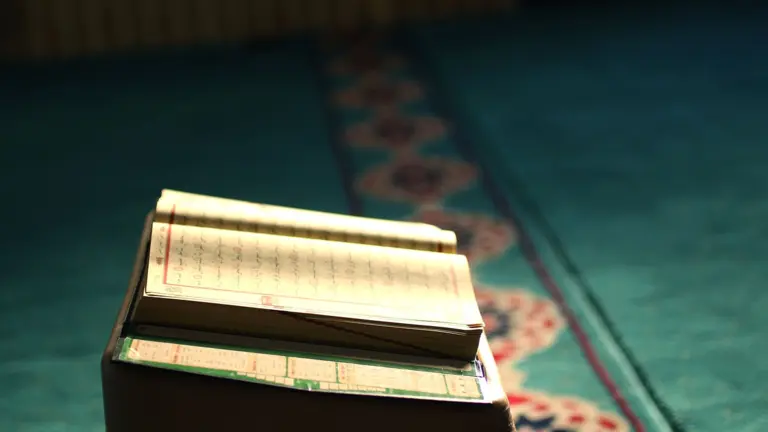
The place of Arabic in Islam first comes from the Quran. The revealed text is in Arabic, and this language became the main medium for reciting, memorizing and transmitting the Islamic message.
Quran translations are useful for understanding the general meaning, but they do not replace the Arabic text. A translation always remains an explanation in another language. It cannot perfectly convey all the nuances, word choices, repetitions, sounds and structure of the original text.
This is why learning Arabic, even gradually, can help students develop a more direct connection with the Quran and Islamic sciences.
To place this topic in a broader context, you can read our article on Arab culture, language and traditions.
Arabic before Islam: poetry, eloquence and oral transmission
Before Islam, Arabic already held an important place in the Arabian Peninsula. Poetry was a way to preserve history, stories, values, honor and tribal memory. Poets were recognized for their mastery of language, eloquence and ability to convey powerful messages.
This oral tradition created a particular linguistic environment. Arabs gave great importance to the beauty of speech, precision of words, rhythm and strength of expression.
When the Quran was revealed, it addressed a people who understood the value of speech and eloquence. This partly explains why the language of the Quran had such a deep impact on listeners at the time.
To explore the broader development of the language, you can read our article on the history of the Arabic language.
The revelation of the Quran and the place of Arabic
The revelation of the Quran gave Arabic a major religious dimension. Arabic was no longer only the language of a people or a culture: it became the language of the final revealed Book, recited in prayer and transmitted from generation to generation.
The Quran in Arabic
The Quran is recited in Arabic in prayer and acts of worship. This explains why millions of Muslims learn at least some surahs, even if they do not speak Arabic in daily life.
But reciting does not always mean understanding. Many believers know passages of the Quran by heart without directly understanding the vocabulary and structures. This is where the study of Quranic Arabic becomes important.
A language of recitation, memorization and understanding
Arabic allowed Quran recitation to be preserved with great precision. Muslims transmitted the verses through memorization, oral teaching, reading and writing.
This transmission is not only about words. It also concerns the way of reciting, the articulation of letters, the rules of reading and the understanding of meaning. This is why the Arabic language, Tajweed and Quranic sciences are closely linked.
Students who want to improve their recitation can follow online Quran and Tajweed lessons.
Quranic Arabic, classical Arabic and Modern Standard Arabic
It is important to distinguish several notions. Quranic Arabic, classical Arabic and Modern Standard Arabic are close to one another, but they do not serve exactly the same learning goal.
- Quranic Arabic focuses on the vocabulary, expressions and structures found in the Quran.
- Classical Arabic refers to the formal Arabic used in classical texts, scholarly works and the learned tradition.
- Modern Standard Arabic is the contemporary form used in media, books, education and official communication.
For a non-Arabic-speaking student, classical Arabic or Modern Standard Arabic often provides a strong foundation. Then Quranic Arabic helps the learner focus more specifically on the vocabulary and structures of the Quran.
To follow a path adapted to this goal, you can discover our Quranic Arabic course.
The role of Arabic in transmitting Islamic sciences
Arabic played an essential role in the transmission of Islamic sciences. Many works of Tafsir, Hadith, Fiqh, creed, language and spirituality were written in Arabic.
To access these texts directly, students need to develop strong linguistic skills: Arabic reading, religious vocabulary, Arabic grammar, understanding of long sentences and the ability to distinguish nuances.
Tafsir, Hadith, Fiqh and religious vocabulary
Each Islamic science has its own vocabulary. For example, studying Tafsir requires understanding Quranic words and their context. Hadith study requires understanding prophetic sayings, chains of transmission and specific formulations. Fiqh uses precise legal terminology.
A beginner does not need to master all of this immediately. But they should understand that serious Arabic learning gradually opens the door to a better understanding of these disciplines.
To discover these subjects progressively, you can also explore our online Islamic studies courses.
Why learn Arabic to better understand the Quran?
Learning Arabic allows students to move from indirect understanding to a more direct understanding. Even if they still use a translation, they begin to recognize certain words, expressions and structures in the Arabic text.
This progress changes the relationship with the Quran. The student no longer reads only a translation: they begin to identify frequent vocabulary, understand short phrases and follow the general meaning of some passages.
Over time, Arabic becomes a tool for deeper reflection, more conscious recitation and better understanding of religious texts.
Reading the Quran, reciting with Tajweed and understanding meaning
Reading the Quran, reciting correctly and understanding the meaning are three connected but distinct goals.
- Reading means recognizing letters, vowels and words.
- Tajweed refers to the rules of recitation: articulation, prolongations, nasalization, pauses and precision.
- Understanding requires studying vocabulary, grammar and sentence meaning.
A student can therefore follow Quran and Tajweed lessons to improve recitation, while studying Quranic Arabic to better understand what is being recited.
How to start learning religious Arabic today
To begin, it is better to follow a simple progression. Trying to understand complex texts immediately can discourage a beginner. It is better to build the foundations step by step.
- Learn the Arabic alphabet to recognize letters and read first words.
- Work on pronunciation to avoid mistakes from the beginning.
- Read words regularly, then simple sentences.
- Study frequent Quranic vocabulary to recognize recurring words.
- Understand the basics of Arabic grammar in order to grasp sentence structure.
- Practise with a teacher to receive correction and progress with method.
If you are a beginner, learning the Arabic alphabet is an essential first step. Then you can move toward reading, vocabulary, Modern Standard Arabic and Quranic Arabic according to your goal.
Learn Arabic with a teacher
With online Arabic courses, you can progress from home with an Arabic teacher. Private lessons make it possible to adapt the pace to your level, whether you want to read the Quran, understand religious Arabic or strengthen your language foundations.
A teacher can correct pronunciation, explain structures, guide reading and help students progress without skipping essential steps.
Book your free trial of 30 minutes
Registration form
Additional resources to go further
Alongside lessons, you can use simple resources to strengthen your foundations: vocabulary sheets, reading exercises, short texts and free Arabic books for beginners.
These resources can help you revise between lessons, but they are most effective when integrated into a clear method with regular correction.
Conclusion: a living language serving understanding and transmission
The religious history of Arabic shows that this language holds a central place in Islam. It is connected to the Quran, recitation, memorization, Islamic sciences and the transmission of an immense spiritual heritage.
This article has explained why Arabic is so important in Muslim religious history. But to gradually access the meaning of texts, cultural interest is not enough: students need a method, regular practice and teacher correction.
By learning the alphabet, reading, pronunciation, Quranic vocabulary and the basics of Arabic grammar, you can move step by step toward a better understanding of the Quran and the Islamic tradition.





No Comments
No comments yet.
No comments yet.