
Sukoon is one of the essential signs in Arabic reading. It shows that a letter does not carry a short vowel. For a beginner, understanding Sukoon helps improve Arabic reading, pronounce letters more accurately and progress in Quran reading.
In Arabic, letters can be accompanied by short vowels such as Fatha, Kasra or Damma. When a letter has Sukoon, it means that the letter is pronounced without a vowel after it. This sign therefore plays an important role in pronunciation, reading and Tajweed.
In this article, we will explain what Sukoon means in Arabic, how to recognize it, how to pronounce it and why it is important for reading the Quran correctly.
What Does Sukoon Mean in Arabic?
Sukoon, written ْ, is a sign placed above an Arabic letter. It indicates that the letter is pronounced without a short vowel.
The word Sukoon is connected to the idea of stillness or absence of movement. In Arabic reading, this means that the letter does not receive a vowel sound such as a, i or u.
For example, a letter with Fatha is read with an a sound, a letter with Kasra is read with an i sound, a letter with Damma is read with a u sound, while a letter with Sukoon is closed without a vowel.
What Does the Sukoon Sign Look Like?
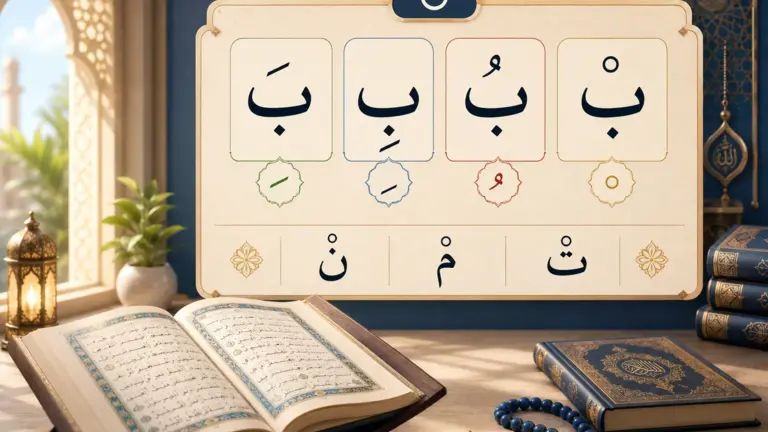
The Sukoon usually looks like a small circle placed above the letter:
- بْ
- تْ
- مْ
- نْ
It should not be confused with short vowels. Its role is not to add a sound, but to show the absence of a vowel after the consonant.
What Is the Difference Between Fatha, Kasra, Damma and Sukoon?
The three main short vowels add a sound to the letter:
- Fatha gives the sound a: بَ is read ba.
- Kasra gives the sound i: بِ is read bi.
- Damma gives the sound u: بُ is read bu.
Sukoon, however, shows that there is no vowel after the letter:
- بْ is pronounced as a closed b sound, without adding a, i or u.
This distinction is important for learning to read Arabic words correctly.
How Do You Pronounce a Letter With Sukoon?
To pronounce a letter with Sukoon, you produce the consonant sound and then stop without adding a vowel. Beginners should avoid adding an extra sound after the letter.
Example With بْ
The letter ب with Sukoon is pronounced as a closed b sound. You should not say ba, bi or bu, but simply close the sound on the consonant.
Example With مْ
The letter م with Sukoon is pronounced as a closed m sound. The mouth closes naturally, without adding a vowel after the letter.
Example With نْ
The letter ن with Sukoon is pronounced as an n without a vowel. In Tajweed, this letter can also be connected to specific rules depending on the letter that follows.
The Role of Sukoon in Quran Reading
Sukoon is very important in Quran reading. It helps respect the structure of words, avoid adding vowels and recite with more precision.
A beginner who does not understand Sukoon may add sounds that are not written. This can change the way a word is read and make the recitation less accurate.
To gradually learn the foundations of reading, you can begin with an Arabic alphabet course.
Sukoon and Tajweed: Why Correction Matters
In Tajweed, some rules depend directly on a letter carrying Sukoon. This is the case, for example, with several rules related to نْ, مْ or letters of prolongation.
Understanding Sukoon therefore helps the learner recognize certain recitation rules. But theory is not always enough. The student also needs to listen, repeat and receive correction.
Tajweed lessons online allow learners to work on these rules with a teacher and correct pronunciation.
Common Mistakes Beginners Make
Beginners often face the same difficulties with Sukoon:
- adding a vowel after a letter with Sukoon;
- confusing Sukoon with short vowels;
- reading too quickly without respecting the sign;
- not closing the consonant sound correctly;
- not applying Tajweed rules linked to letters with Sukoon;
- depending only on phonetics.
These mistakes can be corrected gradually with simple exercises and regular reading.
How to Learn Sukoon Correctly
To learn Sukoon, it is important to begin with the Arabic alphabet and short vowels. Then the learner can compare letters with Fatha, Kasra, Damma and Sukoon.
A useful method is to:
- review Arabic letters;
- learn the short vowels;
- compare بَ, بِ, بُ and بْ;
- read simple syllables;
- listen to correct pronunciation;
- repeat slowly;
- read to a teacher whenever possible.
Students who want to progress in reading, recitation and understanding can also follow online Quran classes or study Quranic Arabic.
Book your free trial of 30 minutes
Registration form
Conclusion: An Essential Foundation for Arabic and Quran Reading
Sukoon may seem like a simple sign, but it is essential in Arabic reading. It shows that a letter is pronounced without a short vowel and helps the learner read words with more precision.
In Quran reading, Sukoon also plays an important role in recitation and in several Tajweed rules. Understanding it helps avoid adding vowels and improves the clarity of reading.
With a progressive method, listening, repetition and support from a teacher whenever possible, every beginner can better master Sukoon and strengthen their foundations in Arabic and Quran recitation.





No Comments
No comments yet.
No comments yet.