
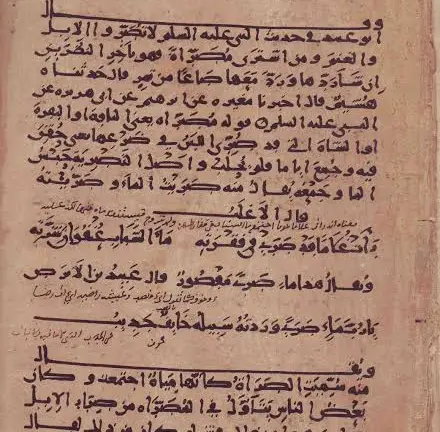
The Arabic language is one of the oldest, most widespread, and most influential Semitic languages in human history. Its history is intertwined with the cultural development of the Arabian Peninsula, culminating in its global spread with the advent of Islam. Its evolution over four thousand years, shaped by efforts at codification and systematization, has made it the eloquent language that unites the sciences and cultures.
Arabic is one of the oldest living languages in the world and belongs to the Middle Semitic branch of the Afro-Asiatic language family. It has evolved over thousands of years to become the language of the Holy Quran and one of the most widely spoken languages in the world. The following is a comprehensive historical overview of its development:
1. Early Origins (c. 3000–1000 BCE)
• The Arabic language belongs to the Northwest/South Semitic branch (part of the Afro-Asiatic language family), which also includes Hebrew, Aramaic, Akkadian, and Amharic.
• Linguists believe that all Semitic languages descended from a common ancestor known as Proto-Semitic.
• Over time, Arabic gradually diverged from the other Semitic languages, while retaining many of its original characteristics.
• As for Old Arabic, its earliest inscriptions appeared in northern Arabia and the Syrian Desert (such as the “Al-Musnad” inscriptions and the Nabataean inscriptions) and date back to the 1st century BCE and the 1st century CE.
• As for Arabic calligraphy: Modern Arabic calligraphy developed primarily from the Nabataean alphabet (which in turn was derived from Aramaic).
2. Ancient Northern Arabic (1000 BCE – 4th century CE)
Before the emergence of Classical Arabic, there were numerous Arabic dialects that left written records, including Safaitic, Thamudic, Lihyanic, Dadanic, and Hasaitic. These dialects were widespread in northern and central Arabia and were written using different scripts.
One of the most famous inscriptions is the Namara Inscription (328 CE), which is considered one of the oldest texts in southern Syria that closely resembles Classical Arabic. It is the epitaph of King Imru’ al-Qais ibn Amr, and its significance lies in the fact that it is one of the earliest texts written in a distinct Arabic language, though it retains characteristics of the Nabataean script, which was evolving toward the Arabic script.
3. Early Classical Arabic (4th–6th centuries CE)
During this period, a unified literary language began to take shape among the Arab tribes, particularly in central and northern Arabia. Several factors contributed to its unification, including:
• The flourishing of Arabic poetry.
• The emergence of literary markets such as the Market of Ukaz.
• The Quraysh dialect became more widespread due to Mecca’s commercial and religious prominence.
• Rhetoric and oratory developed significantly.
4. The Pre-Islamic Era (6th–early 7th centuries CE)
A “common language” emerged among the Arab tribes as a result of literary markets (such as the Market of Ukaz) and annual gatherings. This literary exchange fused the various dialects into a unified standard Arabic used in poetry and oratory, culminating in the Long Odes. Arabic reached a high level of eloquence and rhetorical skill, and poetry and oratory flourished. Pre-Islamic poetry preserved much of Arabic vocabulary and grammar, becoming a primary source for the study of the language.
5. The Revelation of the Holy Quran (610–632 CE)
The revelation of the Holy Quran marked a major turning point in the history of the Arabic language. The emergence of Islam in the seventh century CE was the most significant event in the history of the language, as the revelation of the Holy Quran immortalized the dialect of the Quraysh, established it as the official and standard language for all Muslims, and unified rhetorical and grammatical standards, thereby
• It firmly established many of the language’s rules;
• It preserved its vocabulary and syntax;
• It made Arabic the language of the Islamic religion;
• It contributed to its spread beyond the Arabian Peninsula.
6.The Umayyad Period (661–750 CE)
As the Islamic state expanded:
• Arabic spread throughout the Levant, Iraq, Egypt, and North Africa.
• It became the language of administration and government offices.
• The need arose to establish rules to regulate the language due to the conversion of non-Arabs to Islam.
During this period, the following began:
• The addition of diacritical marks to letters.
• The introduction of inflectional marks to facilitate the reading of the Quran.
7. The Abbasid Era (750–1258 CE)
This is considered the golden age of the Arabic language, during which:
Arabic became the language of science, philosophy, medicine, and mathematics throughout the world during the Abbasid era and in al-Andalus. Greek, Indian, and Persian heritage was translated into Arabic, and new terminology emerged to encompass various sciences.
Schools of grammar were also established in Basra and Kufa. Major dictionaries were compiled. The sciences of rhetoric and prosody flourished; however, as Arabs mingled with other peoples and non-Arabs converted to Islam, “lahn” (linguistic error) began to appear. The scientific foundation of grammar was laid, and among the most famous linguists of this period were:
• Abu al-Aswad al-Du’ali: He established the diacritical marks (the early form of vowel marks).
• Nasr ibn Asim and Yahya ibn Ya’mar: They established the diacritical marks for distinguishing similar letters (b, t, th).
• Al-Khalil ibn Ahmad al-Farahidi: He invented the modern vowel marks (fatḥa, dhamma, and kasra) and compiled the first Arabic dictionary (*Al-‘Ayn*).
• Sibawayh: He authored *Al-Kitāb*, which laid the fundamental foundations of Arabic grammar.
8. The Middle Ages (13th–18th Centuries)
Arabic remained the language of science, literature, and religion across vast swaths of the Islamic world, despite the decline of its political role in some regions. It continued to produce works in medicine, astronomy, mathematics, and philosophy, and local Arabic dialects emerged as a result of Arabic’s interaction with the languages of various peoples.
9. The Arab Renaissance (19th Century)
Following a period of stagnation and severe weakness under Ottoman rule, the nineteenth century witnessed the Arab Renaissance (led by prominent figures such as Rifa’a al-Tahtawi and Nasif al-Yazji), during which the Arabic language experienced a major new revival with the emergence of the press, the establishment of printing presses, the translation of modern sciences, and the updating of vocabulary to accommodate new terminology.
10. Arabic in the Modern Era
The United Nations General Assembly adopted Arabic as its sixth official language on December 18, 1973 (a date that is observed annually as World Arabic Language Day). The language entered the era of “Contemporary Classical Arabic,” which is used in the media, education, and technology.
Arabic is:
• One of the official languages of the United Nations since 1973.
• The official language in more than 20 countries.
• Spoken by more than 400 million people, including native speakers and those who use it as a second language.
• Comprises two main varieties:
o Classical Arabic: The language of education, media, and formal writing.
o Colloquial dialects: such as Egyptian, Levantine, Gulf, Moroccan, and others.
Distinctive Features in the History of Arabic
• Derivation and Inflection: Arabic relies on a system of triliteral (and quadriliteral) roots, whereby hundreds of words are derived from a single root according to precise inflectional patterns.
• Flexibility and Adaptability: The language has preserved its structural foundations for 1,500 continuous years without interruption or fragmentation into separate languages, unlike Latin, which branched into French, Italian, and Spanish.
• Calligraphic diversity: Arabic calligraphy has evolved from its early forms into distinct artistic schools (such as Kufic, Naskh, Thuluth, Diwani, and Ruq’ah).





No Comments
No comments yet.
No comments yet.