
The irregular plural in Arabic is an essential concept for understanding Arabic grammar and expanding your vocabulary. Unlike the regular plural, the irregular plural is not always formed by simply adding an ending to the singular word. It often follows an internal pattern.
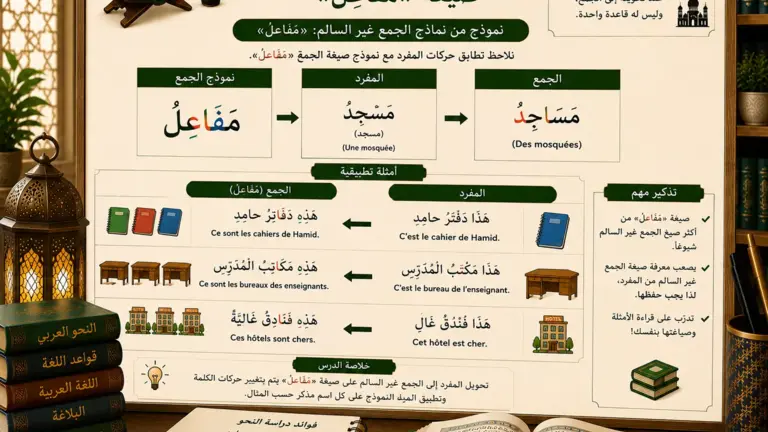
In this lesson, we will study a frequent masculine broken plural pattern: مَفَاعِلُ. This pattern is used to form the plural of several common Arabic nouns, such as مَسْجِدٌ, which becomes مَسَاجِدُ.
This lesson is useful for beginners, but also for students who want to improve their literary Arabic, Modern Standard Arabic and Quranic Arabic. Understanding Arabic broken plurals helps students read more accurately, translate better and memorize Arabic vocabulary more effectively.
What Is an Irregular Plural in Arabic?
In Arabic, there are several types of plurals. Some plurals are regular because they are formed by adding an ending to the singular word. Others are irregular because the internal structure of the word changes.
The irregular plural is often called the broken plural. It refers to a transformation of the word according to a specific pattern.
Example:
- مَسْجِدٌ: a mosque;
- مَسَاجِدُ: mosques.
Here, the word does not simply receive an ending. Its internal structure changes.
Understanding the Pattern مَفَاعِلُ
The pattern مَفَاعِلُ is one of the frequent broken plural patterns in Arabic. It works as a reference form to help students recognize and memorize certain plurals.
In this pattern, the consonants of the singular word are placed into a specific structure with precise vowels. This structure produces a recognizable plural form.
Main example:
- pattern: مَفَاعِلُ;
- singular: مَسْجِدٌ;
- plural: مَسَاجِدُ.
The word مَسَاجِدُ therefore follows the pattern مَفَاعِلُ.
How This Arabic Plural Pattern Works
The pattern مَفَاعِلُ is based on the internal organization of the word. For learners, the goal is not always to guess the plural by themselves, but to recognize the form and memorize it with its singular.
The Singular and the Broken Plural
The singular is the basic form of the word. The broken plural is a transformed form that may change the vowels, the length of the word or the internal structure.
Example:
- دَفْتَرٌ: a notebook;
- دَفَاتِرُ: notebooks.
The plural دَفَاتِرُ also follows the pattern مَفَاعِلُ.
The Role of Vowels in the Pattern
In Arabic broken plurals, vowels play an important role. They help students recognize the pattern and distinguish the singular from the plural.
In the pattern مَفَاعِلُ, a similar vowel structure appears in several words:
- مَسَاجِدُ;
- دَفَاتِرُ;
- مَكَاتِبُ;
- فَنَادِقُ.
This is why it is useful to learn Arabic nouns with their plural form from the beginning.
Table of Examples with the Pattern مَفَاعِلُ
| Singular | Meaning | Plural | Meaning |
|---|---|---|---|
| مَسْجِدٌ | a mosque | مَسَاجِدُ | mosques |
| دَفْتَرٌ | a notebook | دَفَاتِرُ | notebooks |
| مَكْتَبٌ | a desk or office | مَكَاتِبُ | desks or offices |
| فُنْدُقٌ | a hotel | فَنَادِقُ | hotels |
This table shows that several Arabic nouns follow the same irregular plural pattern.
Examples of Sentences with the مَفَاعِلُ Plural
Here are several examples to understand how this broken plural is used in Arabic sentences.
- هَذَا دَفْتَرُ حَامِدٍ: this is Hamid’s notebook.
- هَذِهِ دَفَاتِرُ حَامِدٍ: these are Hamid’s notebooks.
- هَذَا مَكْتَبُ الْمُدَرِّسِ: this is the teacher’s desk.
- هَذِهِ مَكَاتِبُ الْمُدَرِّسِينَ: these are the teachers’ desks.
- هَذَا فُنْدُقٌ غَالٍ: this hotel is expensive.
- هَذِهِ فَنَادِقُ غَالِيَةٌ: these hotels are expensive.
In these examples, the singular and the plural have different forms. Students should therefore learn each noun with its plural.
Why Should Arabic Broken Plurals Be Memorized?
In Arabic, it can sometimes be difficult to guess the irregular plural of a noun automatically. The same type of noun may have different plural forms depending on usage, vocabulary and context.
This is why it is recommended to learn Arabic nouns together with their plural form from the beginning.
For example, instead of learning only مَسْجِدٌ, it is better to learn:
- مَسْجِدٌ: a mosque;
- مَسَاجِدُ: mosques.
This method improves memorization, reading and comprehension of Arabic texts.
Difference Between Regular and Irregular Plurals
The regular plural is generally formed by adding an ending. The irregular plural changes the internal structure of the word.
| Type of Plural | Main Feature | Example |
|---|---|---|
| Regular plural | An ending is added | مُسْلِمٌ / مُسْلِمُونَ |
| Irregular plural | The internal structure changes | مَسْجِدٌ / مَسَاجِدُ |
This difference is fundamental for progressing in Arabic grammar and Arabic vocabulary.
Common Mistakes to Avoid
Here are some common mistakes made by students who learn Arabic broken plurals:
- thinking that all Arabic plurals are regular;
- trying to guess the plural without having learned it;
- confusing several broken plural patterns;
- forgetting the vowels of the pattern مَفَاعِلُ;
- not learning the singular noun with its plural form.
These mistakes are normal at the beginning. They gradually decrease with reading, repetition and correction.
Learn Arabic Grammar with a Teacher
Broken plurals are an important part of Arabic grammar. They require observation, memorization and regular practice. A teacher can help students recognize patterns and use them correctly.
To learn Arabic effectively, online Arabic classes with an Arabic teacher online help students move step by step. A teacher can correct your mistakes, explain the rules and provide exercises adapted to your level.
At Al-Dirassa, you can take private Arabic lessons, start Arabic for beginners, progress in Modern Standard Arabic, strengthen your Quranic Arabic or use free Arabic books for beginners alongside your lessons.
Book your free trial of 30 minutes
Registration form
Conclusion
The pattern مَفَاعِلُ is a frequent form of the Arabic broken plural. It is used in plurals such as مَسَاجِدُ, دَفَاتِرُ, مَكَاتِبُ and فَنَادِقُ.
This type of plural is not always easy to guess. It is therefore important to learn each noun with its plural, read regularly and practice with examples.
With a progressive method, regular exercises and correction from a teacher, Arabic broken plurals become clearer and easier to use in real sentences.





No Comments
No comments yet.
No comments yet.