
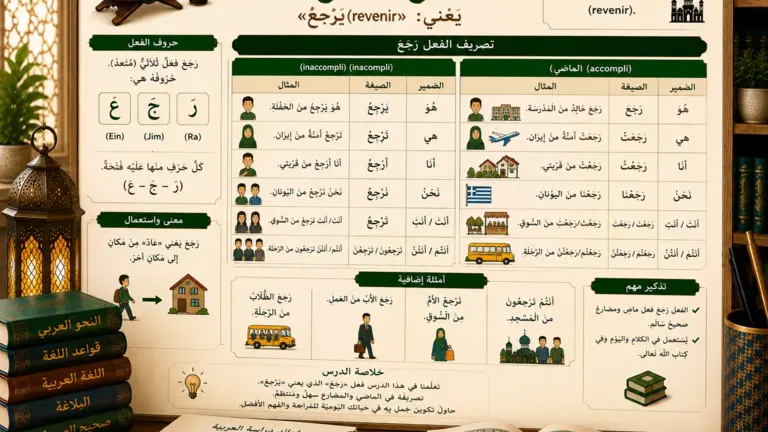
The Arabic verb رَجَعَ means “to return” or “to come back”. It is a very useful verb for building simple Arabic sentences, speaking about movement and expressing the idea of returning from a place.
In this lesson, we will study the meaning of the verb رَجَعَ, its conjugation in the past tense and present tense, and its use in simple Arabic sentences. This lesson is suitable for beginners, but it is also useful for students who want to strengthen their Arabic verb conjugation, vocabulary and understanding of Quranic Arabic.
The verb رَجَعَ is common in Arabic. It can be used in daily language, literary Arabic, Modern Standard Arabic and religious texts.
What Does the Arabic Verb رَجَعَ Mean?
The verb رَجَعَ means “he returned” or “he came back”. It expresses the idea of returning to a place, a person or a previous situation.
Example:
رَجَعَ خَالِدٌ مِنَ الْمَدْرَسَةِ
Khalid returned from school.
In this sentence, the verb رَجَعَ shows that Khalid came back from a place: the school.
A Regular Triliteral Arabic Verb
The verb رَجَعَ is a triliteral verb. This means that it is formed from three main letters:
- ر: rā;
- ج: jīm;
- ع: ʿayn.
These three letters form the root of the verb. In the basic form رَجَعَ, each of these letters carries a fatḥah.
This verb follows a regular conjugation pattern. It is therefore useful for students who are beginning to learn Arabic verbs and basic conjugation models.
Conjugation of رَجَعَ in the Past Tense
The past tense in Arabic usually expresses a completed action. It often corresponds to the English past tense.
The basic form of the verb is:
رَجَعَ
He returned.
Example:
رَجَعَ خَالِدٌ مِنَ الْمَدْرَسَةِ
Khalid returned from school.
Here, the action is completed. Khalid has already returned.
Conjugation of رَجَعَ in the Present Tense
The present tense in Arabic can express an action that is happening now, a habitual action or a future action, depending on the context.
With the verb رَجَعَ, we get forms such as:
- يَرْجِعُ: he returns;
- تَرْجِعُ: she returns or you return;
- أَرْجِعُ: I return;
- نَرْجِعُ: we return.
Example:
هُوَ يَرْجِعُ مِنَ الْحَفْلَةِ
He is returning from the party.
Summary Table of the Verb رَجَعَ
| Pronoun | Arabic Form | Meaning |
|---|---|---|
| He | هُوَ يَرْجِعُ | he returns |
| She | هِيَ تَرْجِعُ | she returns |
| I | أَنَا أَرْجِعُ | I return |
| We | نَحْنُ نَرْجِعُ | we return |
This table presents the most useful forms for beginning to use the verb رَجَعَ in simple Arabic sentences.
Examples of Sentences with رَجَعَ
Here are several examples to understand how the verb رَجَعَ is used.
- رَجَعَ خَالِدٌ مِنَ الْمَدْرَسَةِ: Khalid returned from school.
- تَرْجِعُ آمِنَةُ مِنْ إِيرَانَ: Amina is returning from Iran.
- هُوَ يَرْجِعُ مِنَ الْحَفْلَةِ: he is returning from the party.
- أَنَا أَرْجِعُ مِنْ قَرْيَتِي: I am returning from my village.
- نَحْنُ نَرْجِعُ مِنَ اليُونَانِ: we are returning from Greece.
These examples show that the verb رَجَعَ is often used with a complement indicating the place from which someone returns.
Using رَجَعَ with the Preposition مِنْ
The verb رَجَعَ is often followed by the preposition مِنْ, which means “from”. It indicates the origin of the return.
Examples:
- مِنَ الْمَدْرَسَةِ: from school;
- مِنْ إِيرَانَ: from Iran;
- مِنَ الْحَفْلَةِ: from the party;
- مِنْ قَرْيَتِي: from my village.
After مِنْ, the noun is generally in the genitive case. This rule is important for building correct Arabic sentences.
Difference Between Past and Present Tense
In the previous examples, the verb رَجَعَ appears in the past tense and the present tense.
The past tense indicates a completed action:
رَجَعَ خَالِدٌ
Khalid returned.
The present tense indicates an action that is happening now, a habitual action or a future action depending on the context:
يَرْجِعُ خَالِدٌ
Khalid returns or Khalid is returning.
Understanding this difference is essential for progressing in Arabic verb conjugation.
Why Learn This Arabic Verb?
The verb رَجَعَ is useful because it appears in many contexts. It allows students to speak about movement, travel, returning home or coming back from a place.
It is also important for students who want to better understand Quranic Arabic, because this root appears in religious vocabulary and classical Arabic texts.
Common Mistakes to Avoid
Here are some common mistakes made by students who learn the verb رَجَعَ:
- confusing رَجَعَ with a verb of departure;
- forgetting the preposition مِنْ to indicate the place of origin;
- confusing the past tense رَجَعَ with the present tense يَرْجِعُ;
- not recognizing the present-tense prefixes: يـ, تـ, أـ and نـ;
- neglecting the grammatical case after the preposition مِنْ.
These mistakes are normal at the beginning. They gradually decrease with practice, reading and correction.
Learn Arabic Verbs with a Teacher
Arabic verbs require students to understand the root, conjugation, tenses and associated prepositions. The verb رَجَعَ is a good example for beginning the study of regular Arabic verbs.
To learn Arabic effectively, online Arabic classes with an Arabic teacher online help students move step by step. A teacher can correct your mistakes, explain conjugation and provide exercises adapted to your level.
At Al-Dirassa, you can take private Arabic lessons, start Arabic for beginners, progress in Modern Standard Arabic, strengthen your Quranic Arabic or use free Arabic books for beginners alongside your lessons.
Book your free trial of 30 minutes
Registration form
Conclusion
The verb رَجَعَ means “to return” or “to come back”. It is a regular triliteral Arabic verb formed from the letters ر, ج and ع.
In the past tense, it indicates a completed action, as in رَجَعَ خَالِدٌ. In the present tense, it takes forms such as يَرْجِعُ, تَرْجِعُ, أَرْجِعُ and نَرْجِعُ.
With a progressive method, regular exercises and correction from a teacher, Arabic verbs become easier to understand and use in real sentences.





No Comments
No comments yet.
No comments yet.