
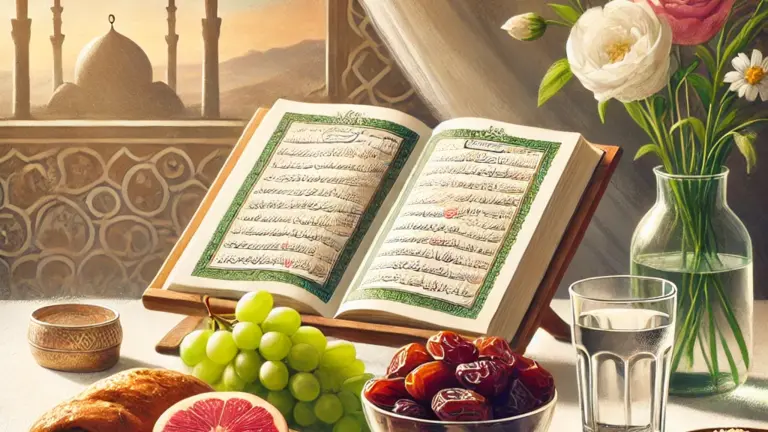
Food rules in Islam are part of the Muslim’s daily life. They distinguish what is halal, meaning permissible, from what is haram, meaning forbidden. These rules are not merely cultural habits; they are based on the Quran, the Sunnah and the general principles of Islamic faith.
Forbidden foods in Islam include pork, blood, animals that died without proper Islamic slaughter, anything dedicated to other than Allah, as well as alcohol and intoxicating substances. The Muslim seeks to consume what is pure, lawful and beneficial, while avoiding what Allah has forbidden.
In this article, you will learn about the main forbidden foods in Islam, the general wisdom behind these prohibitions, modern issues related to additives, and how to apply these rules with seriousness, balance and without excessive obsession.
What Do Halal and Haram Mean in Food?
The word halal refers to what Allah has permitted. The word haram refers to what is forbidden. In food, this distinction helps the Muslim choose what to consume according to faith, obedience to Allah and the search for purity.
Eating halal is not only about avoiding certain ingredients. It is also a way of living with awareness, gratitude and respect for the limits set by Allah.
The believer does not eat only to nourish the body. He or she also seeks blessing, purity and coherence between faith and lifestyle.
To understand these concepts in a broader framework, you can follow Islamic sciences online courses adapted to beginners and more advanced students.
Why Are There Forbidden Foods in Islam?
Forbidden foods in Islam are not arbitrary. They are part of a spiritual and practical education. Allah knows what benefits His servants and what can harm them, even when the full wisdom of a rule is not immediately visible to us.
These prohibitions help to:
- obey Allah in daily life;
- preserve purity in food;
- develop spiritual discipline;
- avoid what harms reason, body or faith;
- respect rules related to slaughter and animal treatment;
- remember that food is a trust and a blessing.
The Muslim accepts these rules first because they come from Allah. Health, social or educational wisdoms may be mentioned, but they do not replace the main foundation: obedience to revelation.
Main Forbidden Foods in the Quran
The Quran mentions several categories of forbidden foods. These prohibitions form the basis of Muslim dietary rules.
Pork
Pork is explicitly forbidden in the Quran. This prohibition concerns pork meat and food products derived from it.
The Muslim avoids it out of obedience to Allah. Even if some people mention health or practical reasons, the first reason remains religious.
To go deeper, read our detailed article: why pork is forbidden in Islam.
Blood
Blood is among the forbidden foods. Islam teaches that an animal consumed as meat must be slaughtered according to specific rules, including the draining of blood.
This rule is connected to food purity and the principles of lawful slaughter.
Dead Animals
A dead animal, meaning an animal that died without lawful slaughter, is forbidden to consume. The Muslim does not eat meat whose origin and slaughter do not respect Islamic rules.
This question is directly connected to halal meat. To learn more, read our guide on halal meat in Islam.
What Has Been Dedicated to Other Than Allah
The Muslim’s food is also linked to faith. Meat sacrificed for other than Allah or in a context incompatible with tawhid is not part of halal food.
The name of Allah, intention and slaughter rules therefore matter in meat consumption.
Alcohol and Intoxicating Substances
Alcohol and substances that impair reason are forbidden in Islam. This prohibition protects faith, prayer, reason, health, family and society.
The term khamr refers to what covers or alters reason. It does not refer only to wine, but to every intoxicating substance.
To go deeper, read our article: why alcohol is forbidden in Islam.
What About Additives, Gelatin and Processed Foods?
Modern products may contain complex ingredients: gelatin, animal fats, flavorings, enzymes, emulsifiers or additives whose origin is not always clear.
Not all additives are haram. Some are plant-based, synthetic or from lawful sources. Others may be animal-based and require verification.
When there is a serious doubt, it is useful to:
- read the ingredient list;
- check halal certification;
- contact the manufacturer if necessary;
- prefer clearly lawful products;
- ask a competent person for complex cases.
However, excessive obsession should be avoided. Islam asks for reasonable effort without turning every uncertain situation into permanent hardship.
Can Forbidden Food Be Consumed in Necessity?
The Quran mentions an exception in case of compulsion or extreme necessity. If a person is in a situation where life is threatened and no lawful alternative exists, he or she may consume only what is necessary, without desiring the forbidden or exceeding the limit.
This exception shows the mercy of Islam. It does not make forbidden foods permissible in ordinary situations.
Necessity must be real, serious and limited. It does not refer to a simple craving, social discomfort or personal convenience.
How to Apply Food Rules in Daily Life
Living halal daily requires awareness, but also balance. The Muslim should avoid what is clearly forbidden, seek what is lawful and not make the religion unnecessarily difficult.
Here are some practical tips:
- choose simple and clearly lawful foods;
- check ingredients when there is a real doubt;
- choose reliable halal meat;
- avoid products containing alcohol, pork or clearly forbidden derivatives;
- ask questions respectfully in restaurants;
- prepare alternatives when traveling;
- avoid excess and constant suspicion.
Learning Halal and Haram Rules with Method
Food rules in Islam are part of a wider learning path: belief, purification, prayer, fasting, manners, halal, haram and the relationship with the Quran.
To better understand verses, rulings and religious vocabulary, you can study Quranic Arabic. This helps recognize words related to halal, haram, food, purity and Muslim life rules.
You can also improve Quran reading through our online Quran and Tajweed classes.
To read more content about Muslim practice, explore our resources to learn Islam.
Book your free trial of 30 minutes
Registration form
FAQ — Forbidden Foods in Islam
What are the main forbidden foods in Islam?
The main forbidden foods include pork, blood, animals that died without Islamic slaughter, what has been dedicated to other than Allah, and alcohol or intoxicating substances.
Why is pork forbidden in Islam?
Pork is forbidden because Allah clearly mentioned it among forbidden foods in the Quran. The first reason is obedience to Allah.
Is alcohol always forbidden in Islam?
Yes, deliberate consumption of alcohol and intoxicating drinks is forbidden. Whatever intoxicates in large amounts is forbidden even in small amounts.
Are all food additives haram?
No. Some additives are plant-based, synthetic or lawful. Their origin should be checked when there is serious doubt, especially with gelatin or animal fats.
Is non-halal meat forbidden?
Meat must follow Islamic slaughter rules to be halal. Dead animals, blood and meat not slaughtered properly are problematic in Muslim food rules.
Can haram food be eaten in necessity?
In extreme necessity, when no alternative exists and life is threatened, a limited exception may exist. It does not apply to ordinary situations.
Conclusion
Forbidden foods in Islam remind us that a Muslim’s diet is not only a matter of taste or habit. It is part of obedience to Allah, seeking what is lawful and purifying daily life.
The believer seeks to eat halal, avoid what is clearly forbidden and apply the rules with seriousness, balance and trust in Allah.
Learning the rules of halal and haram helps Muslims live their faith with more clarity, without negligence or excess.





No Comments
No comments yet.
No comments yet.