
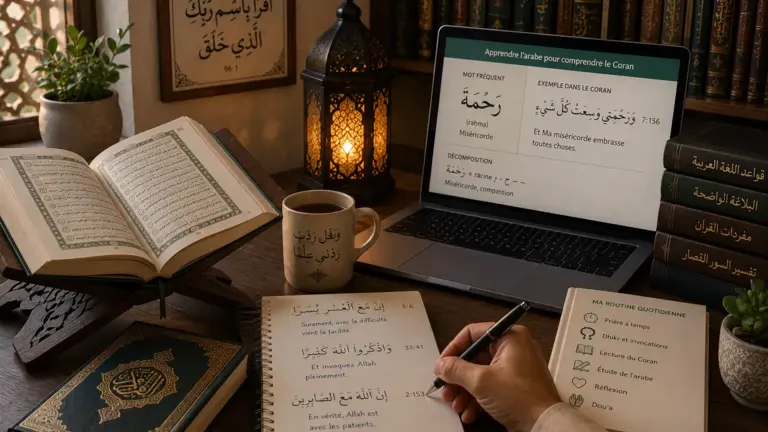
Many Muslims wish to understand the Quran directly, without relying only on translations. They want to recognize words, grasp the meaning of verses, improve their recitation and feel more deeply what they read in prayer.
This desire often begins in a simple way: a verse heard during salah, a short surah recited since childhood, a translation read several times, yet the feeling that part of the meaning remains distant.
The Quran was revealed in the Arabic language. For a Muslim, this gives Arabic a special place: it is the language of recitation, many supplications, prayer and the Book of Allah. Although translations allow access to the general meaning of verses, they do not replace the full richness of the Quranic text in its original language.
Learning Quranic Arabic does not mean becoming a specialist from the beginning. It means progressing gradually: recognizing letters, reading correctly, understanding frequent words, discovering basic structures and connecting this knowledge to the verses being recited.
In this article, we will explain why Quranic Arabic is important for understanding the Quran, how it helps reflection, the difference between recitation, Tajweed and comprehension, where beginners should start, how to organize learning from home and why studying with a teacher can make progress easier.
Why learn Quranic Arabic to understand the Quran?
Learning Quranic Arabic allows the reader to approach verses with more attention and awareness. Even partial understanding can transform the way one recites, listens to and reflects on the Book of Allah.
Many Muslims have recited essential surahs and formulas since childhood without always understanding their detailed meaning. When one begins to understand Quranic vocabulary, recitation takes on a new dimension. The words are no longer only memorized sounds: they carry meaning, reminder and reflection.
This path is not only for advanced students or Arabic speakers. A beginner can already make progress by learning Arabic letters, frequent Quranic words, repeated expressions and simple structures found in the verses.
Can you understand the Quran without knowing Arabic?
Quran translations are useful. They allow readers to access the general meaning of verses and to reflect. They are important, especially for those who do not yet know Arabic.
However, a translation remains an explanation of the meaning in another language. It does not fully replace the original text. Some Arabic words contain several nuances that English cannot always express in a single phrase.
In the Quran, one word may point to a root, a spiritual idea, an action or a relationship between several verses. In translation, these links are not always visible.
Learning Arabic therefore allows the student to go further. Even at a beginner level, recognizing certain Quranic words can already change one’s relationship with the text.
Why translations are not always enough
The Quran was revealed in Arabic. Its language carries nuances, repetitions, rhythms and structures that contribute to meaning.
A translation can help the reader understand the general message, but it does not always transmit all the nuances of vocabulary, grammar, sentence construction and the expressive strength of the Arabic text.
Understanding Arabic helps the learner:
- recognize words that appear frequently in the Quran;
- better understand certain supplications;
- notice differences between close words;
- identify repeated structures in verses;
- follow recitation with greater attention;
- read translation with more depth.
The goal is not to reject translations, but not to be limited to them when one wishes to deepen understanding of the Quran.
What is the difference between Quranic Arabic and Modern Standard Arabic?
Quranic Arabic and Modern Standard Arabic are connected, but they are not studied with exactly the same goal.
Modern Standard Arabic allows students to read, write and understand standard Arabic used in books, media, contemporary texts and many formal contexts.
Quranic Arabic focuses more specifically on understanding the vocabulary, structures and expressions found in the Quran. It is therefore especially suitable for people who want to understand verses, follow recitation and strengthen their relationship with the Book of Allah.
The two paths can complement each other. A person who studies Modern Standard Arabic will find it easier to go deeper into Quranic Arabic, and the reverse is also true. But for understanding the Quran, it is better to begin with the foundations directly useful for the Quranic text.
Which Arabic should you learn to understand the Quran?
To understand the Quran, the learner should focus on Quranic Arabic and the foundations of classical Arabic. This is not the same priority as learning a dialect for travel or conversation in a specific country.
Quranic Arabic requires studying:
- the Arabic alphabet and vowels;
- reading vocalized words;
- frequent Quranic vocabulary;
- Arabic roots;
- common verb forms;
- pronouns;
- prepositions;
- simple verse structures;
- frequent expressions from prayer and supplications.
To progress with method, our online Quranic Arabic courses help students gradually learn vocabulary, reading and structures useful for understanding the Quran.
Book your free trial of 30 minutes
Registration form
The difference between reading, reciting with Tajweed and understanding the Quran
It is important to distinguish three connected but different goals: reading the Quran, reciting with Tajweed and understanding the meaning of the verses.
Reading the Quran means recognizing Arabic letters, vowels, words and verses. It is the foundation for accessing the Arabic text.
Reciting with Tajweed means respecting pronunciation rules, articulation points, elongations, pauses and the flow of recitation.
Understanding the Quran requires studying vocabulary, grammatical structures, frequent expressions and the general meaning of verses.
These three dimensions complement one another. A student may learn to recite correctly without understanding every word. A student may also learn vocabulary while still improving recitation. Ideally, reading, recitation and understanding progress together step by step.
The role of Tajweed in Quran recitation
Tajweed is essential for reciting the Quran correctly. It helps the learner respect letters, articulation points, elongations and reading rules.
Learning Tajweed is not only about beautifying the voice. It is mainly about respecting Quran recitation and avoiding pronunciation mistakes.
Pronouncing Arabic letters correctly
Some Arabic letters are difficult for English speakers because they do not exist in English. Other letters may seem close, but they come from different articulation points.
Working on sounds, letters and makharij helps the student recite with more clarity. It is an important foundation for anyone who wants to improve Quran reading.
Respecting elongations and pauses
Elongations, stops and resumptions play an important role in recitation. An elongation that is too short or too long, or a badly placed pause, can make reading less clear.
If your main goal is to improve recitation, you can follow online Tajweed courses to correct pronunciation with a teacher.
Understanding meaning through Quranic vocabulary
A large part of understanding begins with vocabulary. Some words appear very often in the Quran: the names of Allah, terms related to faith, guidance, mercy, the Hereafter, prophets, prayer and behavior.
By learning these frequent words, the student begins to recognize passages and better follow the general meaning of verses. This makes recitation more alive and attentive.
A beginner does not need to begin with complex rules. They can already progress by learning the most frequent Quranic words, especially those found in short surahs, supplications and prayer.
It is useful to begin with:
- the most frequent names of Allah;
- words related to faith;
- common verbs;
- words from prayer;
- repeated expressions in short surahs;
- simple particles such as “in”, “on”, “toward” or “with”.
This vocabulary should be learned within short phrases and verses, not only as isolated lists.
Understanding simple verse structures
After vocabulary, the learner needs to understand how words are organized. Arabic grammar may seem intimidating, but the first foundations are accessible.
Grammar helps explain the relationships between words: who performs the action, what the verb relates to, how adjectives agree, and how sentences are built.
To understand simple verses, it is useful to study:
- the nominal sentence;
- the verbal sentence;
- masculine and feminine forms;
- singular, dual and plural forms;
- attached pronouns;
- prepositions;
- simple verb forms;
- repeated structures in short surahs.
The goal is not to become a grammarian from the beginning. The goal is to understand gradually how meaning is built in an Arabic sentence.
How Quranic Arabic helps you reflect on verses
Learning the Arabic of the Quran is not only a linguistic effort. It is also an inner journey. By discovering the language of revelation, the student gradually comes closer to the messages of mercy, wisdom, truth and guidance contained in the Quran.
When a reader understands the key words of a verse, their relationship with the text changes naturally. They no longer read only to finish a page or a surah, but to listen, receive and reflect.
The words are no longer only memorized. They carry meaning, reminder and inner light. Understanding a few words, recognizing repeated expressions or grasping the spiritual depth of a verse can nourish the heart and give more meaning to daily worship.
This understanding, even partial at first, helps the reader experience recitation with greater awareness. It also allows the learner to connect verses together and perceive the major themes that structure the Quranic message.
A verse better understood may encourage patience, repentance, gratitude to Allah or a reconsideration of priorities. Linguistic learning then becomes a concrete support for spiritual life.
A more alive and conscious reading
When a reader understands the key words of a verse, their relationship with the text becomes more alive. They no longer read only to complete a page, but to receive a reminder.
This opens the door to a deeper relationship with the Quran, where every passage can become an exhortation, a consolation or an invitation to return to Allah.
This progress is precious, especially for those who want to deepen their connection with the Book of Allah without feeling overwhelmed. Learning word by word, expression by expression, builds a strong and reassuring foundation.
How Quranic Arabic strengthens focus in prayer
Prayer contains words recited in Arabic, including Al-Fatihah, formulas of glorification, tashahhud and certain supplications. When the learner gradually understands these words, focus in prayer may improve.
Understanding a few words, then a few phrases, helps the worshipper become more present. The goal is not to understand everything immediately, but to progress with sincerity and consistency.
Saying Al-hamdu li-Llah, asking for guidance, glorifying Allah in bowing and prostration: all of this gains a special depth when meaning accompanies recitation.
This gradual understanding can also strengthen listening to the Quran, reflection and the connection with the surahs recited daily.
An essential bridge for non-Arabic-speaking Muslims
For many non-Arabic-speaking Muslims, there can be a distance between Quran recitation and understanding its message. This distance is not inevitable.
Learning Quranic Arabic helps build a bridge between reading and meaning, between recitation and reflection.
Even without aiming for complete mastery of the Arabic language, it is possible to make useful progress. Learning basic vocabulary, improving pronunciation and recognizing frequent structures already helps the learner better understand important verses and expressions found regularly in the Quran.
Regaining confidence in recitation
For many learners, understanding also improves confidence. When one knows what one is reading, it becomes easier to memorize, pronounce carefully and remain attentive to meaning.
This progress reduces blockages, motivates study and helps the believer appreciate the linguistic beauty of the Quran. The learner discovers not only the meaning of verses, but also their harmony, rhythm and depth.
Learning Quranic Arabic from home
Learning Arabic from home is now much more accessible than before. Through online courses, free resources, audio materials and structured programs, a beginner can start at their own pace without traveling and with a method adapted to their level.
This solution is especially suitable for working people, parents, students or those who do not have access to an institute nearby. It allows them to begin gradually, without waiting for perfect conditions.
Learning at home still requires discipline. The learner needs to choose a clear method, avoid jumping from one resource to another without continuity and build a realistic routine.
For a broader path, you can also explore our courses to learn Arabic online according to your level and goals.
Where should a beginner start?
A beginner should not try to learn the entire Arabic language at once. It is better to start with the essential foundations, then progress step by step.
1. Learn the Arabic alphabet
The first step is to learn the Arabic alphabet. The student needs to recognize letters, their forms depending on their position in the word, short vowels and long vowels.
This foundation allows the learner to read Arabic directly, without relying only on phonetics. The goal is not speed, but correct reading and confidence.
2. Read vocalized words and short verses
After the alphabet, the learner can begin reading syllables, then simple words. This stage requires patience because some Arabic sounds do not exist in English.
It is important to read slowly, repeat words several times and listen to correct pronunciation. Slow but precise reading is better than fast reading full of mistakes.
3. Memorize frequent Quranic vocabulary
Once the reading foundations are in place, the learner can begin memorizing frequent Quranic words. Some terms appear often in the verses: faith, guidance, mercy, prayer, patience, forgiveness, worship and the Hereafter.
Learning this vocabulary helps the student follow recitation better and recognize words in already familiar surahs.
4. Connect grammar to verses
Grammar becomes easier when it is connected to concrete examples. Instead of learning only abstract rules, the student can observe how words function in verses.
This method makes learning more alive and more directly useful for understanding the Quran.
A progressive method to understand the Quran
To understand the Quran, it is important to follow a clear progression. Moving too fast can create confusion. It is better to progress little by little with solid foundations.
A simple progression may include:
- learning the alphabet and vowels;
- reading vocalized words and short verses;
- listening to correct recitation;
- studying the most frequent Tajweed rules;
- memorizing frequent Quranic vocabulary;
- understanding simple sentence structures;
- studying short surahs with word meanings;
- reading a reliable translation to grasp the general meaning;
- learning grammar rules useful for the Quran;
- reciting to someone able to correct;
- reading longer passages with guidance.
This progression connects reading, recitation and understanding without getting lost in too much theory.
How to organize your learning at home
Success depends greatly on organization. It is better to study a little but regularly than to practice for a long time irregularly.
Choose a regular time
A fixed time helps make learning part of the daily routine. It may be fifteen to twenty minutes per day, or several short sessions during the week.
The most important thing is to choose a realistic time. If the program is too heavy, it becomes difficult to maintain. A simple and consistent routine often produces better results.
Revise before moving forward
Many beginners want to learn new lessons quickly but forget to consolidate the foundations. Revision is essential.
Before adding new words or new rules, one should review previous lessons, reread already studied words and check that sounds are pronounced correctly.
Listen and repeat
Arabic is also learned through the ear. Listening to correct pronunciation helps distinguish sounds and gradually correct reading.
It is useful to listen, repeat out loud and then compare one’s reading with a reliable model. This habit is especially important for difficult letters and Quranic words.
Free resources or structured courses: which should you choose?
Free resources are very useful for getting started. They allow the learner to discover the alphabet, sounds, first words and some basic notions. They are suitable for people who want to test their motivation or review the foundations.
However, free resources can be limited if they do not follow a clear progression. The learner may quickly become scattered between several videos, documents or apps without knowing what to study next.
Online Arabic courses generally offer a more structured framework. They allow the student to progress with a teacher, receive correction, ask questions and follow a program adapted to their level.
Common mistakes to avoid
Learners often face similar difficulties when they want to learn Quranic Arabic, improve recitation and understand the meaning of the Quran.
- Trying to learn too many things at once.
- Relying only on phonetics.
- Neglecting the alphabet and pronunciation.
- Reading too quickly without respecting sounds.
- Confusing close Arabic letters.
- Learning Tajweed rules without practicing them.
- Relying only on translation.
- Trying to understand complex passages without enough foundations.
- Constantly changing learning resources.
- Moving forward without reviewing the basics.
- Lacking consistency.
These mistakes can slow down progress. With a simple method, clear intention and regular sessions, learning becomes more stable.
Why learning with a teacher makes progress easier
Studying alone can be useful for discovering the basics, but learning with a teacher helps avoid many mistakes. A teacher can correct reading, explain rules, adapt the pace and help the student progress according to their level.
A teacher can help with:
- correcting Arabic letter pronunciation;
- explaining words according to context;
- showing the difference between similar structures;
- avoiding linguistic misunderstandings;
- connecting grammar, vocabulary and understanding;
- organizing an adapted progression;
- maintaining consistency in learning.
With a teacher, the student knows what to work on, how to revise and how to move forward without skipping steps.
How Al-Dirassa supports students
Al-Dirassa supports students who want to learn Arabic in order to better understand the Quran. Courses can be adapted to complete beginners as well as to people who can already read but want to deepen their understanding.
Depending on the student’s level, the program can work on the alphabet, reading, Quranic vocabulary, basic grammar, understanding short surahs or gradually studying longer texts.
The goal is to give each student a clear framework, without rushing, with a teacher able to correct, explain and structure progress.
You can also complete this path with online Quran courses to learn how to read, recite, memorize and better understand the Quran with a qualified teacher.
Book your free trial of 30 minutes
Registration form
FAQ — Learning Quranic Arabic to understand the Quran
Can you understand the Quran without learning Arabic?
Translations allow readers to understand the general meaning, but they do not fully replace the Arabic text. Learning Arabic helps grasp the nuances, repetitions and structures of the Quran.
Which Arabic should you learn to understand the Quran?
You should focus on Quranic Arabic and the foundations of classical Arabic: frequent vocabulary, simple grammar, roots, common verbs and verse structures.
What is the difference between Quranic Arabic and Tajweed?
Quranic Arabic helps understand the vocabulary and structures of the Quran. Tajweed concerns the rules of recitation, pronunciation and correct reading.
Is Tajweed enough to understand the Quran?
No. Tajweed helps recite correctly, but it is not enough to understand the meaning. To understand the Quran, one must also study Arabic vocabulary and grammar.
Do you need to master the whole Arabic language before starting?
No. It is not necessary to master the whole Arabic language before beginning. A beginner can progress with the alphabet, reading, frequent words and simple structures.
Does learning Arabic improve focus in prayer?
Yes. Understanding what is recited can strengthen concentration, presence of heart and the meaning of the words pronounced during prayer.
How long does it take to begin understanding the Quran?
With regular practice, a student can begin recognizing frequent words and understanding some simple phrases within a few months. Deeper understanding takes more time.
Are online Quranic Arabic courses suitable for beginners?
Yes. A beginner can start with the alphabet, vowels, frequent Quranic words and simple structures, with progression adapted to their level.
Conclusion: Quranic Arabic as a key to accessing the Quran
Understanding the Quran is a noble and progressive goal. Translations are useful, but learning Arabic opens a more direct relationship with the text.
By starting with the alphabet, frequent vocabulary, simple structures and the foundations of Quranic Arabic, the student can gradually recognize words, understand short verses and read translations with more depth.
Correct recitation, Tajweed and understanding of meaning progress together, but each requires specific work. With a clear method, consistency and the guidance of a qualified teacher, this path becomes accessible, even for a beginner.
The goal is not to reach perfection overnight, but to move forward with sincerity and consistency. Every word understood, every verse better grasped and every improvement in reading can become a door to a stronger relationship with the Book of Allah.





No Comments
No comments yet.
No comments yet.