
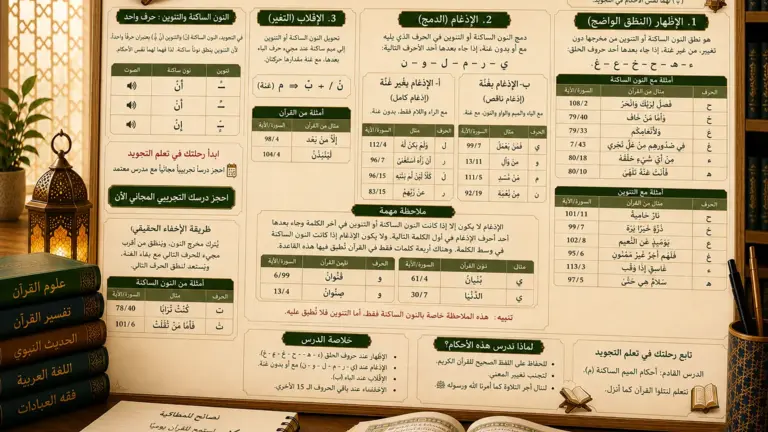
The rules of Noon Sakinah and Tanween are among the essential foundations of Tajweed. They help the student recite the Quran with greater accuracy, fluency and respect for pronunciation rules.
Noon Sakinah نْ and Tanween are connected because Tanween produces a sound close to Noon Sakinah when pronounced. This is why they follow the same rules when another letter comes after them.
This article studies the four main rules: Izhar, Idgham, Iqlab and Ikhfa. For a detailed study of assimilation, read: Idgham in Tajweed.
What is Noon Sakinah?
Noon Sakinah is the letter ن carrying a sukoon: نْ. It can appear in the middle or at the end of a word. Its pronunciation depends on the letter that follows it.
What is Tanween?
Tanween is a sign placed at the end of some words. It represents a short vowel followed by a nasal sound close to Noon.
There are three main forms:
- ـٌ: the sound un, as in كِتَابٌ;
- ـً: the sound an, as in كِتَابًا;
- ـٍ: the sound in, as in كِتَابٍ.
Why do Noon Sakinah and Tanween follow the same rules?
Tanween does not contain the written letter ن, but it produces a sound close to Noon Sakinah. When this sound is followed by another letter, its pronunciation may change according to Tajweed rules.
Table of Noon Sakinah and Tanween rules
| Rule | Arabic name | Letters | Result |
|---|---|---|---|
| Clear pronunciation | الإظهار | ء ه ع ح غ خ | The sound is pronounced clearly. |
| Assimilation | الإدغام | ي ر م ل و ن | The sound merges into the next letter. |
| Conversion | الإقلاب | ب | The sound becomes close to Meem with Ghunnah. |
| Hiding | الإخفاء | ت ث ج د ذ ز س ش ص ض ط ظ ف ق ك | The sound is hidden with Ghunnah. |
1. Izhar — clear pronunciation
Izhar applies when Noon Sakinah or Tanween is followed by one of the six throat letters:
ء ه ع ح غ خ
In this case, the sound is pronounced clearly, without assimilation and without prolonged nasalization.
2. Idgham — assimilation
Idgham applies when Noon Sakinah or Tanween is followed by one of these six letters:
ي ر م ل و ن
They are grouped in the word يَرْمَلُونَ. Idgham can be with Ghunnah or without Ghunnah.
Idgham with Ghunnah
The letters of Idgham with Ghunnah are:
ي ن م و
Audio example:
وَمَا أَنزَلَ اللَّـهُ مِنَ السَّمَاءِ مِن مَّاءٍ فَأَحْيَا بِهِ الْأَرْضَ
Idgham without Ghunnah
The letters of Idgham without Ghunnah are:
ل ر
In this case, the sound merges without nasalization.
3. Iqlab — conversion
Iqlab applies when Noon Sakinah or Tanween is followed by the letter Ba:
ب
The sound changes into a sound close to Meem, with Ghunnah.
| Example | Surah / verse |
|---|---|
| إِلَّا مِن بَعْدِ | 98/4 |
| لَيُنبَذَنَّ | 104/4 |
4. Ikhfa — hiding
Ikhfa applies when Noon Sakinah or Tanween is followed by one of these fifteen letters:
ت ث ج د ذ ز س ش ص ض ط ظ ف ق ك
The sound is hidden with Ghunnah. It is neither clearly pronounced like Izhar nor fully merged like Idgham.
Audio example:
إِنَّا أَنزَلْنَاهُ فِي لَيْلَةِ الْقَدْرِ
How to memorize these rules
- Izhar: the six throat letters: ء ه ع ح غ خ.
- Idgham: the letters of يَرْمَلُونَ.
- Iqlab: only the letter ب.
- Ikhfa: the fifteen remaining letters.
Common mistakes
- Pronouncing every Noon Sakinah the same way.
- Confusing the Tanween sounds un, an and in.
- Omitting Ghunnah in Idgham with Ghunnah.
- Confusing Iqlab and Ikhfa.
- Pronouncing Noon clearly when it should be hidden.
- Learning the theory without oral correction.
Learning these rules with a teacher
These rules are easy to understand in theory, but they require practice to be applied correctly. A teacher helps the student recognize each rule, correct Ghunnah and improve fluency.
To learn with method, explore our online Tajweed courses, our online Quran courses or our free Tajweed courses.
Book your free trial of 30 minutes
Registration form
Conclusion
The rules of Noon Sakinah and Tanween are essential for progressing in Tajweed. They teach when to pronounce clearly, assimilate, convert or hide the sound of Noon or Tanween.
With listening, examples and oral correction, the student can gradually apply these rules in Quran recitation.





No Comments
No comments yet.
No comments yet.