
Arabic personal pronouns are one of the essential foundations of Arabic grammar. They allow you to speak about yourself, address someone directly or refer to an absent person. To learn Arabic correctly, it is important to understand how they work, because they appear very often in Arabic sentences, dialogues, literary texts and the Quran.
In Arabic, personal pronouns are called الضَّمَائِرُ. They are mainly divided into two major categories: separate pronouns, called الضَّمَائِرُ الْمُنْفَصِلَةُ, and attached pronouns, called الضَّمَائِرُ الْمُتَّصِلَةُ.
This complete lesson will help you understand Arabic personal pronouns according to person, gender and number. We will also study the dual form المُثَنَّى, especially the pronoun هُمَا, as well as attached forms used to express possession.
This lesson is useful for beginners, but also for students who want to progress in Classical Arabic, Modern Standard Arabic and Quranic Arabic.
What are personal pronouns in Arabic?
A personal pronoun is a word that replaces a noun or refers to a person. In English, we use pronouns such as “I”, “you”, “he”, “she”, “we”, “you plural”, “they”.
In Arabic, personal pronouns vary according to several elements:
- person: first, second or third person;
- gender: masculine or feminine;
- number: singular, dual or plural;
- form: separate pronoun or attached pronoun.
Arabic also has a special form called the dual, المُثَنَّى. It is used to speak about two people or two things. This concept is important because it does not exist in the same way in English.
The two types of Arabic personal pronouns
To understand Arabic pronouns properly, students must distinguish between separate pronouns and attached pronouns. They do not have exactly the same role in the sentence.
Separate pronouns in Arabic
Separate pronouns, or الضَّمَائِرُ الْمُنْفَصِلَةُ, are independent pronouns. They can appear alone in the sentence and often function as the subject.
Examples:
- أَنَا: I;
- أَنْتَ: you, masculine singular;
- أَنْتِ: you, feminine singular;
- هُوَ: he;
- هِيَ: she;
- نَحْنُ: we.
أَنَا طَالِبٌ
I am a student.
In this sentence, أَنَا is a separate pronoun. It indicates the person who is speaking.
Attached pronouns in Arabic
Attached pronouns, or الضَّمَائِرُ الْمُتَّصِلَةُ, are not used alone. They attach to a noun, a verb or a particle.
When attached to a noun, they often express possession:
- كِتَابِي: my book;
- كِتَابُكَ: your book, masculine;
- كِتَابُكِ: your book, feminine;
- كِتَابُهُ: his book;
- كِتَابُهَا: her book;
- كِتَابُنَا: our book.
When attached to a verb, they may indicate the object of the action:
- خَلَقَنِي: He created me;
- خَلَقَنَا: He created us;
- خَلَقَكَ: He created you, masculine;
- خَلَقَكِ: He created you, feminine.
Classification of Arabic pronouns
Arabic pronouns can be classified according to person, gender and number.
Person
- First person: المُتَكَلِّمُ, the speaker;
- Second person: المُخَاطَبُ, the person being addressed;
- Third person: الغَائِبُ, the person being spoken about.
Gender
- Masculine: المُذَكَّرُ;
- Feminine: المُؤَنَّثُ.
Number
- Singular: المُفْرَدُ;
- Dual: المُثَنَّى;
- Plural: الجَمْعُ.
Complete table of Arabic personal pronouns
| Person | Separate pronoun | Meaning | Attached pronoun | Possessive meaning |
|---|---|---|---|---|
| 1st person singular | أَنَا | I | ـِي | my |
| 1st person plural | نَحْنُ | we | ـنَا | our |
| 2nd person masculine singular | أَنْتَ | you | ـكَ | your |
| 2nd person feminine singular | أَنْتِ | you | ـكِ | your |
| 2nd person dual | أَنْتُمَا | you two | ـكُمَا | your, two people |
| 2nd person masculine plural | أَنْتُمْ | you | ـكُمْ | your |
| 2nd person feminine plural | أَنْتُنَّ | you | ـكُنَّ | your |
| 3rd person masculine singular | هُوَ | he | ـهُ | his |
| 3rd person feminine singular | هِيَ | she | ـهَا | her |
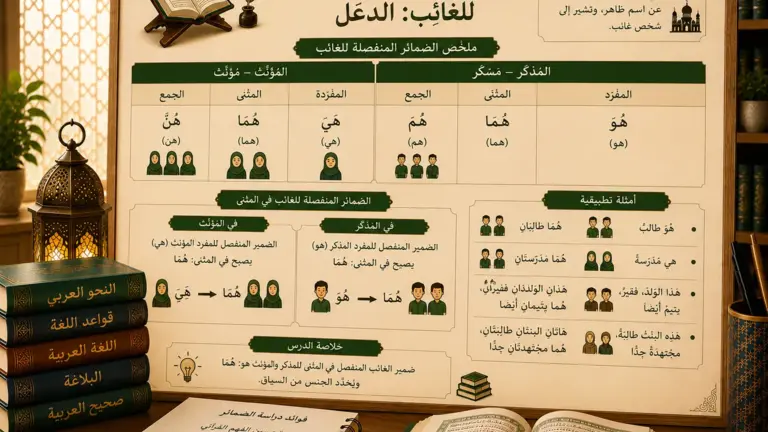
| 3rd person dual | هُمَا | they two, masculine or feminine | ـهُمَا | their, two people |
| 3rd person masculine plural | هُمْ | they | ـهُمْ | their |
| 3rd person feminine plural | هُنَّ | they feminine | ـهُنَّ | their, feminine |
Table of Arabic separate pronouns
| Person | Singular | Dual | Plural |
|---|---|---|---|
| 1st person | أَنَا | — | نَحْنُ |
| 2nd person masculine | أَنْتَ | أَنْتُمَا | أَنْتُمْ |
| 2nd person feminine | أَنْتِ | أَنْتُمَا | أَنْتُنَّ |
| 3rd person masculine | هُوَ | هُمَا | هُمْ |
| 3rd person feminine | هِيَ | هُمَا | هُنَّ |
Table of Arabic attached pronouns
| Person | Singular | Dual | Plural |
|---|---|---|---|
| 1st person | ـِي | — | ـنَا |
| 2nd person masculine | ـكَ | ـكُمَا | ـكُمْ |
| 2nd person feminine | ـكِ | ـكُمَا | ـكُنَّ |
| 3rd person masculine | ـهُ | ـهُمَا | ـهُمْ |
| 3rd person feminine | ـهَا | ـهُمَا | ـهُنَّ |
First person: I and we
The first person refers to the speaker.
- أَنَا: I;
- نَحْنُ: we.
The corresponding attached pronouns are:
- ـِي: my;
- ـنَا: our.
أَنَا خَالِدٌ
I am Khalid.
بَيْتِي قَرِيبٌ
My house is near.
رَبِّي
My Lord.
رَبُّنَا
Our Lord.
Second person: the addressee
The second person refers to the person being addressed. In Arabic, it changes according to gender and number. It is called المُخَاطَبُ.
- أَنْتَ: you, masculine singular;
- أَنْتِ: you, feminine singular;
- أَنْتُمَا: you two;
- أَنْتُمْ: you, masculine plural;
- أَنْتُنَّ: you, feminine plural.
The corresponding attached pronouns are:
- ـكَ: your, when addressing one man;
- ـكِ: your, when addressing one woman;
- ـكُمَا: your, for two people;
- ـكُمْ: your, masculine plural;
- ـكُنَّ: your, feminine plural.
Masculine addressee pronouns: أَنْتَ and أَنْتُمْ
The pronoun أَنْتَ means “you” when addressing a man or a boy.
أَنْتَ وَلَدٌ
You are a boy.
مَنْ أَنْتَ؟
Who are you?
The pronoun أَنْتُمْ means “you” when addressing several men, several boys or a grammatically masculine group.
أَنْتُمْ أَوْلَادٌ
You are boys.
مِنْ أَيْنَ أَنْتُمْ؟
Where are you from?
Attached addressee pronouns: ـكَ and ـكُمْ
The attached pronoun ـكَ means “your” when addressing a man or a boy.
كِتَابُكَ
Your book.
أَيْنَ كِتَابُكَ؟
Where is your book?
The attached pronoun ـكُمْ means “your” when addressing several men, several boys or a grammatically masculine group.
كِتَابُكُمْ
Your book.
مَا لُغَتُكُمْ؟
What is your language?
Third person: the absent person
The third person refers to a person or group being spoken about. In Arabic, it is called الغَائِبُ, the absent person.
- هُوَ: he;
- هِيَ: she;
- هُمَا: they two, masculine or feminine;
- هُمْ: they, masculine;
- هُنَّ: they, feminine.
The corresponding attached pronouns are:
- ـهُ: his;
- ـهَا: her;
- ـهُمَا: their, for two people;
- ـهُمْ: their, masculine plural;
- ـهُنَّ: their, feminine plural.
Third-person pronouns: هُوَ, هِيَ, هُمْ and هُنَّ
To speak about a man, a boy or a masculine singular noun, Arabic uses هُوَ, meaning “he”.
هُوَ طَوِيلٌ
He is tall.
To speak about a woman, a girl or a feminine singular noun, Arabic uses هِيَ, meaning “she”.
هِيَ مَرِيضَةٌ
She is ill.
To speak about several men, boys or a masculine plural group, Arabic uses هُمْ, meaning “they”.
هُمْ طِوَالٌ
They are tall.
To speak about several women or girls, Arabic uses هُنَّ, meaning “they feminine”.
هُنَّ مَرِيضَاتٌ
They are ill, feminine.
The pronoun هُمَا and the Arabic dual
The personal pronoun هُمَا is used to speak about two absent people or two absent things. In Arabic grammar, this corresponds to the dual, called المُثَنَّى.
The pronoun هُمَا is special because it is used for both the masculine dual and the feminine dual. The context tells whether it refers to two men, two women, two boys, two girls or two things.
هُمَا for the masculine dual
هُوَ طَالِبٌ
He is a student.
هُمَا طَالِبَانِ
They are both students.
In this example, هُمَا replaces two masculine persons.
هُمَا for the feminine dual
هِيَ مُدَرِّسَةٌ
She is a teacher.
هُمَا مُدَرِّسَتَانِ
They are both teachers, feminine.
In this example, هُمَا replaces two feminine persons.
How to recognize the dual in Arabic
To use هُمَا correctly, students must recognize the Arabic dual. The dual indicates that there are two elements.
It is often recognized through the endings:
- ـَانِ in the nominative case;
- ـَيْنِ in the accusative or genitive case.
Examples:
- طَالِبَانِ: two students;
- مُدَرِّسَتَانِ: two female teachers;
- وَلَدَانِ: two boys;
- بِنْتَانِ: two girls.
Table of third-person Arabic pronouns
| Gender and number | Arabic pronoun | Translation |
|---|---|---|
| Masculine singular | هُوَ | he |
| Masculine dual | هُمَا | they two, masculine |
| Masculine plural | هُمْ | they, masculine |
| Feminine singular | هِيَ | she |
| Feminine dual | هُمَا | they two, feminine |
| Feminine plural | هُنَّ | they, feminine |
This table shows that هُمَا is identical for the masculine dual and the feminine dual.
Simple examples with Arabic personal pronouns
| English | Arabic |
|---|---|
| He is a teacher. | هُوَ مُدَرِّسٌ |
| They are teachers, masculine. | هُمْ مُدَرِّسُونَ |
| She is a teacher. | هِيَ مُدَرِّسَةٌ |
| They are teachers, feminine. | هُنَّ مُدَرِّسَاتٌ |
| His father is a doctor. | أَبُوهُ طَبِيبٌ |
| Their father is a doctor. | أَبُوهُمْ طَبِيبٌ |
| Her book is in the bag. | كِتَابُهَا فِي الْحَقِيبَةِ |
| Their book is in the bag, feminine. | كِتَابُهُنَّ فِي الْحَقِيبَةِ |
Examples with هُمَا
- هُمَا طَالِبَانِ: they are both students.
- هُمَا مُدَرِّسَتَانِ: they are both teachers, feminine.
- هَذَانِ الوَلَدَانِ فَقِيرَانِ، هُمَا يَتِيمَانِ أَيْضًا: these two boys are poor; they are also orphans.
- هَاتَانِ البِنْتَانِ طَالِبَتَانِ، هُمَا مُجْتَهِدَتَانِ جِدًّا: these two girls are students; they are very hardworking.
How to use attached pronouns in Arabic
Attached pronouns can attach to three types of words: a noun, a verb or a particle.
Attached pronouns with a noun
When an attached pronoun is added to a noun, it often expresses possession. The noun then becomes definite. This means that it does not take a double final vowel, called tanwīn.
أُسْتَاذٌ
A teacher.
أُسْتَاذُكَ
Your teacher.
The word أُسْتَاذُكَ is made definite by the attached pronoun ـكَ. It therefore does not take tanwīn.
Other examples:
- رَبُّكَ: your Lord, addressed to a man;
- رَبُّكِ: your Lord, addressed to a woman;
- رَبُّكُمَا: your Lord, for two people;
- رَبُّكُمْ: your Lord, masculine plural;
- رَبُّكُنَّ: your Lord, feminine plural;
- رَبِّي: my Lord;
- رَبُّنَا: our Lord.
Attached pronouns with a verb
When an attached pronoun is added to a verb, it can indicate the person receiving the action.
- خَلَقَكَ: He created you, masculine;
- خَلَقَكِ: He created you, feminine;
- خَلَقَكُمَا: He created you both;
- خَلَقَكُمْ: He created you, masculine plural;
- خَلَقَكُنَّ: He created you, feminine plural;
- خَلَقَنِي: He created me;
- خَلَقَنَا: He created us.
Attached pronouns with a particle
Some pronouns can also attach to particles. This is the case with the particle لِـ, which can indicate possession or destination.
- لَهُ: to him / for him;
- لَهَا: to her / for her;
- لَهُمَا: to them both;
- لَهُمْ: to them, masculine;
- لَكَ: to you, masculine;
- لَكِ: to you, feminine;
- لَكُمَا: to you both;
- لَكُمْ: to you, masculine plural;
- لَكُنَّ: to you, feminine plural.
Forms with إِيَّا
In Arabic, certain forms built with إِيَّا express an object pronoun with emphasis or separation. They appear in forms such as إِيَّاكَ, إِيَّاهُ or إِيَّاكُمْ.
| Person | Singular | Dual | Plural |
|---|---|---|---|
| 2nd person masculine | إِيَّاكَ | إِيَّاكُمَا | إِيَّاكُمْ |
| 2nd person feminine | إِيَّاكِ | إِيَّاكُمَا | إِيَّاكُنَّ |
| 3rd person masculine | إِيَّاهُ | إِيَّاهُمَا | إِيَّاهُمْ |
| 3rd person feminine | إِيَّاهَا | إِيَّاهُمَا | إِيَّاهُنَّ |
A very well-known example:
إِيَّاكَ نَعْبُدُ
You alone we worship.
In this construction, the pronoun is placed emphatically before the verb.
Attached pronouns with إِنَّ
The particle إِنَّ often means “indeed” or “truly”. It can receive attached pronouns.
| Construction | Resulting form | Meaning |
|---|---|---|
| إِنَّ + ـنَا | إِنَّا | Indeed, we |
| إِنَّ + ـكَ | إِنَّكَ | Indeed, you |
| إِنَّ + ـهُ | إِنَّهُ | Indeed, he / indeed, Him |
| إِنَّ + ـِي | إِنِّي | Indeed, I |
These forms are frequent in Arabic texts and in the Quran. They help students recognize attached pronouns connected to particles.
Why Arabic pronouns are indeclinable
Arabic personal pronouns are generally indeclinable. In Arabic, we say that they are مَبْنِيٌّ. This means that their final form remains fixed and does not change according to their grammatical function in the sentence.
For example, the pronoun أَنْتُمْ always keeps its form. It does not change its final vowel according to grammatical case.
This rule is important because it distinguishes pronouns from declinable nouns.
Examples of sentences with Arabic personal pronouns
- هُوَ مَالِكُ الْمَنْزِلِ: he is the owner of the house;
- هَذَا بَيْتُهُ: this is his house;
- هُمْ حَضَرُوا إِلَى مِصْرَ: they came to Egypt;
- هَذِهِ فَنَادِقُهُمْ: these are their hotels;
- أَنْتَ تِلْمِيذٌ وَمُحَمَّدٌ أُسْتَاذُكَ: you are a student and Muhammad is your teacher;
- أَنْتِ وَزَمِيلاتُكِ قَرَأْتُنَّ الْكِتَابَ: you and your classmates read the book;
- أَنَا خَالِدٌ وَالصِّينُ بَلَدِي: I am Khalid and China is my country;
- أَنَا وَمُحَمَّدٌ زَمِيلَانِ، بُيُوتُنَا عِنْدَ الْمَسْجِدِ: Muhammad and I are classmates; our houses are near the mosque.
Examples of pronouns in the Quran
Arabic pronouns appear very often in the Quran. Recognizing them helps students better understand verse structure and the relationships between words.
لَكُمْ دِينُكُمْ وَلِيَ دِينِ
For you is your religion, and for me is my religion. 109:6
In this example, كُمْ indicates “your / you”, while ـِي in دِينِ refers to “my religion”.
إِنَّا أَعْطَيْنَاكَ الْكَوْثَرَ
Indeed, We have granted you al-Kawthar. 108:1
In this sentence, إِنَّا contains the attached pronoun ـنَا, while أَعْطَيْنَاكَ also contains an attached pronoun meaning “you”.
فَسَبِّحْ بِحَمْدِ رَبِّكَ وَاسْتَغْفِرْهُ إِنَّهُ كَانَ تَوَّابًا
So glorify your Lord with praise and ask His forgiveness. Indeed, He is ever Accepting of repentance. 110:3
In this example, رَبِّكَ, اسْتَغْفِرْهُ and إِنَّهُ contain attached pronouns.
Common mistakes with Arabic pronouns
- confusing separate pronouns and attached pronouns;
- using أَنْتَ instead of أَنْتِ;
- confusing أَنْتَ and أَنْتُمْ;
- using ـكَ for a group instead of ـكُمْ;
- forgetting dual forms such as أَنْتُمَا or هُمَا;
- using هُمْ for two people instead of هُمَا;
- using هُنَّ for two women instead of هُمَا;
- confusing ـكَ and ـكِ;
- forgetting that a noun with an attached pronoun becomes definite;
- trying to decline personal pronouns like ordinary nouns;
- translating Arabic pronouns word for word without considering the context.
Tips to memorize Arabic pronouns
To memorize Arabic personal pronouns, it is better to progress step by step. Trying to learn all pronouns at once can make the lesson difficult, especially for a beginner.
- Start with the most frequent separate pronouns: أَنَا, أَنْتَ, هُوَ, هِيَ and نَحْنُ.
- Then add the attached pronouns related to possession: ـِي, ـكَ, ـكِ, ـهُ and ـهَا.
- Use each pronoun with simple words such as book, house, teacher, student or country.
- Read the sentences aloud to improve your Arabic pronunciation.
- Review regularly with short examples.
- Observe pronouns in Arabic texts and short Quranic verses.
Learn Arabic grammar with a teacher
Personal pronouns are an essential foundation for learning Arabic online. They help students build simple sentences, understand short texts and progress toward more advanced grammar topics.
For a beginner, it is important to learn the Arabic alphabet, Arabic reading, Arabic pronunciation, personal pronouns, nominal and verbal sentences, basic Arabic vocabulary and the first rules of conjugation step by step.
If your goal is to understand classical texts, the Quran or invocations, it is also useful to follow a structured program in Quranic Arabic. If you want to speak, read and write in a more general setting, you can focus on Classical Arabic and Modern Standard Arabic.
At Al-Dirassa, you can follow a private Arabic course online, start as a beginner, progress in Classical Arabic, strengthen your Quranic Arabic or use our free books to learn Arabic.
For families, Al-Dirassa also offers Arabic classes for children, adapted to each student’s age, pace and level.
Book your free trial of 30 minutes
Registration form
FAQ — Arabic personal pronouns
What are the two types of pronouns in Arabic?
The two main types are separate pronouns, called الضَّمَائِرُ الْمُنْفَصِلَةُ, and attached pronouns, called الضَّمَائِرُ الْمُتَّصِلَةُ.
What is the difference between a separate pronoun and an attached pronoun?
A separate pronoun can be used alone, such as أَنَا or هُوَ. An attached pronoun attaches to a noun, a verb or a particle, as in كِتَابِي, خَلَقَنِي or لَهُ.
How do you say “I” in Arabic?
“I” is أَنَا. It is a first-person separate pronoun.
How do you say “we” in Arabic?
“We” is نَحْنُ. The corresponding attached pronoun is often ـنَا, as in رَبُّنَا, “our Lord”.
What does هُمَا mean?
هُمَا means “they two”, masculine or feminine. It is used for the dual, meaning two absent people or two absent things.
What is the difference between هُمَا, هُمْ and هُنَّ?
هُمَا refers to two people or two things. هُمْ refers to a masculine group of three or more. هُنَّ refers to a feminine group of three or more.
What is the difference between ـكَ and ـكِ?
ـكَ is used when addressing a man, while ـكِ is used when addressing a woman.
Does a noun with an attached pronoun take tanwīn?
No. When a noun receives an attached pronoun, it becomes definite and generally does not take tanwīn.
Conclusion
Arabic personal pronouns are divided into two major categories: separate pronouns, such as أَنَا, أَنْتَ, هُوَ and هِيَ, and attached pronouns, such as ـِي, ـكَ, ـهُ and ـهَا.
They vary according to person, gender and number. They can express the subject, possession, the object of a verb or the complement of a particle. Mastering them helps students better understand Arabic sentences, dialogues, literary texts and Quranic verses.
The pronoun هُمَا also shows the importance of the dual in Arabic. With a progressive method, regular examples and correction from a teacher, Arabic personal pronouns become clearer and easier to use in real sentences.





No Comments
No comments yet.
No comments yet.