
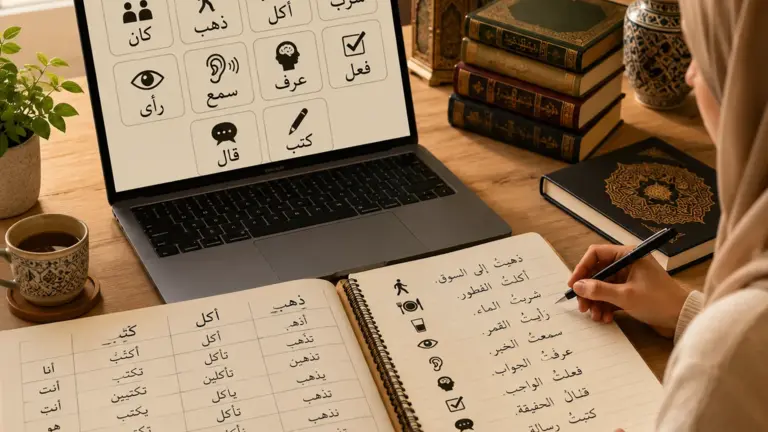
Arabic verbs are essential for building simple sentences and communicating in daily life. Even with limited vocabulary, knowing the most common Arabic verbs allows you to talk about actions, movement, needs, thoughts and simple situations.
For beginners, learning Arabic verbs in the right order is very useful. The goal is not only to memorize a list, but to understand how to use these verbs in real sentences.
In this guide, you will learn the most common Arabic verbs, their meanings, simple examples and the basics of conjugation in the past, present and imperative.
Why learn common Arabic verbs?
Verbs give life to a sentence. Without verbs, it is difficult to express actions such as going, eating, drinking, writing, speaking or understanding.
Learning frequent verbs helps you:
- form your first sentences;
- understand simple conversations;
- read short texts;
- improve your vocabulary;
- prepare for Arabic grammar;
- progress in Modern Standard Arabic.
Essential Arabic verbs to know
Here are some very useful verbs for beginners. The forms shown are usually given in the past tense, third person masculine singular, because this is often the base form used in Arabic dictionaries.
Daily action verbs
- أَكَلَ — akala — to eat
- شَرِبَ — shariba — to drink
- كَتَبَ — kataba — to write
- قَرَأَ — qara’a — to read
- دَرَسَ — darasa — to study
- عَمِلَ — ‘amila — to work
Speech and thinking verbs
- قَالَ — qala — to say
- سَأَلَ — sa’ala — to ask
- عَرَفَ — ‘arafa — to know
- فَهِمَ — fahima — to understand
- سَمِعَ — sami‘a — to hear
- رَأَى — ra’a — to see
Movement verbs
- ذَهَبَ — dhahaba — to go
- جَاءَ — ja’a — to come
- دَخَلَ — dakhala — to enter
- خَرَجَ — kharaja — to leave / go out
- رَجَعَ — raja‘a — to return
- جَلَسَ — jalasa — to sit
Table of the most used Arabic verbs
| Arabic | Transliteration | Meaning | Example |
| كَانَ | kana | to be / was | كانَ الجَوُّ حارًّا — The weather was hot. |
| ذَهَبَ | dhahaba | to go | ذَهَبْتُ إلى السُّوقِ — I went to the market. |
| أَكَلَ | akala | to eat | أَكَلْتُ الفُطورَ — I ate breakfast. |
| شَرِبَ | shariba | to drink | شَرِبْتُ الماءَ — I drank water. |
| رَأَى | ra’a | to see | رَأَيْتُ القَمَرَ — I saw the moon. |
| سَمِعَ | sami‘a | to hear | سَمِعْتُ الخَبَرَ — I heard the news. |
| عَرَفَ | ‘arafa | to know | عَرَفْتُ الجَوابَ — I knew the answer. |
| فَعَلَ | fa‘ala | to do | فَعَلْتُ الواجبَ — I did the homework. |
| قَالَ | qala | to say | قالَ الحَقيقَةَ — He said the truth. |
| كَتَبَ | kataba | to write | كَتَبْتُ رِسالَةً — I wrote a letter. |
How Arabic verbs work
In Arabic, verbs change according to person, number, gender and tense. This may seem difficult at first, but the forms become easier when you learn them with regular examples.
Past tense in Arabic
In the past tense, the base form is often the third person masculine singular. For example:
- ذَهَبَ — he went
- ذَهَبْتُ — I went
- ذَهَبْتَ — you went
- ذَهَبَتْ — she went
Present tense in Arabic
In the present tense, a prefix is usually added according to the person:
- أَذْهَبُ — I go
- تَذْهَبُ — you go / she goes
- يَذْهَبُ — he goes
- نَذْهَبُ — we go
Imperative in Arabic
The imperative is used to give an order or instruction. For example:
- اِذْهَبْ — go!
- اِكْتُبْ — write!
- اِقْرَأْ — read!
- اِسْمَعْ — listen!
Example sentences with Arabic verbs
To memorize verbs, use them in short sentences:
- أَنا أَدْرُسُ العَرَبِيَّةَ — I study Arabic.
- هُوَ يَكْتُبُ الدَّرْسَ — He writes the lesson.
- هِيَ تَقْرَأُ الكِتابَ — She reads the book.
- نَحْنُ نَفْهَمُ السُّؤالَ — We understand the question.
- أَنا أَذْهَبُ إلى المَدْرَسَةِ — I go to school.
Tips to memorize Arabic verbs
- learn verbs in sentences, not alone;
- repeat aloud;
- group verbs by theme;
- learn the past and present tense first;
- write three sentences for each new verb;
- review frequent verbs every week;
- listen to simple sentences in Modern Standard Arabic.
Why learn verbs with a teacher?
Arabic verbs are rich, and their conjugation can quickly become complex. A teacher can help you learn in the right order, correct your pronunciation and use verbs in natural sentences.
With Al-Dirassa’s online Arabic classes, you can work on reading, grammar, conjugation, vocabulary and speaking with a teacher.
You can also complete your learning with:
Book your free trial of 30 minutes
Registration form
Frequently asked questions
What are the most important Arabic verbs for beginners?
Verbs such as to go, eat, drink, write, read, say, see, hear, understand, know and do are among the most useful verbs to start with.
What is the base form of an Arabic verb?
The base form given in dictionaries is often the third person masculine singular in the past tense, for example كَتَبَ for “he wrote”.
Should I learn Arabic conjugation from the beginning?
Yes, but progressively. Start with a few frequent verbs in the past and present tense, then add other forms step by step.
How can I memorize Arabic verbs quickly?
Use them in short sentences, repeat aloud, review regularly and learn verbs by theme.
Conclusion: verbs are the foundation of Arabic sentences
Common Arabic verbs are essential for understanding and building sentences. By learning the most frequent verbs with examples, you quickly improve comprehension, reading and expression.
Start with a few essential verbs, learn their main forms, then use them in simple sentences.
With a clear method, regular practice and adapted correction, Arabic verbs become a strong foundation for continuing your language learning.





No Comments
No comments yet.
No comments yet.