
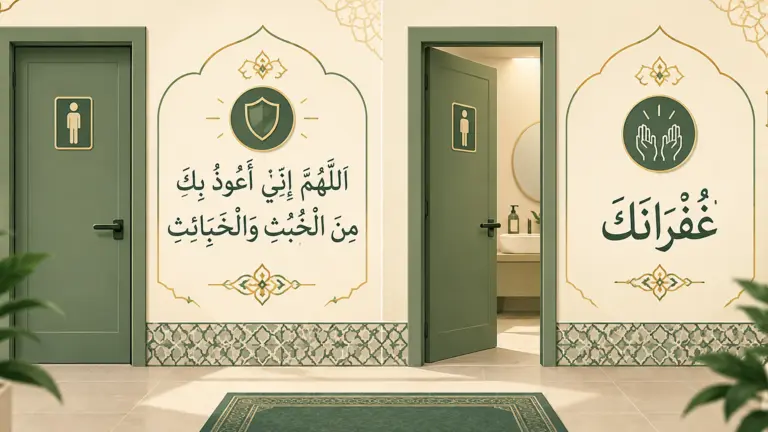
In Islam, some very ordinary actions of daily life are accompanied by supplications taught by the Prophet ﷺ. Entering and leaving the restroom are among them. Two short formulas are especially important to know: a supplication seeking protection before entering and a request for forgiveness after leaving.
The restroom dua is easy to memorise, even for someone who is just beginning to learn the daily adhkār. The main point is to distinguish the two moments clearly: the supplication before entering and the one recited after leaving.
What dua should you say before entering the restroom?
Before entering the restroom, the Prophet ﷺ would recite a supplication seeking Allah’s protection. It is reported, among other sources, in Sahih al-Bukhari from Anas ibn Malik.
اللَّهُمَّ إِنِّي أَعُوذُ بِكَ مِنَ الْخُبُثِ وَالْخَبَائِثِ
Transliteration: Allāhumma innī aʿūdhu bika mina-l-khubthi wa-l-khabā'ith.
Meaning: O Allah, I seek refuge in You from evil beings and evil things.
This supplication is reported in Sahih al-Bukhari 142 and 6322, as well as Sahih Muslim 375a.
It is recited before entering. This practical detail is important: the supplication is best pronounced before entering the place used for relieving oneself, not once already inside.
What does “Al-khubuth wal-khaba'ith” mean?
The Arabic formula ends with:
الْخُبُثِ وَالْخَبَائِثِ
In traditional explanations of the hadith, this expression is understood as seeking protection from evil beings, particularly male and female devils. English translations may vary slightly, for example “evil beings”, “male and female devils”, or “evil and evil beings”.
What remains unchanged is the overall meaning: the believer asks Allah for His protection before entering a place associated with impurity and privacy.
Should Bismillah be said before entering the restroom?
The word Bismillah is sometimes added before this supplication in posters and popular collections. However, to avoid presenting narrations of different strength as though they were identical, the most rigorous approach here is to retain the formula clearly established in the authentic collections:
اللَّهُمَّ إِنِّي أَعُوذُ بِكَ مِنَ الْخُبُثِ وَالْخَبَائِثِ
This is the safest formula to memorise when looking for the dua before entering the restroom.
What dua should you say after leaving the restroom?
After leaving the restroom, another very short prophetic formula is reported from ‘Aishah رضي الله عنها:
غُفْرَانَكَ
Transliteration: Ghufrānaka.
Meaning: I ask You for forgiveness.
This supplication is reported in Jamiʿ at-Tirmidhi 7. It is recited after leaving the restroom.
Only one Arabic word is needed, which makes this dua particularly easy to remember even for someone who cannot yet read Arabic.
Why ask for forgiveness after leaving the restroom?
The hadith clearly establishes that the Prophet ﷺ would say Ghufrānaka when leaving. The precise wisdom behind this request for forgiveness, however, has been discussed by scholars.
It is therefore important to distinguish between two levels: the practice itself is established by hadith, while the explanations of its wisdom come from scholarly commentary and should not be presented as the Prophet’s own words.
For the Muslim who simply wants to follow the Sunnah, the essential point is easy to remember: after leaving the restroom, say:
غُفْرَانَكَ
Restroom dua: the two formulas to remember
To memorise the essentials without confusion:
| Moment | Arabic | Transliteration | Meaning |
|---|---|---|---|
| Before entering | اللَّهُمَّ إِنِّي أَعُوذُ بِكَ مِنَ الْخُبُثِ وَالْخَبَائِثِ | Allāhumma innī aʿūdhu bika mina-l-khubthi wa-l-khabā'ith | O Allah, I seek refuge in You from evil beings and evil things. |
| After leaving | غُفْرَانَكَ | Ghufrānaka | I ask You for forgiveness. |
These two supplications belong to the daily supplications. Their value lies precisely in being connected to a specific situation: the aim is not only to memorise words, but to develop the habit of reciting them at the appropriate moment.
How should you enter and leave the restroom according to Islamic manners?
The dua is only one part of the etiquette related to the restroom. Several practices are traditionally taught on the basis of the Sunnah and the rules of purification.
Among the commonly taught manners is entering with the left foot and leaving with the right. These points of etiquette should nevertheless be distinguished from the two supplications themselves, which are directly supported by the hadiths cited above.
The restroom is also a place where privacy, cleanliness and purification after relieving oneself deserve particular attention.
These rules make more sense when studied within the broader framework of purification and everyday Islamic practice.
Should the dua be recited inside the restroom?
The supplication for entering is recited before going inside. Ghufrānaka is said once you have come out.
This distinction also avoids intentionally reciting formulas of dhikr inside the restroom when they can be said before or after.
In a modern home, where the toilet may be in a bathroom that also contains a sink or shower, some situations may require more detailed legal explanation. A general recommendation should therefore not be turned into an absolute rule for every contemporary layout.
How can you easily memorise the restroom dua?
The best method is to associate each supplication with the corresponding action. There is no need to recite both formulas one after another simply to learn them.
Before opening the door, repeat:
Allāhumma innī aʿūdhu bika mina-l-khubthi wa-l-khabā'ith.
Then, once outside:
Ghufrānaka.
Connecting a precise action to a precise formula gradually creates an automatic habit. The same principle applies to Bismillah before a meal or the supplications recited before sleep.
Someone who wants to develop this type of habit can also establish a daily dhikr and adhkār routine in which each supplication is tied to a particular time of day.
How can you teach the restroom dua to a child?
For a child, it is usually more effective not to present the supplication as an isolated formula to memorise. It should be linked to the real situation.
Parents can begin by reciting the supplication themselves before the child enters the restroom, then gradually ask the child to repeat it. Once the entry formula is learned, Ghufrānaka can be added on leaving.
The meaning should also be explained in simple words: “Before I go in, I ask Allah to protect me; when I come out, I ask Him for forgiveness.”
This progression is easier to remember than a long list of formulas. Al-Dirassa also offers a guide to easy duas for Muslim children to learn.
Transliteration or Arabic: how can you learn the supplication correctly?
Transliteration is useful when you do not yet know the Arabic alphabet. However, it can never reproduce every Arabic sound perfectly.
In Allāhumma innī aʿūdhu bika mina-l-khubthi wa-l-khabā'ith, sounds such as ع, خ and ث have no exact equivalent in English. Transliteration is therefore a helpful starting point, but listening to and reproducing the pronunciation of an Arabic speaker is preferable for progress.
Understanding the words also helps avoid mechanical recitation. The word aʿūdhu, for example, expresses seeking refuge and protection.
Daily supplications: learn gradually instead of memorising everything at once
The restroom dua belongs to a wider set of adhkār associated with ordinary actions: eating, sleeping, leaving the home, waking up and beginning certain activities.
There is no need to learn everything at the same time. A more sustainable method is to master one supplication, use it regularly and then add another.
After learning the restroom supplication, it is natural to continue with evening and bedtime adhkār and gradually broaden your practice through the Islamic supplications – duʿā category.
Learning the rules and supplications of everyday life in Islam
Knowing a supplication is useful, but understanding its context, source and related rules allows it to be practised with greater discernment.
Those who want to study purification, supplications, acts of worship and other religious foundations progressively can follow online Islamic Studies courses with structured teaching.
Book your free trial of 30 minutes
Registration form
FAQ about the restroom dua
What is the dua before entering the restroom?
Before entering, recite: Allāhumma innī aʿūdhu bika mina-l-khubthi wa-l-khabā'ith — اللَّهُمَّ إِنِّي أَعُوذُ بِكَ مِنَ الْخُبُثِ وَالْخَبَائِثِ. This supplication is reported, among other sources, in Sahih al-Bukhari.
What should you say after leaving the restroom?
When leaving, the Prophet ﷺ would say: Ghufrānaka — غُفْرَانَكَ — meaning “I ask You for forgiveness”. This formula is reported in Jamiʿ at-Tirmidhi 7.
When should the restroom duas be recited?
The supplication for protection is recited before entering. Ghufrānaka is said after leaving. The two formulas therefore correspond to two different moments.
Which restroom dua should a child learn first?
You can start with the entry supplication and always associate it with the moment the child goes to the restroom. Once it is learned, Ghufrānaka can easily be added on leaving.
Can the restroom dua be learned only through transliteration?
Yes, transliteration can be used as a support at the beginning. It remains approximate for some Arabic sounds, however, so in the long term it is better to listen to correct pronunciation and gradually learn to read the Arabic text.




No Comments
No comments yet.
No comments yet.