
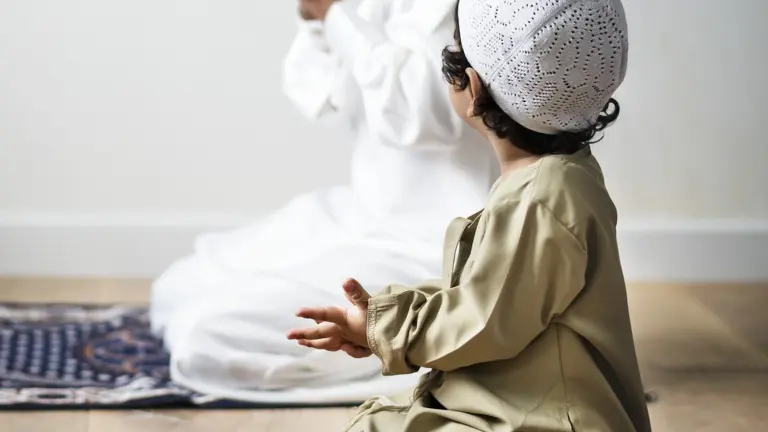
Teaching children supplications is a beautiful way to help them come closer to Allah from a young age. Short duas help children ask Allah for help, thank their Lord, pray for their parents and develop a simple relationship with faith.
Easy duas for children should be chosen wisely: they should be short, useful, easy to repeat and connected to real moments in daily life.
In this article, you will find 10 easy supplications to teach Muslim children, with Arabic text, transliteration, meaning and a simple explanation.
To support your child more broadly in learning faith, you can read our guide on Islamic education for children.
Key points about duas for children
Supplications for children should be taught gradually. It is better to learn one short dua, understand it well and repeat it regularly than to memorize a long list without meaning.
Parents can begin with duas related to:
- parents;
- prayer;
- seeking knowledge;
- food;
- sleep;
- repentance;
- protection;
- gratitude.
The goal is for the child to understand that one can speak to Allah in every situation.
Why teach duas to children?
Supplications help children build a living relationship with Allah. They teach the child that a Muslim does not rely only on personal effort, but asks Allah for guidance, forgiveness, knowledge, protection and goodness.
Teaching duas to children helps to:
- develop their love for Allah;
- give them a simple spiritual routine;
- teach them to thank Allah;
- teach them to seek forgiveness;
- strengthen their connection to prayer;
- help them gradually memorize Arabic;
- bring Allah’s remembrance into family life.
For a wider list of daily duas for adults and children, you can read our article on daily supplications in Islam.
How to teach a dua to a child
A child learns better when learning is short, regular and connected to a real moment. It is not necessary to ask the child to memorize everything quickly.
Here is a simple method:
- choose only one supplication at a time;
- read the Arabic text slowly;
- repeat the transliteration with the child;
- explain the meaning in simple words;
- connect the dua to a real situation;
- repeat it every day for a week;
- encourage the child without excessive pressure.
If the child cannot yet read Arabic, transliteration can help at the beginning. But the long-term goal is to help the child recognize letters and gradually read supplications in Arabic.
1. Dua for parents
This supplication teaches children gratitude toward their parents and family mercy.
Arabic text:
رَبِّ ارْحَمْهُمَا كَمَا رَبَّيَانِي صَغِيرًا
Transliteration: Rabbi irham-huma kama rabbayani saghira.
Meaning: My Lord, have mercy on them as they raised me when I was small.
Reference: Surah Al-Isra, 17:24.
Simple explanation for children: This dua asks Allah to have mercy on our parents for everything they do for us.
2. Dua for being regular in prayer
This supplication helps children understand that prayer is an important connection with Allah.
Arabic text:
رَبِّ اجْعَلْنِي مُقِيمَ الصَّلَاةِ وَمِنْ ذُرِّيَّتِي رَبَّنَا وَتَقَبَّلْ دُعَاءِ
Transliteration: Rabbi-j‘alni muqima s-salah, wa min dhurriyyati, Rabbana wa taqabbal du‘a.
Meaning: My Lord, make me an establisher of prayer, and from my descendants. Our Lord, accept my supplication.
Reference: Surah Ibrahim, 14:40.
Simple explanation for children: We ask Allah to help us love prayer and perform it correctly.
3. Dua for parents and believers
This supplication teaches children to ask forgiveness for themselves, their parents and the believers.
Arabic text:
رَبَّنَا اغْفِرْ لِي وَلِوَالِدَيَّ وَلِلْمُؤْمِنِينَ يَوْمَ يَقُومُ الْحِسَابُ
Transliteration: Rabbana ghfir li wa li-walidayya wa lil-mu’minina yawma yaqumu l-hisab.
Meaning: Our Lord, forgive me, my parents and the believers on the Day the account is established.
Reference: Surah Ibrahim, 14:41.
Simple explanation for children: We ask Allah to forgive us, forgive our parents and forgive the believers.
4. Dua for more knowledge
This supplication is very short and ideal for children who are beginning to learn.
Arabic text:
رَبِّ زِدْنِي عِلْمًا
Transliteration: Rabbi zidni ‘ilma.
Meaning: My Lord, increase me in knowledge.
Reference: Surah Ta-Ha, 20:114.
Simple explanation for children: We ask Allah to help us learn what is useful.
5. Dua for good in this world and the Hereafter
This supplication is complete because it asks Allah for good in this life, good in the Hereafter and protection from the Fire.
Arabic text:
رَبَّنَا آتِنَا فِي الدُّنْيَا حَسَنَةً وَفِي الْآخِرَةِ حَسَنَةً وَقِنَا عَذَابَ النَّارِ
Transliteration: Rabbana atina fi d-dunya hasanah, wa fi l-akhirati hasanah, wa qina ‘adhaba n-nar.
Meaning: Our Lord, give us good in this world and good in the Hereafter, and protect us from the punishment of the Fire.
Reference: Surah Al-Baqarah, 2:201.
Simple explanation for children: We ask Allah for good now, later and in the Hereafter.
6. Dua of Yunus during difficulty
This supplication teaches children to return to Allah when they are sad, worried or have made a mistake.
Arabic text:
لَا إِلَهَ إِلَّا أَنْتَ سُبْحَانَكَ إِنِّي كُنْتُ مِنَ الظَّالِمِينَ
Transliteration: La ilaha illa Anta, subhanaka inni kuntu mina z-zalimin.
Meaning: There is no deity worthy of worship except You. Glory be to You. I was truly among the wrongdoers.
Reference: Surah Al-Anbiya, 21:87.
Simple explanation for children: When we make a mistake or face difficulty, we return to Allah and ask for His help.
7. Dua for lawful provision
This supplication can be taught to older children to help them understand the importance of halal and trust in Allah.
Arabic text:
اللَّهُمَّ اكْفِنِي بِحَلَالِكَ عَنْ حَرَامِكَ، وَأَغْنِنِي بِفَضْلِكَ عَمَّنْ سِوَاكَ
Transliteration: Allahumma-kfini bi-halalika ‘an haramik, wa aghnini bi-fadlika ‘amman siwak.
Meaning: O Allah, make what is lawful sufficient for me so that I avoid what is unlawful, and enrich me by Your grace so that I need no one besides You.
Simple explanation for children: We ask Allah to give us what is good and allowed, and to keep us away from what is bad.
8. Morning dua for a beneficial day
This supplication is suitable for children before school or before a day of learning.
Arabic text:
اللَّهُمَّ إِنِّي أَسْأَلُكَ عِلْمًا نَافِعًا، وَرِزْقًا طَيِّبًا، وَعَمَلًا مُتَقَبَّلًا
Transliteration: Allahumma inni as’aluka ‘ilman nafi‘a, wa rizqan tayyiba, wa ‘amalan mutaqabbala.
Meaning: O Allah, I ask You for beneficial knowledge, good provision and accepted deeds.
Simple explanation for children: We ask Allah for a useful day, good learning and good actions.
9. Dua for deeds to be accepted
This supplication teaches children that good actions should be done for Allah and accepted by Him.
Arabic text:
رَبَّنَا تَقَبَّلْ مِنَّا إِنَّكَ أَنْتَ السَّمِيعُ الْعَلِيمُ
Transliteration: Rabbana taqabbal minna innaka Anta s-Sami‘u l-‘Alim.
Meaning: Our Lord, accept this from us. Indeed, You are the All-Hearing, the All-Knowing.
Reference: Surah Al-Baqarah, 2:127.
Simple explanation for children: After a good deed, we ask Allah to accept it.
10. Dua for forgiveness and repentance
This supplication teaches children to recognize mistakes and return to Allah.
Arabic text:
رَبِّ اغْفِرْ لِي وَتُبْ عَلَيَّ إِنَّكَ أَنْتَ التَّوَّابُ الْغَفُورُ
Transliteration: Rabbi ghfir li wa tub ‘alayya innaka Anta t-Tawwabu l-Ghafur.
Meaning: My Lord, forgive me and accept my repentance. You are the Accepter of repentance, the Forgiving.
Simple explanation for children: When we make a mistake, we can ask Allah to forgive us and try to do better.
Which dua should a child learn first?
It is better to begin with the shortest and most frequent supplications:
- Bismillah before eating;
- Al-hamdu liLlah after a blessing;
- Rabbi zidni ‘ilma before studying;
- Rabbi irham-huma for parents;
- the supplication before sleeping.
Parents can then gradually add longer supplications according to the child’s age and memorization ability.
How to create a dua routine at home
Supplications become easier to memorize when connected to a specific moment.
For example:
- say Bismillah before every meal;
- say Al-hamdu liLlah after eating;
- recite a short supplication before sleeping;
- repeat Rabbi zidni ‘ilma before homework;
- review one short dua as a family every evening.
Consistency is more important than quantity. One well-understood supplication can have more impact than a long list recited without attention.
Learning duas in Arabic gradually
Many children first learn supplications through transliteration. This is useful at the beginning, but learning to read Arabic helps improve pronunciation, recognize words and gradually read the Quran.
To help your child read supplications without relying only on transliteration, you can enroll them in Islamic courses for children or a structured program to learn Arabic online.
Studying a Quranic Arabic course also helps children understand frequent words from supplications, prayer and Quran.
Connecting supplications to Quran and prayer
Several supplications in this list come from the Quran. Learning them helps the child build a connection with verses, prophetic stories and Allah’s words.
To improve recitation, memorization and pronunciation of short surahs, you can explore our program to learn Quran and Tajweed online.
If you wish to supplicate yourself for your children’s protection, guidance and success, read our article on duas for children in Islam.
For more articles related to children, supplications, education and Muslim life, visit our Islam and culture section.
Book your free trial of 30 minutes
Registration form
FAQ — Easy duas for children to learn
Which duas should children learn first?
It is recommended to begin with short supplications such as Bismillah, Al-hamdu liLlah, Rabbi zidni ‘ilma, the dua for parents and the dua before sleeping.
How can children learn duas easily?
Teach only one supplication at a time, explain its meaning, repeat it in context and encourage the child without excessive pressure.
Can a child make dua in English?
Yes, a child can call upon Allah in English or in their own language. It is also beneficial to gradually teach Arabic supplications with their meanings.
Do children have to memorize supplications by heart?
Memorization is beneficial, but it should be gradual. Understanding and consistency are more important than quantity.
What dua can be learned before school?
The supplication Rabbi zidni ‘ilma, meaning “My Lord, increase me in knowledge,” is short, easy and very suitable before school or homework.
How can learning be kept from becoming pressure?
Keep a gentle pace, value effort, explain the meaning of supplications and integrate them naturally into daily life.
What is the difference between this article and “dua for children”?
This article presents supplications children can learn themselves. The article “dua for children” is more for parents who want to supplicate for their children’s protection, guidance and success.
Conclusion: teaching children to speak to Allah
Teaching children supplications gives them a precious spiritual reference point. They discover that they can ask Allah for knowledge, forgiveness, protection and good in this world and the Hereafter.
These duas should be taught with gentleness, repetition and understanding. The more the child understands what is being recited, the more the connection with Allah becomes alive and natural.
By gradually transmitting these supplications, parents help children build a faith routine that can accompany them in daily life.





No Comments
No comments yet.
No comments yet.