
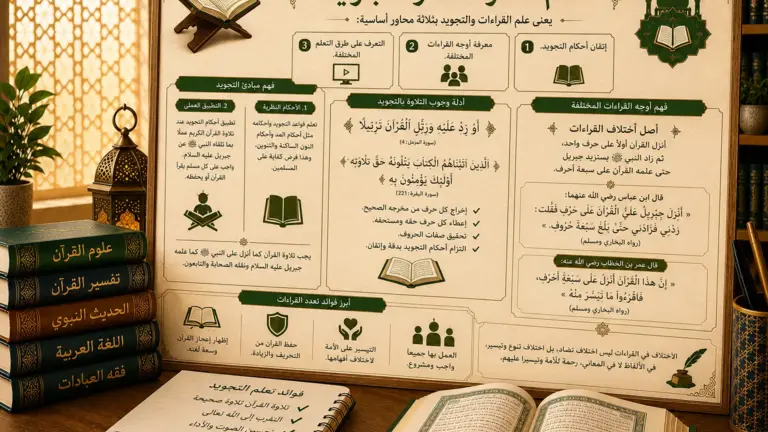
The Qira’at of the Quran are among the most precise sciences of Quranic recitation. They show the richness of Quranic transmission and the care with which the recitation of the Quran has been preserved through generations.
Many students hear about the seven readings, the ten readings, Hafs, Warsh or the seven Ahruf. These notions are often confused, although they do not refer to the same thing.
This article explains what Qira’at are, why scholars speak about seven and ten readings, how they differ from the Ahruf, and how to approach this science properly.
What is a Qira’ah?
The word Qira’ah means reading or recitation. In Quranic sciences, a Qira’ah is a Quranic reading transmitted by a recognized imam according to precise rules and an authentic chain of transmission.
A Qira’ah is not a translation of the Quran. It is not a contradictory version either. It is a transmitted way of reciting the Quranic text, with specific features in pronunciation, vocalization, elongation or the reading of certain words.
Are the Qira’at and the seven Ahruf the same?
It is common to confuse the seven Ahruf mentioned in hadith with the seven famous readings known in Quranic studies.
The seven Ahruf relate to the revelation and the ease granted to the Muslim community in reciting the Quran. The seven readings, however, refer to a later scholarly classification in the field of transmission and authentication of readings.
The fact that both notions involve the number seven does not mean they are identical. This distinction is essential.
Why do we speak about seven readings?
The seven readings correspond to a famous classification in the history of Qira’at. They are attributed to seven major imams of recitation:
- Nafi‘ of Madinah;
- Ibn Kathir of Makkah;
- Abu ‘Amr of Basrah;
- Ibn ‘Amir of Sham;
- ‘Asim of Kufa;
- Hamzah of Kufa;
- Al-Kisa’i of Kufa.
Each imam had narrators who transmitted his reading. For example, the reading of Nafi‘ was transmitted by Warsh and Qalun. The reading of ‘Asim was transmitted by Hafs and Shu‘bah.
Why do we also speak about ten readings?
Scholars later recognized three additional readings, bringing the total number of canonical readings to ten. These are the readings of Abu Ja‘far, Ya‘qub and Khalaf.
The ten recognized readings are studied in advanced programs and require strong mastery of recitation, Tajweed, Arabic and oral transmission.
Where do Hafs, Warsh and Qalun fit?
Hafs, Warsh and Qalun are not the main imams of Qira’ah in this context. They are narrators. Hafs transmits the reading of ‘Asim. Warsh and Qalun transmit the reading of Nafi‘.
The recitation of Hafs from ‘Asim is the most widespread in much of the Muslim world today. Warsh from Nafi‘ is especially known in North Africa and parts of Africa.
These transmissions are not local inventions. They belong to a structured science transmitted from teacher to student.
Do the Qira’at change the meaning of the Quran?
The Qira’at should not be understood as competing texts. They are recognized readings transmitted according to strict rules. Some differences may bring linguistic nuances, but they do not contradict the message of the Quran.
This topic must be approached with respect and caution. Qira’at are not learned through superficial comparison, but through serious study with a qualified teacher.
The link between Qira’at and Tajweed
Tajweed is essential for every recitation, whatever Qira’ah is studied. Before approaching advanced readings, the student must master Arabic letters, vowels, articulation points, elongations, stopping and starting.
A student who has not yet mastered one main recitation may mix rules if studying several readings too early.
How to study Qira’at
Studying Qira’at requires oral transmission. Reading a table of differences is not enough. The student must recite to a teacher, be corrected, repeat regularly and progress gradually.
A coherent path is to master one recitation first, often Hafs from ‘Asim, then study other Riwayat or Qira’at according to the student’s level.
Al-Dirassa offers online Quran courses to strengthen recitation, Tajweed and advanced preparation.
Advanced students may also prepare for an Ijaza in Quran recitation.
Book your free trial of 30 minutes
Registration form
Conclusion
The Qira’at of the Quran show the richness and precision of Quranic transmission. It is important to distinguish between the seven Ahruf, the seven readings, the ten recognized readings and the Riwayat transmitted by narrators.
For most students, the first objective should be clear: learn to recite one reading correctly with Tajweed before approaching advanced variations.




No Comments
No comments yet.
No comments yet.