
Introduction
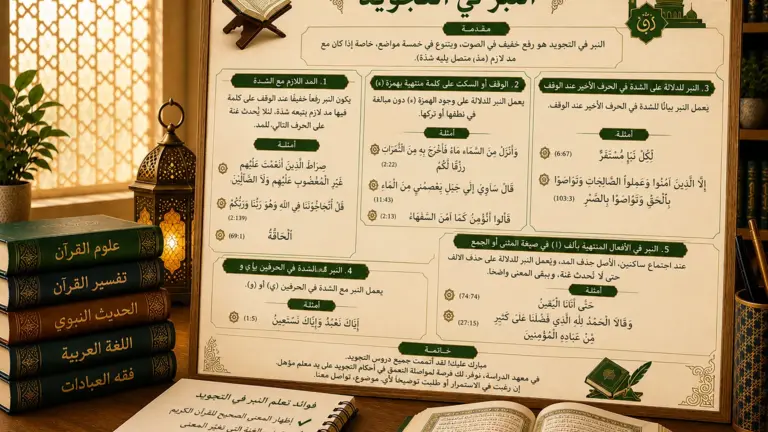
Nabr in Tajweed refers to a subtle elevation of the voice and is identified in five distinct forms, particularly when accompanied by Madd al Lazeem (an elongation followed by a shedda).
1. Elongation with Madd al Lazeem Accompanied by a Shedda
A subtle voice elevation occurs when pausing on a word. Scholars implemented this rule to prevent producing a ghunna on the letter that follows the elongation (madd).
Examples:
صِرَاطَ الَّذِينَ أَنْعَمْتَ عَلَيْهِمْ غَيْرِ الْمَغْضُوبِ عَلَيْهِمْ وَلَا الضَّالِّينَ
The path of those upon whom You have bestowed favour, not of those who have evoked [Your] anger or of those who are astray. (1:7)
قُلْ أَتُحَاجُّونَنَا فِي اللَّهِ وَهُوَ رَبُّنَا وَرَبُّكُمْ
Say, [O Muhammad], “Do you argue with us about Allah while He is our Lord and your Lord?” (2:139)
الْحَاقَّةُ
The Inevitable Reality (69:1)
2. Pausing or Taking a Break on a Word Ending with Hamza (ء)
We employ an nabr to subtly indicate the presence of the hamza (ء) to avoid either exaggerating its pronunciation or omitting it altogether.
Examples:
وَأَنزَلَ مِنَ السَّمَاءِ مَاءً فَأَخْرَجَ بِهِ مِنَ الثَّمَرَاتِ رِزْقًا لَّكُمْ
and sent down from the sky rain and brought forth thereby fruits as provision for you. (2:22)
قَالَ سَآوِي إِلَىٰ جَبَلٍ يَعْصِمُنِي مِنَ الْمَاءِ
[But] he said, “I will take refuge on a mountain to protect me from the water.” (11:43)
قَالُوا أَنُؤْمِنُ كَمَا آمَنَ السُّفَهَاءُ
They say, “Should we believe as the foolish have believed?” (2:13)
3. Employing An-Nabr for Emphasizing the Shadda on the Final Letter During a Pause
لِّكُلِّ نَبَإٍ مُّسْتَقَرٌّ
For every happening is a finality. (6:67)
إِلَّا الَّذِينَ آمَنُوا وَعَمِلُوا الصَّالِحَاتِ وَتَوَاصَوْا بِالْحَقِّ وَتَوَاصَوْا بِالصَّبْرِ
Except for those who have believed and done righteous deeds and advised each other to truth and patience. (103:3)
4. Emphasizing An-Nabr with Shadda on the Letters ي or و
Examples:
إِيَّاكَ نَعْبُدُ وَإِيَّاكَ نَسْتَعِينُ
It is You we worship and You we ask for help. (1:5)
5. Emphasizing An-Nabr for Verbs Ending with Alif ا in Dual or Plural Conjugation
When two consecutive sakoons are present, the standard rule requires the omission of the madd (extension). However, to indicate the removal of this alif ا, we use an nabr. This prevents ghunna and keeps the meaning clear.
Examples:
حَتَّىٰ أَتَانَا الْيَقِينُ
Until there came to us the certainty. (74:74)
وَقَالَا الْحَمْدُ لِلَّهِ الَّذِي فَضَّلَنَا عَلَىٰ كَثِيرٍ مِّنْ عِبَادِهِ الْمُؤْمِنِينَ
And they said, “Praise be to Allah, who has favoured us over many of His believing servants.” (27:15)
Conclusion
Congratulations, you have successfully completed all the Tajweed lessons! At Al-dirassa Institute, we provide an opportunity to further delve into the tajweed rules under the guidance of a qualified teacher. If you wish to continue or seek clarification on any topics, please contact us.
Book your free trial of 30 minutes
Registration form





No Comments
No comments yet.
No comments yet.